


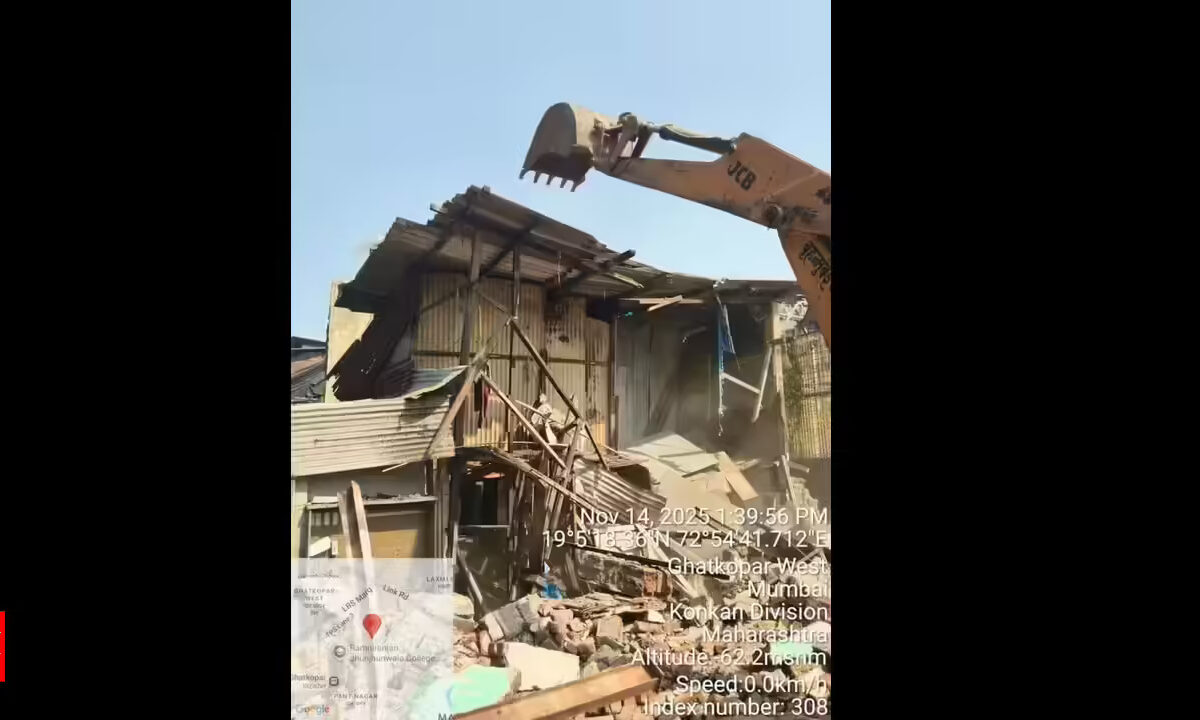
Mumbai’s civic administration has initiated another phase of its road-widening efforts in Ghatkopar, clearing structures that have long obstructed one of the suburb’s most congested corridors. The municipal body removed 37 encroachments along the stretch between Jhunjhunwala College and the Andheri–Ghatkopar Link Road, marking a significant step towards improving east–west connectivity and reducing traffic delays in a key residential and commercial zone.
Officials from the ward office overseeing the operation said the action forms part of a broader mobility upgrade strategy aimed at easing pressure on arterial corridors that serve thousands of daily commuters. The targeted stretch runs adjacent to the busy Ghatkopar (West) railway station and directly influences traffic distribution across the wider Andheri–Ghatkopar belt. According to officials, structures located on the project alignment had become consistent roadblocks, slowing progress on widening the carriageway and compromising pedestrian safety. The demolition work, carried out after a series of surveys and procedural notifications, is expected to accelerate the long-pending expansion of the link road. Urban mobility experts note that such interventions—though often logistically challenging—are essential for cities like Mumbai, where outdated road widths and unplanned growth limit movement, increase pollution loads and reduce overall public transport efficiency. They say widening projects, when integrated with improved pedestrian pathways and safe crossings, can support more sustainable urban travel patterns.
An official involved in the project said the widening of this particular corridor is viewed as a priority, given its role as a connector between dense residential pockets and major transport nodes. The official added that demolition activity will continue in stages wherever structures are identified as obstructing approved alignments. The phased approach, they said, helps balance development needs with on-ground sensitivity, especially in areas with longstanding residential and commercial establishments. Local residents travelling through the zone have frequently highlighted long queues, narrow turns and inadequate pedestrian space as major concerns. With the link road forming one of the limited east–west relievers available in the central suburbs, its strengthening is expected to bring measurable benefits in both travel time and last-mile connectivity.
Urban development analysts also underline the need to pair road expansion with sustainable mobility solutions, including wider footpaths, well-marked crossings, improved traffic calming and integration with bus and metro networks. Such measures align with Mumbai’s larger ambition of building more resilient and equitable transport infrastructure that prioritises safety, accessibility and reduced emissions. The civic body has indicated that further work will be scheduled once remaining encroachments are cleared. As Mumbai continues to grow vertically and economically, transport planners argue that such interventions—when executed with community engagement and long-term planning—can support the transition towards more efficient and inclusive city systems.
Also Read : Thane Vadodara Mumbai Expressway Completion Expected To Reduce Ghodbunder Highway Congestion By 2026
