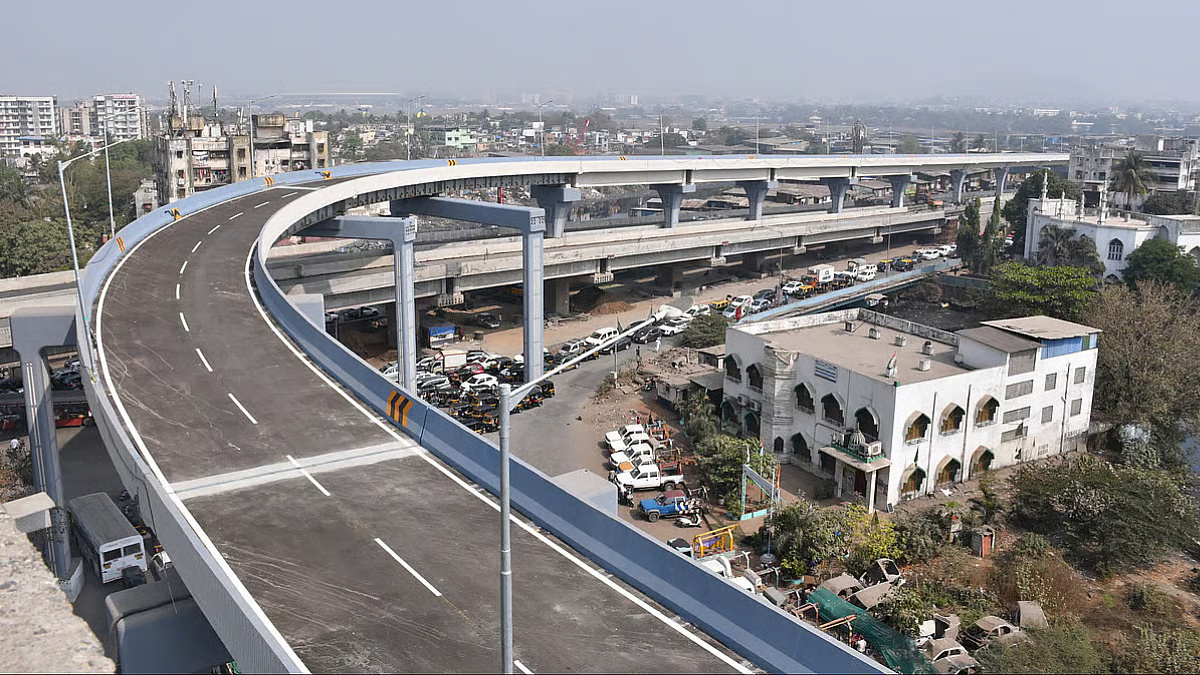
Mumbai’s civic administration has proposed a new 4.24-kilometre elevated corridor between Kurla and Ghatkopar in an effort to ease the chronic congestion along LBS Marg, one of the busiest arterial stretches in the eastern suburbs. The Brihanmumbai Municipal Corporation (BMC) has floated a tender for multidisciplinary engineering firms, estimating the project at around ₹1,635 crore. Officials say the plan forms part of a wider push to tackle growing traffic volumes and improve east–west connectivity across the city’s densest residential and commercial clusters.
The proposed structure begins near Kalpana Talkies in Kurla and extends up to Pankhe Shah Dargah in Ghatkopar. Of the total length, the main elevated portion will span nearly 3.9 kilometres, with additional ramps planned on both ends to ensure smoother merging and dispersal of traffic. Civic engineers note that this corridor has been designed to de-bottleneck a stretch that routinely witnesses severe delays during peak office hours, exacerbated by high-density redevelopment and increasing private vehicle ownership in the region. A senior official said the project is intended to create a dedicated elevated movement spine that separates long-distance through-traffic from local neighbourhood flows. This, according to the civic body, will shorten travel times, enhance junction efficiency, and improve reliability for thousands of daily commuters. However, experts in sustainable mobility caution that flyovers alone cannot resolve congestion unless supported by stronger public transport links, better footpaths, and last-mile connectivity. They also warn that new elevated structures must be planned to avoid worsening heat islands or creating unsafe under-flyover spaces.
Urban planners observing the project say that eastern suburbs continue to experience rapid real estate and employment growth, making it vital to invest in mobility infrastructure that supports inclusion and accessibility. They emphasise that travel improvements must balance motorised mobility with safer walking and cycling routes, particularly in areas where low-income populations depend on public transport. A transport researcher noted that integrating the flyover with bus priority systems and future metro links could help avoid induced demand, an effect where expanded road capacity attracts more vehicles. The tender process marks the first step in detailed design and feasibility assessment. BMC officials have indicated that environmental considerations, drainage resilience, and alignment with the city’s long-term climate action framework will be part of the evaluation. Given Mumbai’s commitment to equitable urban growth, experts argue that major infrastructure projects must ensure minimal disruption to local communities during construction, especially in densely populated areas such as Kurla.
As Mumbai continues to expand its transport network, the success of the Kurla–Ghatkopar flyover will depend on how well it integrates with wider multimodal plans, supports sustainable mobility, and contributes to a safer and more efficient urban environment. The project is expected to move into the detailed planning phase once contractors are appointed.
BMC Clears Rs 1,635-Crore Kurla–Ghatkopar Flyover Plan To Ease LBS Traffic