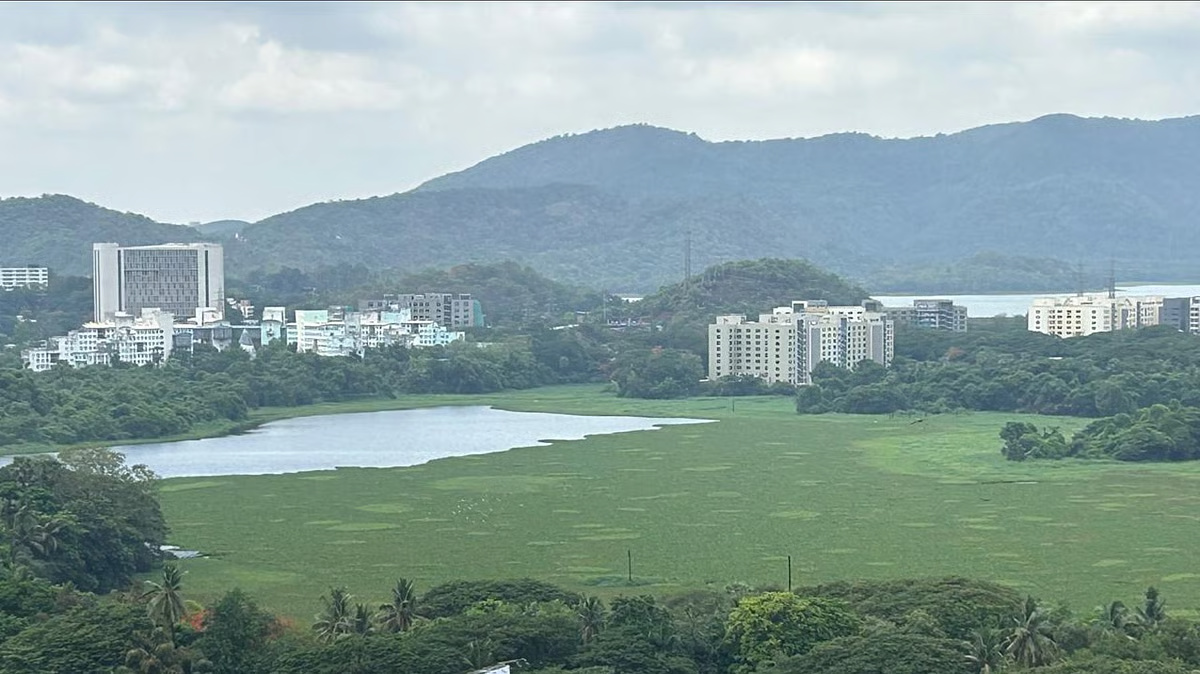
Mumbai has initiated a large-scale restoration programme for Powai Lake, aiming to curb sewage inflow, remove invasive vegetation, and stabilise the lake’s long-term ecological health. The ₹66-crore project, undertaken by the civic administration, marks one of the city’s most significant freshwater rejuvenation efforts and is expected to be completed within 18 months.
The restoration plan addresses the rapid spread of water hyacinth, which has intensified in recent months due to untreated wastewater entering the lake. According to officials, nutrient-rich sewage has allowed the invasive weed to proliferate, reducing oxygen levels and constraining aquatic life. The administration’s strategy combines new infrastructure with rerouting of existing wastewater networks to ensure that raw sewage no longer reaches the waterbody. Two tenders floated earlier this year laid the foundation for the project—one for a new sewer line and another for an 8 million litres per day (MLD) sewage treatment plant. Both interventions form part of a broader framework to manage the estimated 18 MLD of sewage currently reaching Powai Lake from surrounding neighbourhoods. A civic engineer noted that the earlier infrastructure had become inadequate for the area’s dense residential growth and needed a complete redesign to protect the lake’s ecological balance.
Under the new configuration, 8 MLD of wastewater will be processed at the planned treatment plant located at the defunct Powai pumping station. The treated water will be channelled back into the lake, supporting its hydrology without adding pollutants. Another 8 MLD will be steered through the existing sewer network to the Bhandup treatment facility, while the remaining 2 MLD will be diverted via the Peru Baug pumping station to the Mithi River treatment plant. A single contractor will be responsible for construction as well as six years of post-completion maintenance, ensuring accountability and long-term performance. Urban planners and sustainability experts view the initiative as a critical step toward building climate-resilient water systems in Mumbai. They note that freshwater bodies play an essential role in moderating urban temperatures, supporting biodiversity, and offering equitable access to public green spaces. Reviving Powai Lake, they argue, aligns with global principles of sustainable, low-carbon urban development and supports Mumbai’s broader ambition to create healthier neighbourhoods.
For residents, the project offers the potential for cleaner surroundings, improved public spaces, and restored recreational value. While the lake continues to face challenges from encroachments and stormwater contamination, the new sewage-handling system is expected to significantly reduce environmental stress. Officials emphasise that long-term success will depend on continuous monitoring, community engagement, and coordinated urban planning.
Also Read: Mumbai Moves Ahead With Uttan-Virar Sea Link Boosting Maharashtras Long-Pending Transport Connectivity
BMC Begins Rs 66-Crore Powai Lake Revival With New STP And Sewage Diversion