


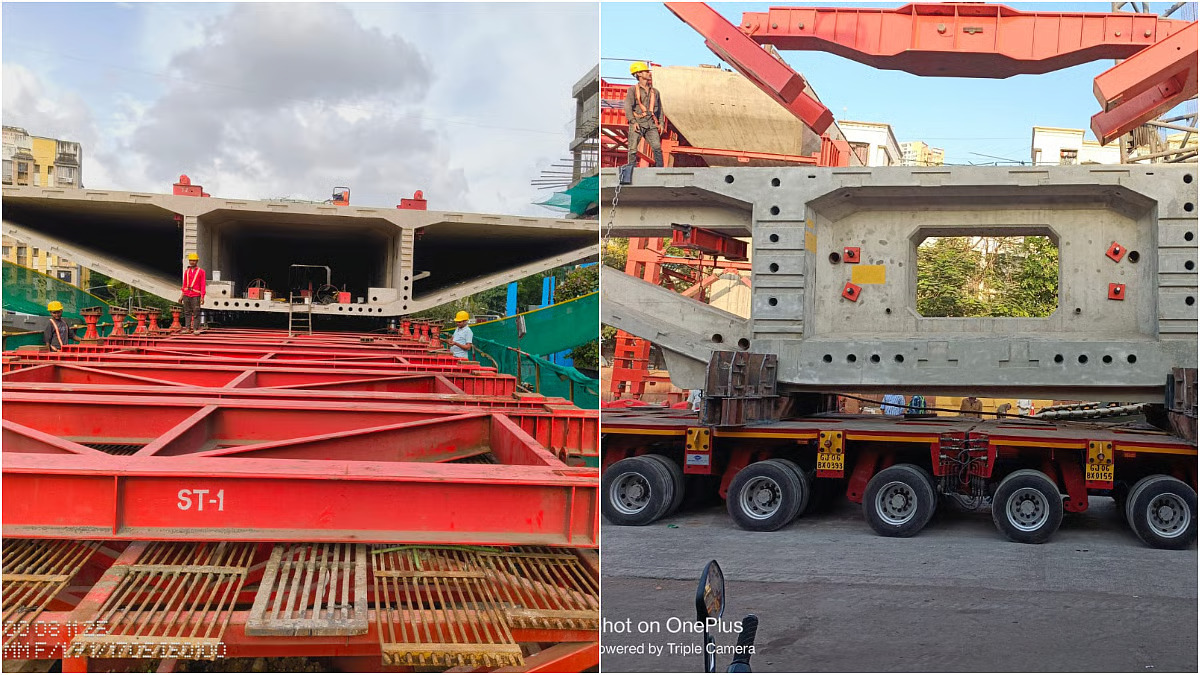
Mumbai’s ambitious Goregaon-Mulund Link Road (GMLR) project is reaching a critical milestone as the six-lane flyover near Dindoshi Court approaches completion. The 1,265-metre elevated structure, forming part of Phase 3(A) of the Rs 14,000 crore project, will connect the Western Express Highway at Goregaon with the Eastern Express Highway at Mulund, significantly reducing east-west travel time from 75 to 25 minutes.
Of the 31 planned piers, 27 have been successfully constructed, while work continues on the remaining four at Ratnagiri Junction. Officials confirmed that girder launching, deck slab casting, and the approach roads construction are slated to commence soon, with the flyover expected to open to traffic by May 16, 2026. Divided into two sections from Goregaon to Mulund, the flyover begins near Dindoshi Court, curves 90 degrees at Ratnagiri Junction, and descends at Dadasaheb Phalke Chitranagari. Construction uses reinforced concrete box girders, and a dedicated pedestrian bridge with escalators has been incorporated to ensure safe, convenient crossing for foot traffic.
A senior BMC bridge department official explained that of 26 construction spans, 12 have been completed, with the remaining 14 expected to be finalised by February 15, 2026. The approach road at Dindoshi Court is scheduled to finish by January 31, while the Dadasaheb Phalke Chitranagari side will be completed by April 30. Any residual works will be concluded within the following 15 days. Minor disruptions persist on the Mulund side during the second phase, but the authorities confirmed that rehabilitation and cleared plot acquisition are underway to resume remaining work. The GMLR project, spanning 12.2 kilometres, is being executed in four phases. Once completed, the corridor is expected to provide seamless east-west connectivity across Mumbai, easing congestion on arterial roads, reducing travel time, and improving overall traffic management. The project represents one of the city’s largest urban infrastructure investments, integrating sustainable construction techniques and pedestrian-friendly designs.
Urban planners and transport experts have highlighted the project’s significance in fostering equitable mobility across the city. Beyond traffic decongestion, the flyover is expected to improve connectivity for commercial zones, residential communities, and emergency services, while aligning with Mumbai’s broader goals of creating eco-friendly, efficient urban transport corridors. As Mumbai continues to expand its infrastructure footprint, the GMLR flyover stands as a critical link in modernising the city’s road network, exemplifying large-scale, sustainable urban development.
Also Read: IndiGo Expands Long Haul Flights From Delhi To Manchester Bali And Krabi
