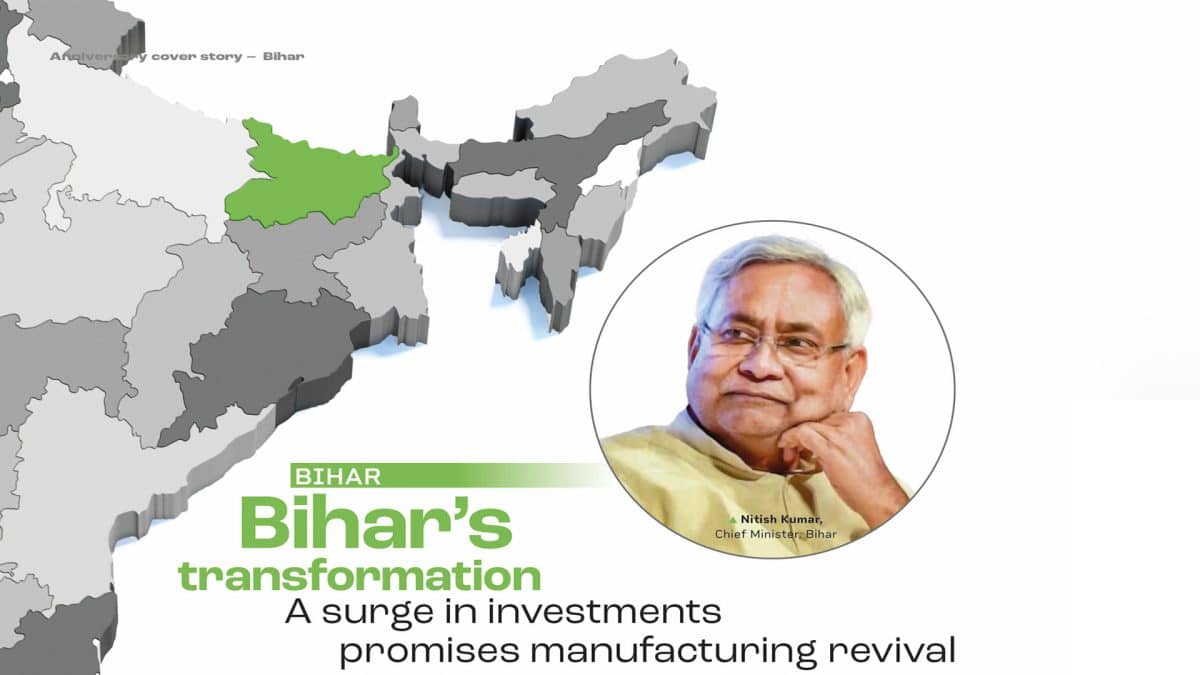
Bihar Industrial Investment Plan Drives Economic Shift
Bihar has outlined an expansive industrialisation roadmap anchored in a ₹50 lakh crore investment ambition, positioning the state for a structural economic shift over the next five years. The strategy, centred on large-scale infrastructure creation and policy reforms, aims to generate up to one crore jobs, signalling a decisive move to integrate eastern India more deeply into national manufacturing and logistics networks.
At the core of the Bihar industrial investment plan is a transition from policy intent to execution. State officials indicate that industrial corridors, expressway expansion, logistics systems and improved air connectivity are being aligned to support manufacturing clusters and urban growth centres. This infrastructure-first approach reflects a broader attempt to correct historical gaps in connectivity that have constrained industrial dispersal across the region. Policy architecture is also being recalibrated to attract private capital. A new investment promotion framework, alongside sector-specific policies covering logistics, exports, textiles and startups, is designed to reduce entry barriers and improve project viability. A recently approved semiconductor policy signals intent to participate in emerging technology supply chains, while institutional mechanisms such as a dedicated MSME directorate and marketing authority aim to strengthen small-scale enterprise ecosystems.
Early indicators suggest incremental momentum. During the last financial year, the state received hundreds of investment proposals amounting to over ₹17,000 crore, with land allotments enabling industrial projects and job creation across districts. While modest relative to the headline target, these figures point to a pipeline of activity that could scale if infrastructure delivery and regulatory certainty remain consistent. A defining feature of the Bihar industrial investment plan is its integration with urban development. Planned industrial townships, electronic manufacturing zones and large-scale projects such as an integrated manufacturing city are expected to reshape land use patterns and trigger peri-urban expansion. For cities, this implies new demands on housing, mobility, water systems and climate-resilient infrastructure—areas where execution quality will determine whether growth remains inclusive or uneven. Labour and regulatory reforms are also being positioned as enablers. Measures linked to ease of doing business, including single-window clearances and compliance simplification, aim to reduce project delays. Provisions supporting women’s participation in the workforce and startup financing schemes suggest an effort to broaden economic inclusion alongside industrial expansion.
For Bihar, long characterised by outmigration and limited large-scale manufacturing, the plan represents a strategic inflection point. However, urban planners caution that the scale of ambition will require sustained coordination between land, infrastructure, and environmental systems to avoid fragmented growth. If effectively implemented, the Bihar industrial investment plan could reshape regional economic geography, but its long-term impact will depend on how well infrastructure, skills, and sustainability priorities converge in the coming decade.