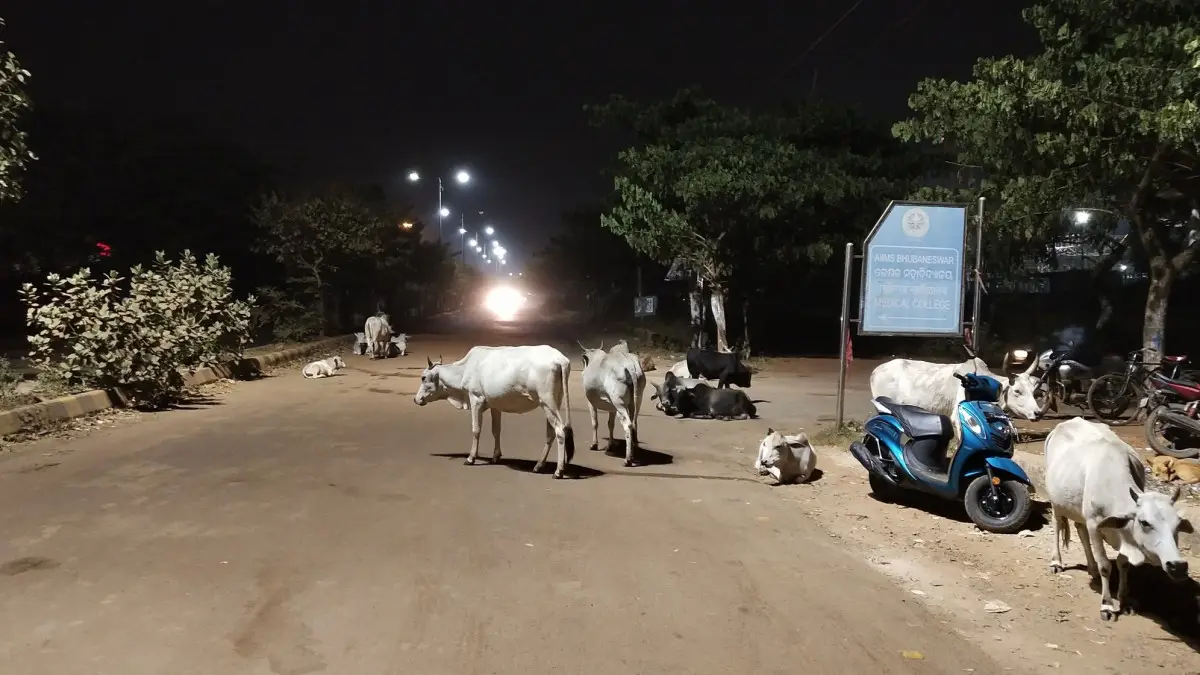
Bhubaneswar Struggles To Curb Rising Stray Cattle Menace On Roads
The Bhubaneswar Municipal Corporation (BMC) has announced a series of infrastructure plans to tackle the growing stray cattle menace across the city, which has increasingly endangered road safety, disrupted daily commutes, and worsened sanitation conditions. In response to mounting public concern, officials have committed to expanding animal shelters and introducing a dedicated fodder farm, cattle hospital, and welfare centre on a 25-acre plot at Jamukoli. However, the situation continues to deteriorate as abandoned dairy cattle spill over from main roads to inner lanes, raising serious civic and environmental alarms.
Stray cattle are a persistent and escalating hazard on Bhubaneswar’s roads, particularly affecting two-wheeler users and children. Locals report difficulty in navigating congested lanes, with cattle often blocking paths, engaging in territorial fights, or loitering in high-traffic zones. These daily disruptions not only heighten accident risks but also slow emergency response and increase air pollution from idling vehicles. Residents argue that the problem stems from unchecked urban cattle abandonment and a lack of enforceable penalties for negligent animal owners. Sanitation concerns have also worsened during the monsoon season, with open defecation by stray cattle combining with flooded roads to create a foul-smelling, unhygienic urban environment. Overflowing drains and soggy garbage piles attract more animals, who feed on plastic and organic waste alike—leading to potential health crises for both animals and humans.
Urban health experts warn that rising animal waste on roads could exacerbate the spread of waterborne and zoonotic diseases, especially in low-lying residential pockets and commercial markets. BMC officials admit that current infrastructure is insufficient. Existing shelters can house only around 800 animals, while the stray population exceeds that capacity significantly. A daily cattle-catching squad operates from Jamukoli, but with limited reach and resources. Plans are underway to enhance shelter facilities, create medical care units, and install a dedicated fodder processing plant. Officials have also submitted proposals to secure more government land between Bhubaneswar and Cuttack for future shelters, but the process remains stalled due to administrative delays and bureaucratic hurdles.
A long-term solution hinges on community participation, inter-departmental coordination, and behavioural change among urban cattle owners. Experts suggest BMC must not only increase its shelter and medical capacity but also strengthen its by-laws to penalise abandonment and incentivise responsible cattle care. The stray cattle issue intersects with urban waste management, traffic regulation, and public health, making it imperative for Bhubaneswar’s planners to treat it not as a temporary nuisance, but as a systemic urban challenge needing holistic and sustainable action.