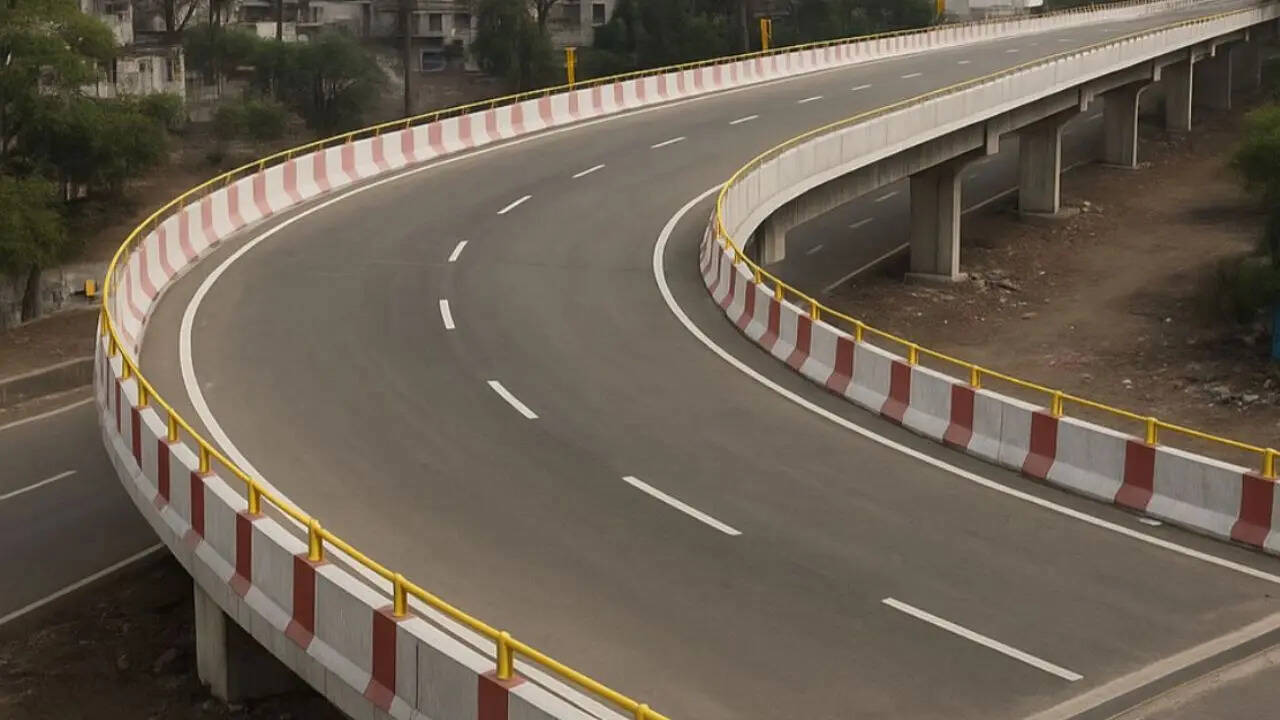
Recurring accidents on Bhopal’s Subhash Nagar Railway Over Bridge have sparked growing concerns over its serpentine layout and unsafe traffic infrastructure. Within just eight hours, two vehicles met with accidents on the same stretch, prompting experts and commuters alike to question the flyover’s structural safety. With four sharp turns and a dangerously placed divider, the design flaws are now under intense scrutiny as the city confronts the risk of a potential tragedy.
Built to ease congestion and connect Maida Mill with Prabhat Petrol Pump, the Subhash Nagar Railway Over Bridge was meant to streamline traffic toward Bhopal Railway Station. However, its ‘snake-like’ layout—featuring four abrupt directional shifts in rapid succession—has turned it into a hazardous route, especially during night-time commutes. In two separate incidents, vehicles lost control while negotiating sharp curves, colliding with a low-height divider immediately after a turn. While no fatalities have been reported so far, the pattern of crashes points to design lapses rather than driver error. Experts argue that such serpentine flyovers must be engineered with precision, including better illumination, signage, and physical buffers to guide vehicles safely through the twists. The absence of these essentials, coupled with faulty traffic signals at key junctions, increases the risk of collisions, particularly during peak hours or poor visibility conditions.
Experts in structural engineering have raised red flags over the suitability of the bridge’s layout. A senior structural specialist explained that while space constraints may justify non-linear flyover alignments in urban environments, safety must never be compromised. The Subhash Nagar bridge’s multiple turns leave drivers with little time to adjust, especially those unfamiliar with the route or navigating in low light. Moreover, the placement and height of the central divider have emerged as critical hazards, with its sudden emergence on a descent making it difficult to detect and avoid. Compounding the danger is the erratic functioning of traffic signals near Jinsi Chowk, creating conflict points where vehicles merge from multiple directions without regulated flow. Calls are growing louder for immediate corrective action, including a safety audit, improved signage, lighting upgrades, and re-engineering of traffic movement at both ends of the flyover before further mishaps occur.
The situation on Bhopal’s Subhash Nagar flyover reflects a broader urban planning challenge: balancing infrastructure development with user safety. While the bridge may have reduced traffic load in the area, its flawed design is fast becoming a liability. With repeated crashes and near-misses, authorities are being urged to initiate immediate structural reviews and retrofit interventions. As city roads become increasingly complex, ensuring that commuter convenience doesn’t come at the cost of safety is critical. The Subhash Nagar stretch serves as a stark reminder that sustainable urban mobility requires not just construction—but thoughtful, inclusive, and safe design.