


The Ministry of Road Transport and Highways (MoRTH) has officially notified toll rates for two critical highway stretches connecting Bhavnagar and the Dholera Special Investment Region (SIR).
This marks a significant step towards operationalising the strategic Bhavnagar–Dholera corridor under India’s ambitious infrastructure modernisation framework. The notification, dated May 1, 2025, sets toll collection into motion along a combined 54.587-kilometre stretch spanning portions of National Highway 751 (NH-751) and National Expressway 8 (NE-8), also referred to as the Ahmedabad-Dholera Expressway. Once tolling begins, commuters travelling between Bhavnagar and the activation zone of Dholera SIR are expected to experience seamless connectivity with reduced travel time and enhanced road quality.
According to officials, the National Highways Authority of India (NHAI) will administer the toll collection process, with a plaza established near Bhadbhid village in Bhavnagar district. The newly tolled segments include a 30.727 km section of NH-751 from Nari Junction near Bhavnagar to Adhelai—the tail end of the Dholera SIR—and a 23.860 km portion of NE-8 from Adhelai Interchange to Dholera Interchange, which connects the investment zone’s core. The NH-751 segment stretches between design kilometre 136.000 and 169.308, while the NE-8 stretch spans from kilometre 84.709 to 109.019. Together, they form a crucial transport spine feeding into one of India’s most ambitious greenfield smart city projects—Dholera SIR. Experts involved in Gujarat’s infrastructure planning assert that tolling will support asset maintenance and facilitate long-term sustainable operation of these corridors.
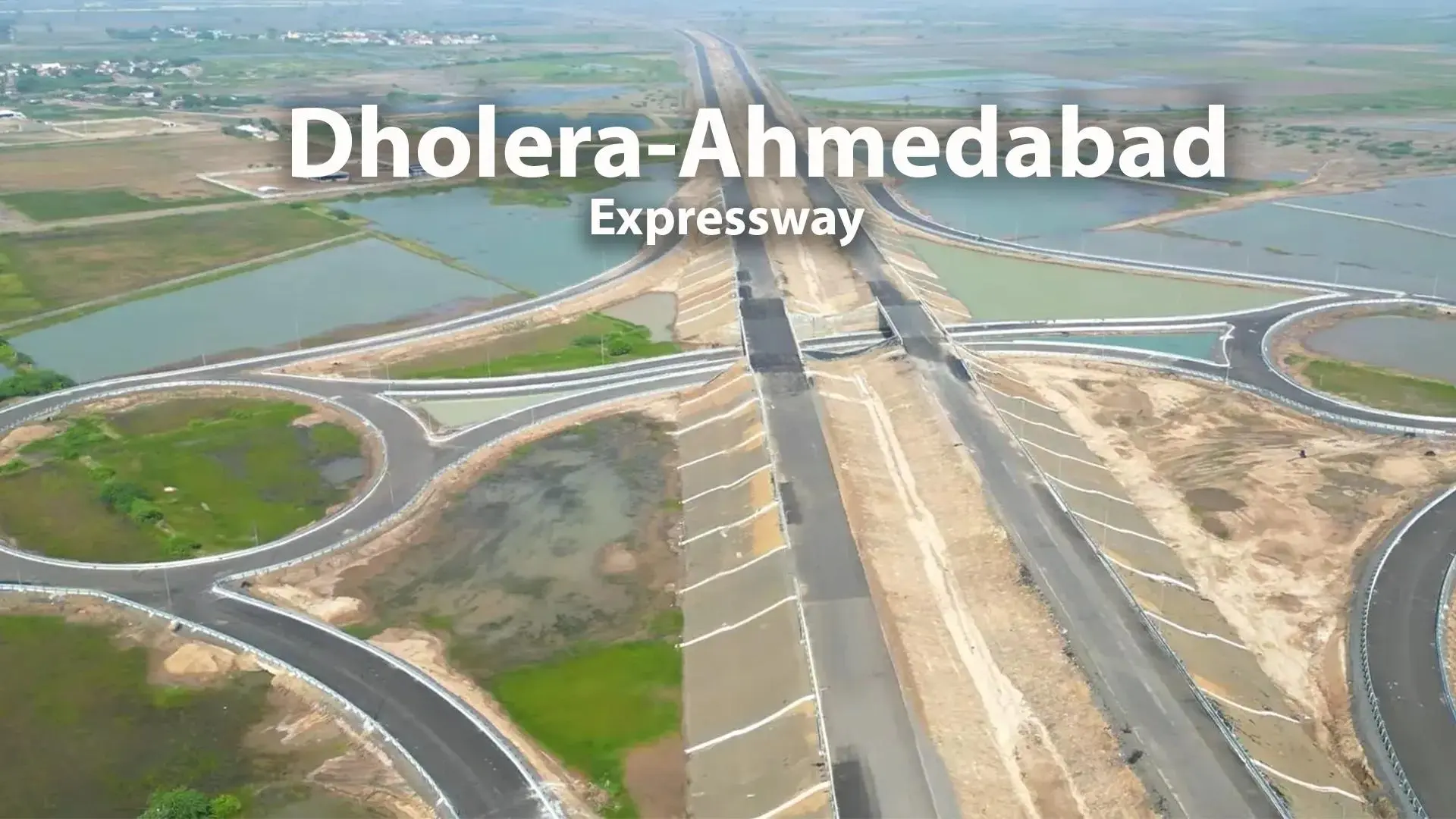
The Ahmedabad-Dholera Expressway, which forms the backbone of NE-8, is presently nearing completion. Official sources indicated that over 95 percent of the expressway’s civil works have been finalised, and the segment from Adhelai to Dholera is ready for public use. With formal tolling notification now in place, the operational opening of this stretch is imminent. This development will enable direct, high-speed access from Bhavnagar to the heart of the Dholera SIR. Urban mobility experts suggest that the Dholera SIR corridor holds enormous potential not only in terms of industrial logistics and smart city development but also as a model for decarbonised regional transport planning. Built as part of India’s larger Delhi–Mumbai Industrial Corridor (DMIC), Dholera SIR is envisioned to be a zero-carbon urban centre powered largely by renewable energy, supported by high-speed connectivity and next-generation infrastructure.
The addition of tolled, well-maintained highway links is expected to significantly reduce dependency on diesel-based logistics, as improved road conditions and expressway standards lower idle times, enhance vehicle efficiency, and streamline supply chain movements. This aligns with India’s climate goals of cutting down emissions and building sustainable urban centres that integrate circular economic principles. State-level infrastructure authorities note that the tolling regime is part of a broader public-private investment model intended to sustain the operational quality of roads and encourage usage-based charges for high-speed corridors. The move also reflects a strategic shift towards monetising national infrastructure in a way that balances equity with environmental sustainability.
However, voices from civil society and commuter groups have urged authorities to ensure that toll rates remain fair and not prohibitive for local commuters, especially small-scale transporters and daily road users from villages located along the corridor. “Equity in access must not be overlooked as infrastructure scales up,” cautioned an urban development researcher from a Gujarat-based policy institute. Meanwhile, urban planners see the Bhavnagar–Dholera route as a prototype for integrated transit-oriented development (TOD) around future Indian smart cities. With Dholera SIR’s activation area set to attract green manufacturing, EV logistics, and digital technology hubs, robust last-mile connectivity is paramount. The NH-751 and NE-8 linkage provides a dual arterial framework that could support electric freight corridors, shared mobility systems, and drone-based logistics in the near future.
Officials from the state road development agency confirmed that coordination is ongoing with renewable energy partners and city developers to integrate solar power infrastructure along the expressway, including potential EV charging stations at strategic nodes. This could turn the corridor into one of India’s first partially solar-powered expressways, reinforcing the green credentials of the Dholera urban vision. As India moves towards climate-resilient infrastructure planning, projects like these demonstrate a shift from conventional road building to more environmentally embedded transit ecosystems. The NE-8 and NH-751 stretches are more than just highways—they represent the arteries of a future where sustainable growth, smart mobility, and decentralised development converge.
That said, infrastructure experts caution that simply building expressways and collecting tolls is not a panacea. “Last-mile connectivity, affordability, and multimodal integration must be scaled up alongside, or the benefits will remain limited to select industrial corridors,” one urban policy expert remarked. For instance, linking the Bhavnagar–Dholera expressway with local bus routes, bike lanes, and sustainable public transport options will be critical for inclusivity. Furthermore, ecological groups are advocating for stringent environmental audits of all expressway operations and toll plazas, especially in areas like Bhadbhid village, which may see a spike in vehicular movement and related emissions. Recommendations have been submitted to integrate noise barriers, tree-lined medians, and water runoff harvesting systems as standard features along the corridor.
With the expressway’s completion on the horizon and tolling notifications in place, Gujarat stands at a strategic crossroads—literally and figuratively—in shaping the future of equitable, low-emission infrastructure. The journey from Bhavnagar to Dholera may soon become more convenient and efficient, but the true success of this corridor will lie in how well it serves people, preserves the environment, and promotes inclusive development.
Also Read : Mumbai to Bengaluru in Six Hours Soon
