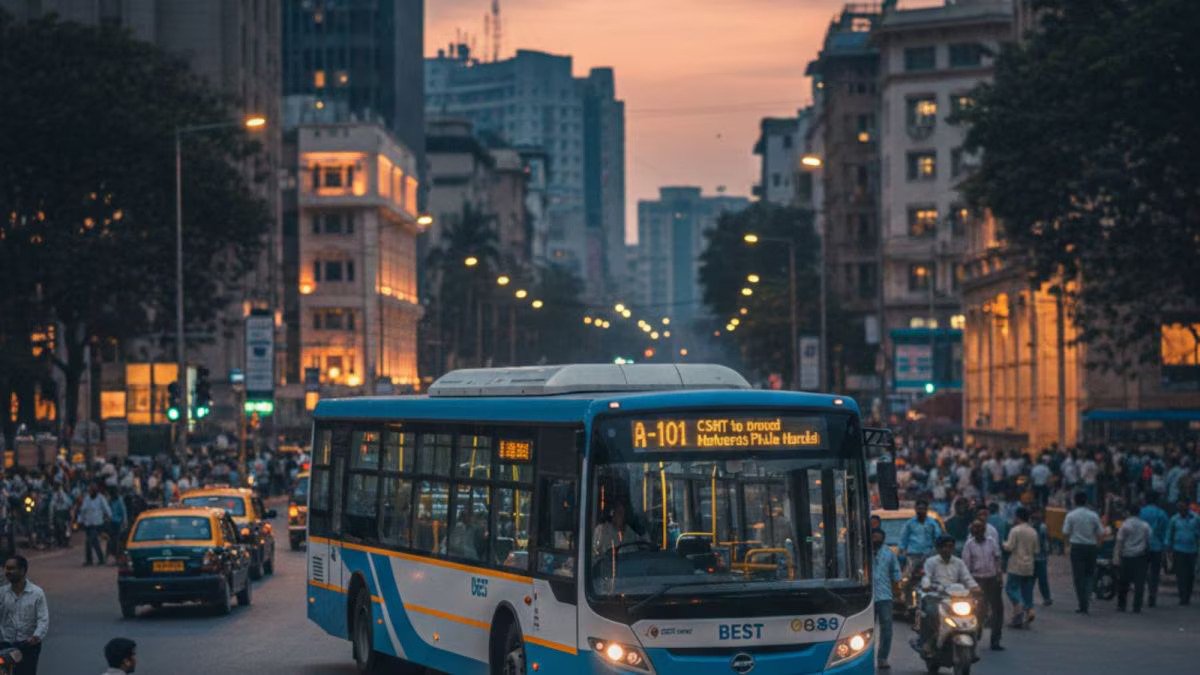
Mumbai’s public bus network is set to undergo a calibrated operational reset as the Brihanmumbai Electric Supply and Transport rolls out route rationalisation and fleet upgrades across the city from March 1, 2026. The changes, affecting multiple high-traffic corridors, are aimed at easing congestion, improving service reliability, and aligning surface transport with Mumbai’s evolving mobility and climate priorities.
According to transport officials, the revised plan introduces a mix of route diversions, short-term terminations, and the conversion of several services into air-conditioned operations. For a city where buses remain the most affordable and widely used mode of transport, these adjustments carry implications not just for daily commuters, but also for traffic flow, fuel efficiency, and urban emissions. Several long-running routes have been restructured to avoid congested loops and bottlenecks. Services operating through dense commercial and residential zones in south and west Mumbai will now take more direct corridors, reducing turnaround time and improving schedule adherence. Urban mobility experts say such route trimming is critical in cities where overlapping services often slow down operations without adding meaningful coverage.
Other services have been shortened to operate between high-demand nodes rather than extending into low-usage stretches. Transport planners argue that this approach allows the undertaking to redeploy buses to underserved areas while maintaining frequency on core corridors. In dense neighbourhoods with narrow roads, fewer buses circulating unnecessarily can also reduce local congestion and road safety risks. A notable element of the overhaul is the expansion of air-conditioned bus services across suburban and cross-city routes. Multiple services linking residential clusters with employment hubs in western suburbs, eastern industrial zones, and peripheral growth areas are being upgraded. While AC buses are costlier to operate, officials note that newer fleets are more energy-efficient and attract commuters who might otherwise rely on private vehicles or app-based transport.
Industry observers view the move as part of a broader transition towards cleaner and more commuter-friendly public transport. As Mumbai pushes for modal shift away from private cars, improving comfort and predictability in buses is seen as essential, particularly for middle-income users. Over time, this could also influence real estate demand around well-served bus corridors, complementing metro-led transit-oriented development. The changes also reflect financial and operational pressures facing urban bus systems nationwide. Rising fuel costs, fleet maintenance challenges, and staffing constraints have made route optimisation unavoidable. Transport economists say cities that proactively rationalise networks are better positioned to integrate electric buses and low-emission fleets in future phases.
For commuters, the coming weeks will involve adjustment, especially where routes no longer extend into familiar neighbourhoods. Officials indicate that on-ground monitoring will continue, with scope for further fine-tuning based on passenger feedback and ridership data. As Mumbai recalibrates its bus network, the long-term test will be whether efficiency gains translate into a more reliable, inclusive, and sustainable daily commute.
BEST Revises Bus Routes Expands Air Conditioned Services Starting March