


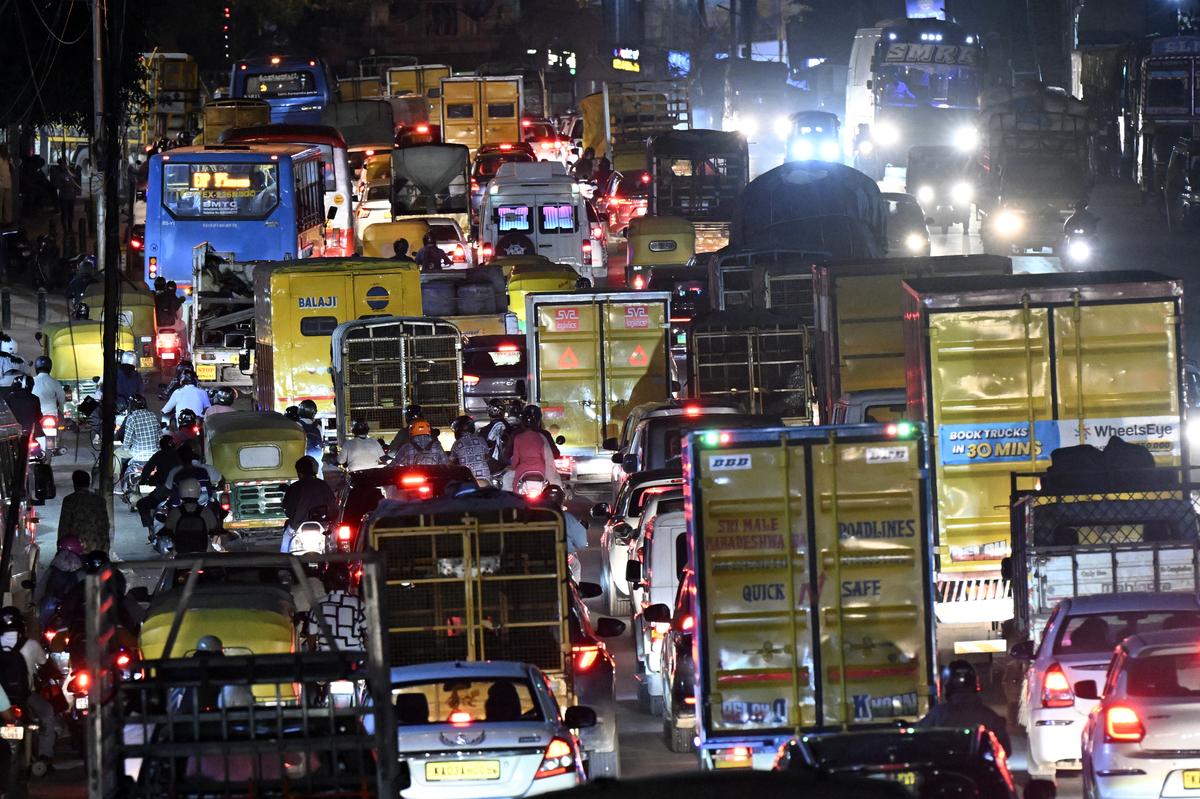
Commuters navigating Bengaluru’s Outer Ring Road (ORR) near Iblur Junction are bracing for heavier traffic as metro construction work intensifies in the area. The Bengaluru Traffic Police (BTP) have installed barricades along the ORR stretch from the 27th Main Road flyover down ramp to Iblur Government School, a move that will remain in effect until November 20. Officials said this is necessary to facilitate the construction of a new metro station under Phase 2 of the Bengaluru Metro project.
Iblur Junction, notorious for its traffic snarls, is a key node connecting Sarjapur Road and HSR Layout with Bellandur, Kadubeesanahalli, and other southeastern corridors of the city. The installation of barricades has further restricted lane availability, forcing vehicles from multiple feeder roads to merge into a limited section of the main carriageway and service lanes, exacerbating congestion, particularly during peak morning and evening hours. Officials from BMRCL confirmed that pillars for the upcoming Iblur metro station are being constructed as part of Phase 2. The barricades are a safety measure, ensuring that both workers and commuters are protected while heavy machinery operates along the ORR stretch. While the temporary inconvenience is significant, experts emphasise that such interventions are essential for long-term urban mobility improvements and for reducing reliance on carbon-intensive road transport.
Traffic management authorities highlighted that the junction’s complexity is compounded by the convergence of service roads and main lanes at the barricaded section. Residents and office commuters alike are expected to face delays until metro construction activities conclude in late November. Efforts to ease congestion, including alternate routing through nearby streets, have been suggested, although the area’s high density limits flexibility. Iblur Junction serves as a critical urban artery for residents and corporate commuters, with traffic from Sarjapur, HSR Layout, and Bellandur frequently bottlenecking during peak hours. In the past, authorities had sought cooperation from private institutions to ease traffic load, but such measures have met with limited success. Officials maintain that the current disruptions, though inconvenient, are temporary and will pave the way for enhanced public transit solutions once the metro station becomes operational.
Urban mobility experts note that infrastructure projects such as this, while initially causing short-term disruption, contribute to sustainable city development. By expanding metro connectivity, Bengaluru aims to reduce private vehicle dependency, lower carbon emissions, and improve commuting efficiency across the ORR corridor. BMRCL and city traffic officials have urged commuters to plan travel times accordingly and explore alternate routes where feasible. As Bengaluru continues its metro expansion under Phase 2, authorities are balancing immediate traffic concerns with long-term benefits, highlighting the city’s commitment to sustainable, equitable, and eco-friendly public transport solutions.
Also Read : Chennai Metro Phase 2 TBM Bhavani Completes RK Salai Breakthrough
