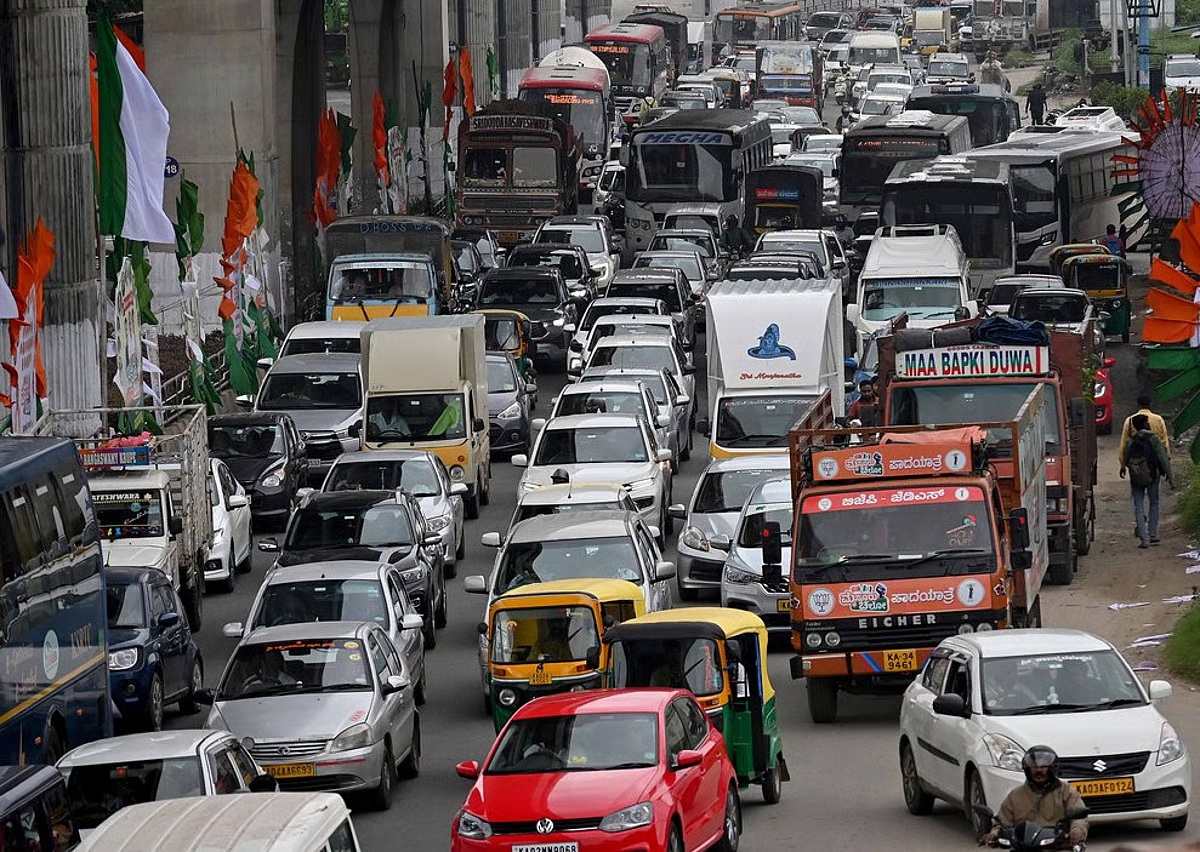
Bengaluru will see temporary but significant traffic reconfiguration on January 26 as Republic Day celebrations take place at the Manekshaw Parade Ground, prompting authorities to restrict movement across key arterial roads in the city’s central business district. While the measures are time-bound, the disruptions once again draw attention to the challenges of managing civic events in a rapidly densifying metropolis where mobility, safety, and economic continuity are closely intertwined. The traffic advisory outlines full vehicular restrictions on a crucial east–west corridor connecting administrative and commercial zones during the morning hours. Several adjoining roads will also face parking prohibitions, with diversions put in place to manage traffic volumes around the parade venue. Authorities say the restrictions are essential to ensure security and crowd safety during the national event.
For daily commuters, however, the curbs coincide with peak travel hours for service workers, small traders, and public transport users who depend on predictable road access through the city core. Urban mobility experts note that while such measures are standard for ceremonial events, their impact is amplified in cities where alternative transit options remain limited and road networks already operate near capacity. The affected zones include areas that host offices, retail clusters, public institutions, and transit hubs. Disruptions in these locations often cascade into longer travel times, increased fuel consumption, and higher emissions as vehicles idle or reroute through narrower streets. From a sustainability perspective, repeated traffic diversions highlight the need for better integration between event planning and low-carbon mobility strategies, including improved public transport prioritisation and pedestrian management.
Senior civic officials have urged residents to cooperate with on-ground personnel, follow signage, and use alternate routes. Diversion corridors have been identified to reduce congestion, though traffic planners acknowledge that short-term fixes cannot fully offset structural pressures on the city’s road infrastructure. The episode also underscores a broader planning challenge: how Indian cities accommodate large public events without disproportionately burdening everyday economic activity. Business districts depend on reliable access for employees, deliveries, and customers, and frequent disruptions can carry hidden costs for productivity and small enterprises.
Urban planners argue that future-proofing such events will require a shift toward decentralised celebration venues, staggered scheduling, and stronger public communication systems. Investment in mass transit connectivity, real-time traffic management, and last-mile pedestrian infrastructure could reduce reliance on blanket road closures. As Bengaluru continues to position itself as a global innovation hub, balancing civic pride with inclusive, climate-resilient urban mobility will remain an ongoing test. The Republic Day arrangements serve as a reminder that ceremonial planning is no longer just a security exercise, but a reflection of how cities manage space, movement, and economic life in an era of rapid urban growth.