


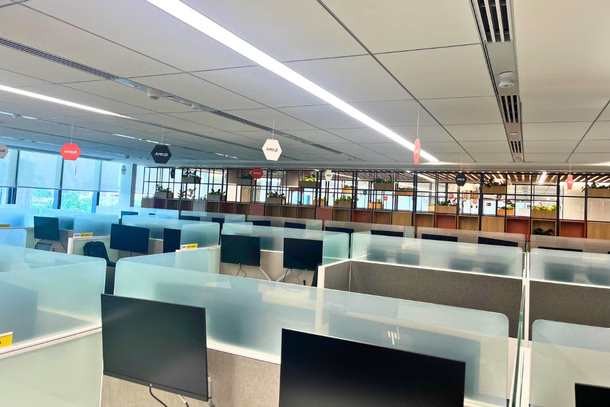
The opening of a large-scale technology workplace in the city’s eastern corridor marks another step in Bengaluru’s transition from a services-led IT hub to a deeper centre for advanced electronics and semiconductor engineering. The newly operational campus, located within the International Tech Park Bengaluru, adds over eight lakh square feet of built workspace to the city’s commercial stock, reinforcing long-term confidence in Karnataka’s electronics and chip manufacturing ambitions.
Urban economists say the development reflects a shift in how global technology firms are using Indian cities not just as talent bases, but as integral nodes in product development, testing and validation. Bengaluru’s established research talent, combined with state-led policy incentives, has made the city increasingly central to semiconductor-related design and engineering workflows. The campus is part of a broader consolidation of research, engineering and validation functions across southern India. Industry specialists note that the co-location of high-grade workspaces with clean-room infrastructure and testing facilities reduces development cycles and improves collaboration across supply chains. Such integrated campuses also tend to generate stable, long-term employment rather than cyclical project-based hiring. From an urban development perspective, the investment strengthens Whitefield’s evolution into a high-density innovation district. While the area has long been associated with IT services, newer developments are demanding higher specifications energy-efficient buildings, flexible floorplates, advanced utilities and transport connectivity to support specialised manufacturing-linked research. This has implications for how Bengaluru plans infrastructure upgrades, public transport integration and power reliability in technology corridors.
Experts tracking India’s semiconductor roadmap say facilities like this are critical as the country moves beyond assembly and testing into higher-value activities. India’s competitiveness increasingly depends on capabilities such as equipment validation, materials engineering and precision inspection areas that require both skilled manpower and tightly controlled physical environments.The presence of wafer-scale validation and advanced inspection functions in India also has sustainability implications. Localising such activities reduces dependency on overseas testing cycles, cutting logistics emissions and enabling faster iteration. Analysts argue that this aligns with India’s broader push towards climate-resilient industrial growth by embedding efficiency into production ecosystems rather than treating sustainability as an afterthought. State officials and industry leaders have consistently positioned Karnataka as a key pillar in India’s electronics system design and manufacturing ambitions. Bengaluru, in particular, benefits from an ecosystem where academic institutions, startups and global manufacturers operate within close proximity, enabling knowledge transfer and co-innovation.
As India seeks to strengthen domestic semiconductor capacity amid global supply chain realignments, the expansion of high-grade technology workplaces signals a maturing market. For cities like Bengaluru, the challenge now lies in ensuring that such growth remains inclusive supported by transit-oriented development, skilled workforce pipelines and resilient urban infrastructure that can sustain advanced manufacturing-driven economies over the long term.
Also Read: Bengaluru Housing Market Experiments With Experience Led Design
Bengaluru Tech Corridor Gains Major Semiconductor Workplace
