


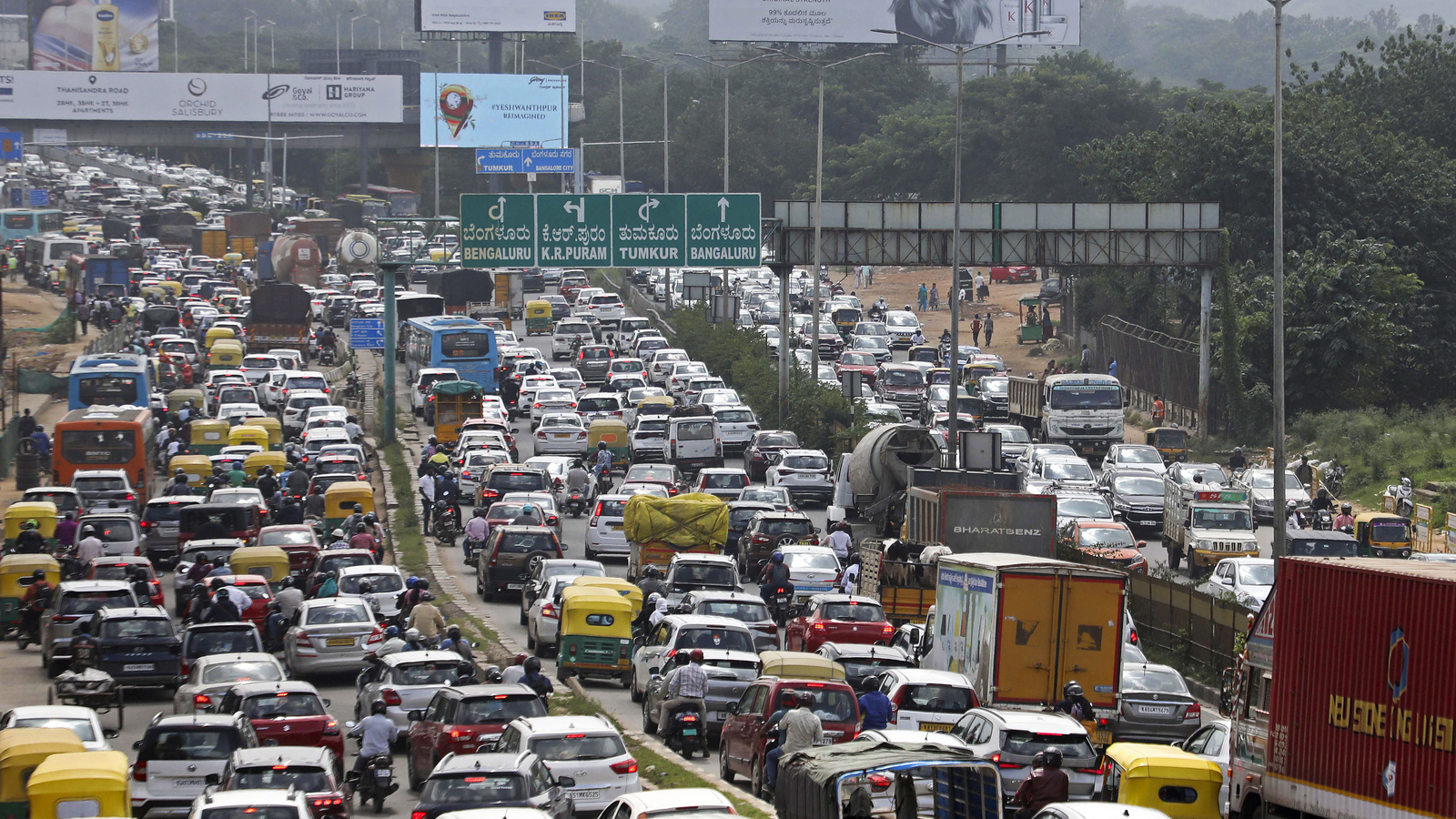
Bengaluru is hurtling towards an unwanted milestone as it edges closer to overtaking Delhi in vehicle count — a development that’s triggering widespread concern over air quality, traffic gridlock, and urban sustainability. The city, once celebrated as India’s “Garden City,” is now witnessing an unsustainable rise in private vehicle ownership, with an average of 2,500 vehicles hitting its roads every single day.
The figure includes over 1,500 two-wheelers, nearly 500 private cars, and more than 300 commercial and public transport vehicles — a pace that urban planners say is dangerously outstripping infrastructure capacity. According to data from Karnataka’s transport department, Bengaluru is now home to over 1.23 crore vehicles, with two-wheelers forming the bulk at 83 lakh and cars totalling over 25 lakh. This is just 30 lakh short of Delhi’s vehicle count, which stands at around 1.54 crore. Experts say if the current trajectory continues, Bengaluru could become India’s most vehicle-congested city by 2026. But the problem is not just one of numbers. As vehicle ownership grows, Bengaluru’s already overburdened roadways are collapsing under pressure. The average commute time within the city has doubled in just a decade, while congestion levels peak during rush hours, turning even short journeys into hour-long hauls.
What’s worse, the city’s vehicle emissions are now contributing significantly to its deteriorating air quality. Although Bengaluru still fares marginally better than Delhi on pollution indices, the trend is worrying. With rising nitrogen dioxide levels and particulate matter concentrations, citizens and health professionals are increasingly voicing concerns over the long-term impact on public health, especially respiratory illnesses among children and the elderly. The city’s car-centric urban planning is being called into question. Critics argue that lenient registration norms and lax enforcement around parking policies have encouraged unregulated growth. One of the key recommendations by mobility experts is the implementation of a mandatory “proof of parking” policy — where vehicle buyers must demonstrate access to a legal parking space before registration is granted.
“The absence of strict regulation is a recipe for urban collapse,” warns a Bengaluru-based traffic analyst. “Roads are not private parking lots. Without policy reform, we’re setting ourselves up for irreversible damage — not just to mobility, but to air, public health, and overall liveability.” Several other solutions have been proposed, including congestion charges for cars entering certain high-density zones, higher taxes on second-car ownership, and heavy investment in public transit options like metro and bus connectivity. However, such measures are yet to gain serious political momentum. Meanwhile, the state government continues to focus on road expansion and flyover construction — strategies that urbanists argue merely defer the problem rather than solve it. “Adding more roads to fix congestion is like loosening your belt to fight obesity,” said one civic researcher. “Without addressing the volume of vehicles, it is futile.”
Citizens too are beginning to mobilise. From hyperlocal campaigns advocating for cycling infrastructure and pedestrian rights, to RWAs pushing back against encroachments and illegal parking, Bengaluru’s residents are taking small steps to reclaim their city from vehicular dominance. The irony is hard to ignore: a city that once basked in its salubrious climate and leafy boulevards now risks choking on its own fumes. Without decisive intervention — both political and civic — Bengaluru may soon find itself as not only the country’s IT capital but also its congestion capital. Whether Bengaluru can pull back from the brink will depend on how urgently it recalibrates its urban priorities. For a city still in the race to define what a smart, sustainable metropolis should look like, the next few years may be decisive.
Also Read :Mumbai Teli Gali Flyover Gets of Abandoned Vehicles
