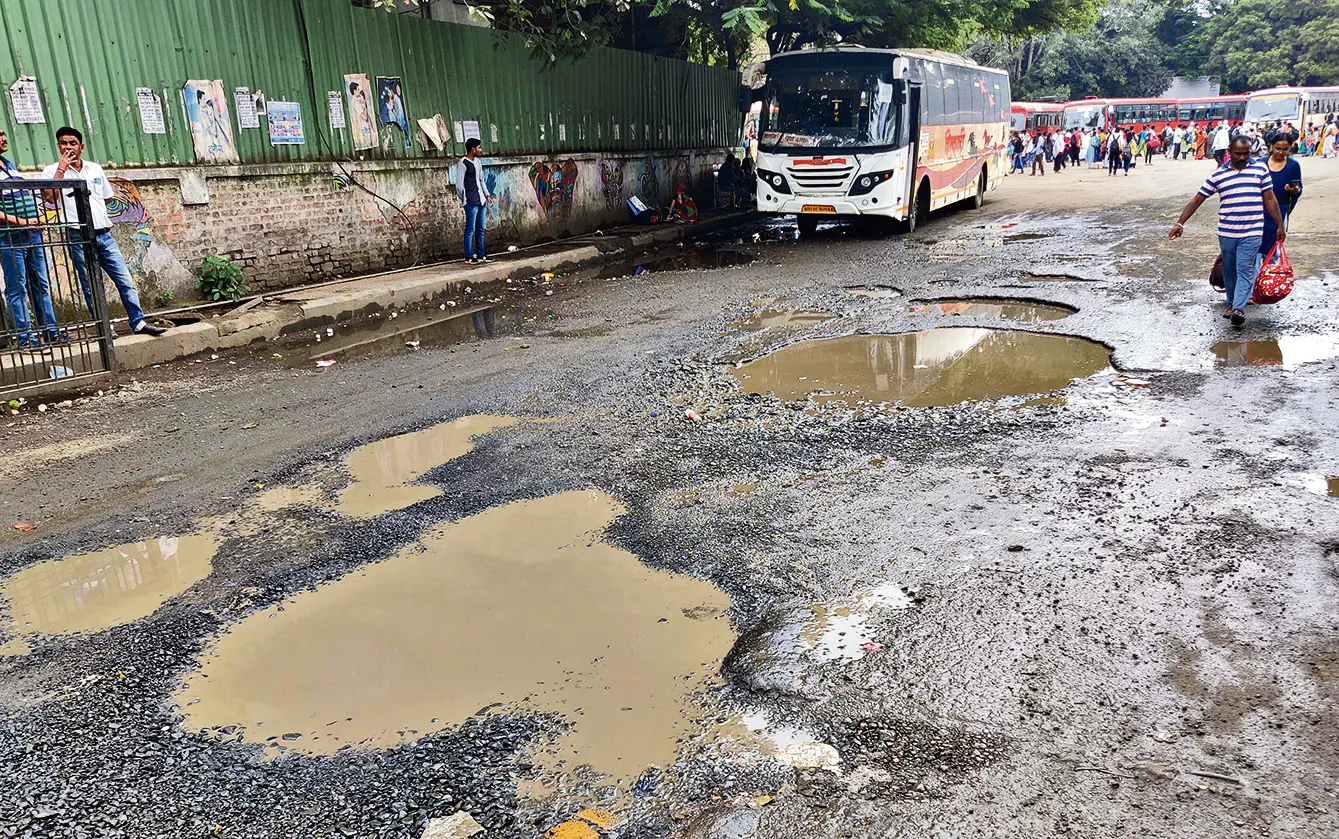
Bengaluru’s Bannerghatta–Attibele stretch, a crucial artery connecting South Zone suburbs to the city centre, is facing significant infrastructure challenges, with over 300 potholes detected along a 16-kilometre section. An AI-assisted survey of the corridor highlights growing safety risks for daily commuters, increased maintenance demands, and broader implications for urban mobility in India’s tech hub.
The assessment was conducted using an artificial intelligence-powered pothole detection system developed by a civic technology lab. The system analysed dashcam footage of the road, identifying surface irregularities frame by frame through a deep-learning segmentation model trained on tens of thousands of global road images. While several false positives required manual correction, the exercise represents one of the most comprehensive attempts to quantify real-world road degradation along a major Bengaluru route.
Urban mobility experts say the findings underscore persistent gaps in city maintenance. “Potholes of this magnitude on a high-traffic corridor not only slow down vehicle flow but also increase accident risks, particularly for two-wheeler users, who form a majority of commuters in Bengaluru,” noted a senior transport analyst. Prolonged neglect can affect the efficiency of commercial transport, last-mile connectivity, and daily commuting costs, with economic ramifications for both households and businesses. The survey also flagged secondary hazards: roadside dust, inconsistent lane markings, and obstructive debris. Urban planners argue these conditions compromise the safety and inclusivity of public roads, particularly for vulnerable riders, and strain emergency response capabilities during peak traffic hours. The economic impact extends beyond repair costs, influencing property values and commercial activity along poorly maintained stretches.
In response to the challenge, the AI model is being expanded into a crowdsourced dataset, enabling citizens across multiple Indian cities to contribute dashcam footage of damaged roads. Such initiatives aim to build a scalable database to inform municipal planning, optimise maintenance schedules, and reduce repair backlogs. For policymakers, integrating AI-driven monitoring with real-time civic reporting could improve infrastructure resilience and accelerate progress toward sustainable urban mobility. As Bengaluru expands its urban footprint, ensuring reliable, safe, and climate-resilient transport corridors remains critical. Experts emphasise that systematic data collection, proactive maintenance, and citizen engagement can collectively reduce accident risks, improve traffic efficiency, and support equitable city growth. For the Bannerghatta–Attibele corridor, the survey highlights both an urgent civic priority and a replicable model for other rapidly urbanising corridors across India.