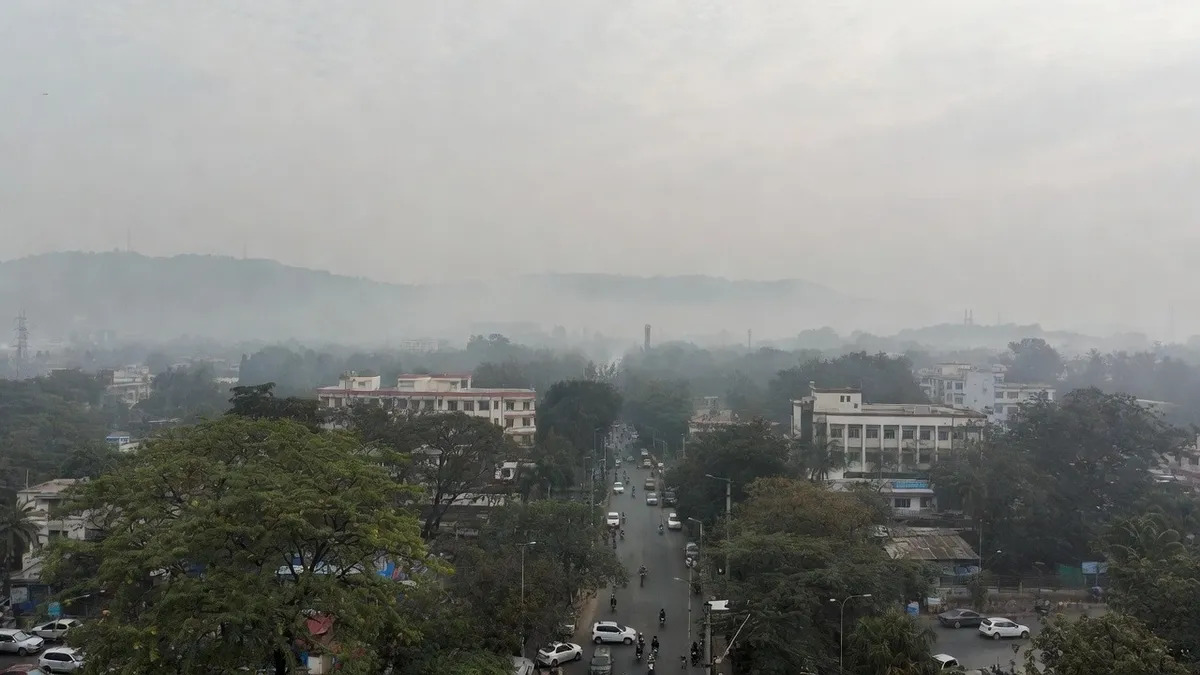
Bengaluru’s air quality performance in 2025 presents a paradox for India’s technology capital. While the city avoided the extreme pollution episodes seen in northern metros, new parliamentary data shows it lagging behind Chennai, Mumbai and Hyderabad in achieving genuinely clean-air days, a benchmark increasingly linked to public health, workforce productivity and long-term urban resilience. Measured under India’s Air Quality Index framework, Bengaluru recorded no days classified as poor, very poor or severe last year. Yet it achieved only 41 days in the “good” category, placing it behind Mumbai and Chennai, and revealing a city stuck in a prolonged middle ground. For a metropolitan economy driven by high-value services, liveability indicators such as air quality are becoming as critical as transport or housing supply.
The AQI system categorises air quality based on concentrations of fine particulate matter, particularly PM2.5 among the most harmful urban pollutants. Days with PM2.5 levels below 30 micrograms per cubic metre are considered “good”, while readings up to 60 fall into the “satisfactory” band. Bengaluru’s data shows most days clustered in this middle range, suggesting relative stability but limited progress towards cleaner baselines. In contrast, Chennai demonstrated a more consistent low-pollution profile, with a high number of days remaining close to the clean-air threshold. Mumbai, despite dense traffic and construction pressures, outperformed other large metros on the number of good-air days, dipping into poorer categories only briefly. Hyderabad followed a different trajectory registering almost no good days, but maintaining a remarkably steady “satisfactory” profile across most of the year. Urban planners say this distinction matters.
A city dominated by satisfactory air quality may appear safe on paper, but prolonged exposure still carries health risks, particularly for children, the elderly and outdoor workers. From a built-environment perspective, it also signals missed opportunities in urban design, mobility planning and emissions management. Western Indian cities with heavier industrial footprints, such as Ahmedabad and Surat, showed far greater volatility, frequently slipping into poorer AQI bands. At the other extreme, the national capital continued to struggle with recurring hazardous episodes, underscoring the widening divergence in air-quality outcomes across India’s urban system. For Bengaluru, the challenge is structural rather than episodic. Experts point to vehicle dependence, road dust, construction activity and limited last-mile public transport integration as persistent contributors.
While the city benefits from geography and wind patterns that prevent pollution spikes, these advantages alone are proving insufficient to deliver cleaner air. In response to rising concern, the state administration has directed senior officials to convene an expert group to identify immediate and medium-term interventions. Such measures are expected to focus on emissions monitoring, construction regulation and inter-agency coordination. As Indian cities compete for global capital, talent and sustainable growth, air quality is emerging as a defining metric of urban performance. For Bengaluru, moving from “not bad” to demonstrably clean air may determine whether it remains competitive as a climate-resilient, people-first metropolis in the decade ahead.