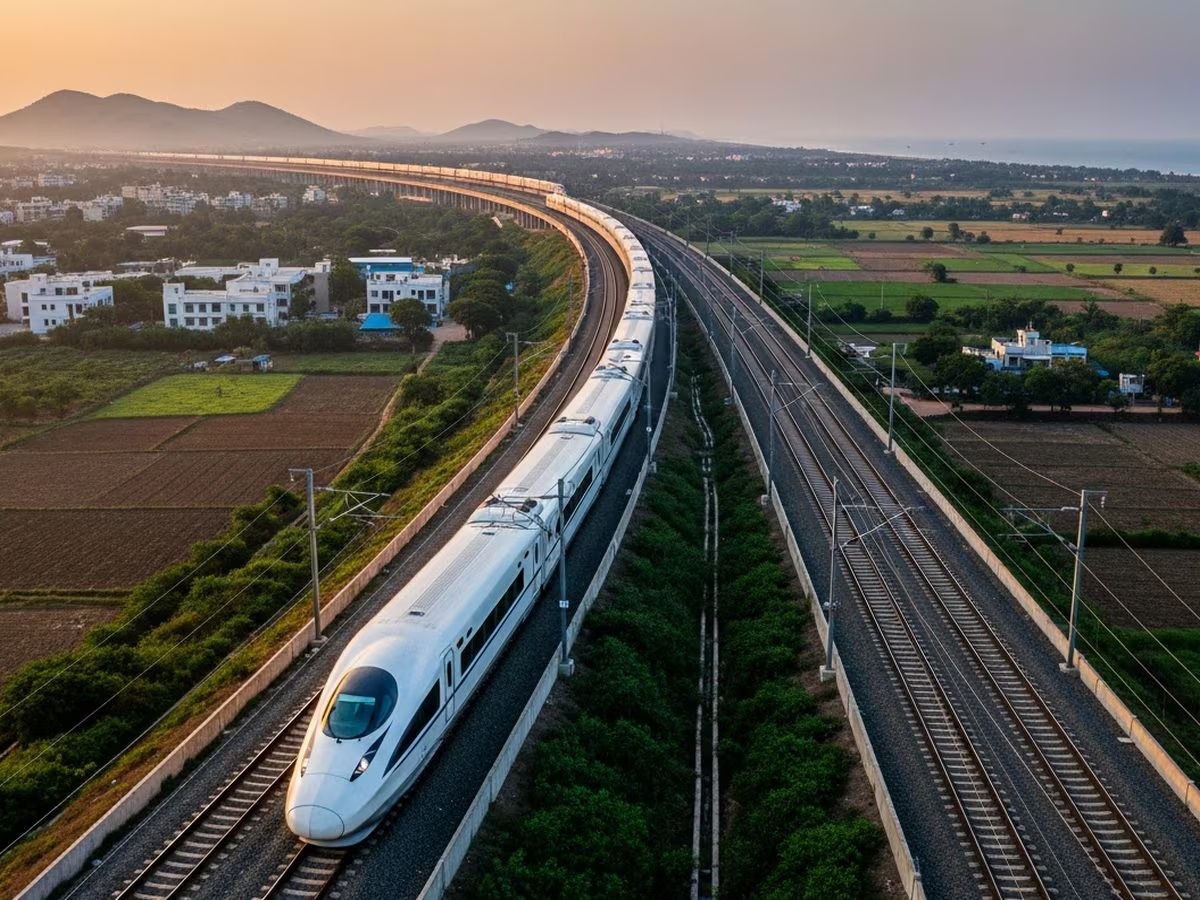
A renewed push for a high-speed rail corridor linking Bengaluru with Pune and Mumbai has brought fresh focus on how inter-city infrastructure could reshape economic geography across southern and western India. The proposal, discussed this week in Bengaluru, is being framed not just as a mobility upgrade but as a strategic investment in industrial productivity, regional balance, and climate-efficient transport.
Senior members of the Karnataka government indicated that faster rail connectivity between the country’s technology hub and its financial capital would address long-standing capacity constraints in road and aviation networks. Urban planners note that the corridor could act as a spine connecting manufacturing clusters, logistics hubs, and tier-two cities that often remain bypassed by large national projects. The high-speed rail corridor is being positioned as a complement to recently announced national rail projects rather than a competitor. While planned routes linking Bengaluru with Hyderabad and Chennai strengthen southern connectivity, officials argue that a western alignment would unlock broader economic value. Industrial belts across central Karnataka and parts of western Maharashtra could gain faster access to ports, capital markets, and skilled labour pools.
From an urban development perspective, experts highlight that rail-led growth tends to produce more compact and transit-oriented cities compared to highway expansion. High-speed rail, if designed with regional stations and last-mile planning, can reduce freight and passenger dependence on carbon-intensive road travel. This aligns with India’s long-term commitments to lower urban emissions while supporting economic expansion. Real estate and infrastructure analysts say the Bengaluru–Pune–Mumbai high-speed rail corridor could influence land use patterns along its route. Cities such as Hubballi, Belagavi, and Kolhapur are likely to see increased interest in industrial parks, warehousing, and mixed-use developments, provided zoning and infrastructure planning keep pace. Without safeguards, however, rapid land value escalation could marginalise local communities, making inclusive planning critical.
The economic case for the high-speed rail corridor also rests on productivity gains. Business travel between Bengaluru and Mumbai currently relies heavily on air routes that are both congested and carbon-intensive. A reliable rail alternative could lower logistics costs, improve labour mobility, and support distributed manufacturing a key policy objective for balanced regional growth. Policy observers caution that such mega-projects often stall at the feasibility stage due to coordination gaps between states and the Centre. For the corridor to move forward, clarity on alignment, financing models, and environmental impact assessments will be essential. Transparent public consultation will also be necessary to build trust in communities affected by land acquisition. As India expands its high-speed rail ambitions, the Bengaluru–Pune–Mumbai high-speed rail corridor represents a test case for whether infrastructure can simultaneously deliver speed, sustainability, and equitable urban growth rather than simply connecting big cities faster.