


Bengaluru Piped Gas Rollout Slowed by Infrastructure Gaps and Administrative Delays
Bengaluru’s ambition to expand household piped gas access is progressing unevenly as infrastructure constraints and administrative complexities slow last-mile connections across the city.
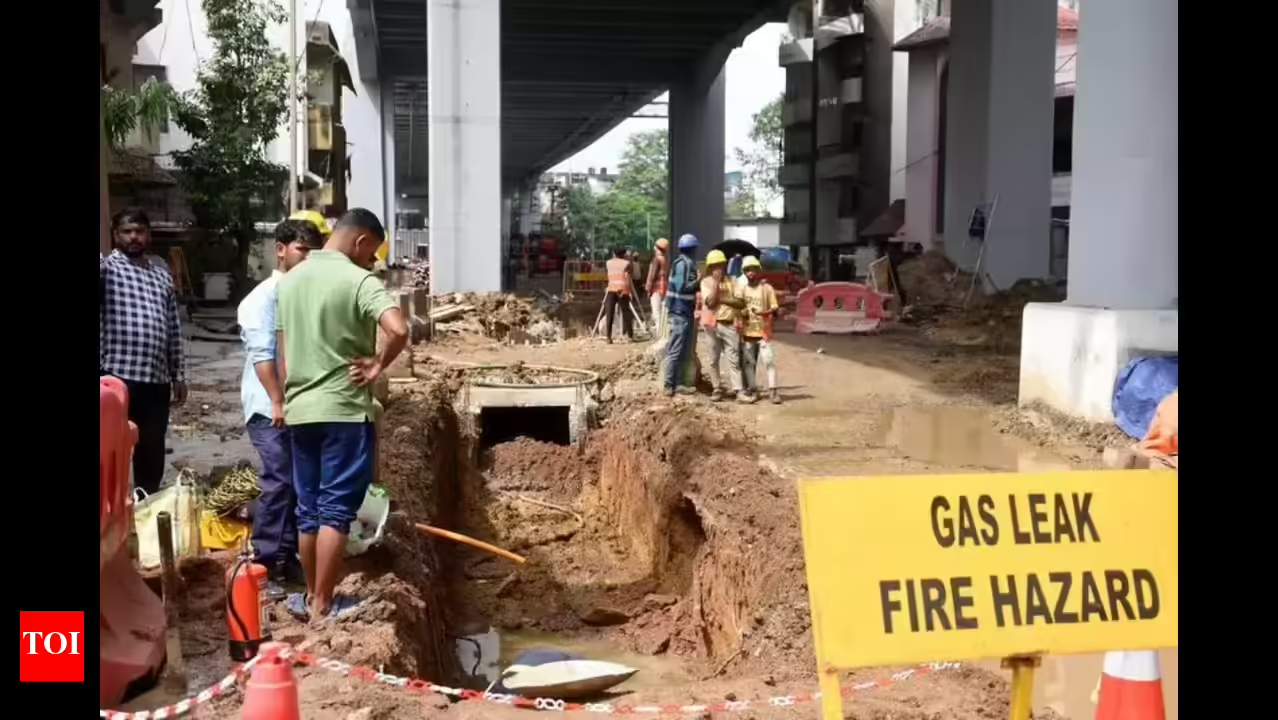
While the groundwork for the network has been laid in several areas, a large share of homes remain unconnected, highlighting deeper challenges in urban planning, underground utility coordination and regulatory approvals in one of India’s fastest-growing metropolitan regions.Data from state urban development monitoring systems indicates that the broader City Gas Distribution initiative has extended pipeline infrastructure to several lakh homes across Karnataka. However, only a portion of these households currently receive active supply. Within Bengaluru alone, network infrastructure exists for many residential clusters, yet operational connections are significantly lower due to difficulties in extending pipelines from trunk networks to individual neighbourhoods.Urban planners say the slowdown reflects a structural problem common in older Indian cities: the absence of a comprehensive underground utility map. Bengaluru’s roads already carry water pipelines, sewer lines, electrical cables and telecom networks. Without coordinated mapping and designated utility corridors, laying additional pipelines becomes complex, particularly in dense historic neighbourhoods where road widths and public space are limited.Another challenge stems from recent road infrastructure upgrades. Several arterial roads were reconstructed under urban renewal and Smart City programmes, including concrete “white-topping” projects designed to increase road durability. However, in many cases dedicated utility corridors were not incorporated during construction, leaving limited scope to install gas pipelines without reopening completed roads.Officials involved in the Bengaluru piped gas project say acquiring space for underground infrastructure remains a key hurdle. In tightly packed neighbourhoods, even minor excavation can disrupt traffic, drainage and existing utilities.
As a result, expansion efforts have been concentrated in newly developed areas on the city’s periphery where road layouts allow easier pipeline installation.Regulatory approvals have also emerged as a bottleneck. Industry representatives note that pipeline installation requires multiple clearances from civic departments overseeing roads, drainage, public works and utilities. The sequential approval process can slow execution, even when physical infrastructure is technically feasible.Energy infrastructure experts emphasise that expanding piped natural gas access remains important for urban sustainability goals. Household gas pipelines reduce reliance on cylinder deliveries, lower transport emissions and support cleaner cooking energy. They also form the backbone for compressed natural gas networks used by public transport fleets, an important component in India’s efforts to reduce urban air pollution.Policy frameworks supporting the Bengaluru piped gas project have existed for several years, including provisions requiring city master plans to accommodate gas distribution networks and related infrastructure such as CNG stations. Yet implementation across agencies has been uneven, reflecting the coordination challenges typical of rapidly expanding metropolitan regions.Urban policy analysts argue that resolving the issue will require integrated infrastructure planning. Digitised underground mapping, dedicated utility corridors and coordinated approvals across civic bodies could help accelerate expansion while preventing repeated road excavation.
As Bengaluru continues to grow outward, the city’s ability to synchronise transport, energy and utility networks may determine how quickly essential urban services — including piped gas — reach millions of residents in the coming decade.
Also Read:Bengaluru Biogas Expansion Converts Wet Waste To Energy
