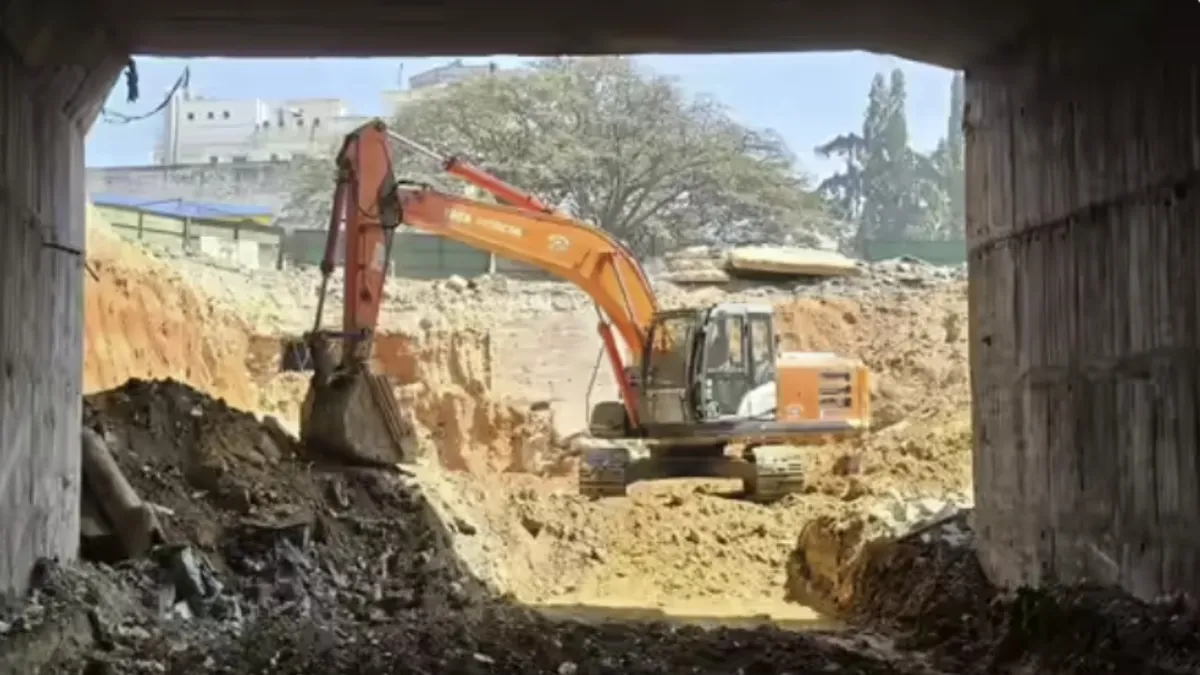
Bengaluru ORR Kanteerava Studio Underpass Work Resumes After Years Of Delay
Bengaluru’s Kanteerava Studio Junction underpass on the Outer Ring Road has finally seen renewed construction after more than 14 years of delays. The long-pending project, which connects Peenya to Nandini Layout, aims to ease traffic congestion in northwestern Bengaluru. With the Peenya-side ramp and central stretch already complete, work on the remaining ramp has resumed following utility relocations, offering hope for safer, more efficient commuting in the city’s busiest corridors.
After over a decade of stalled progress, Bengaluru’s Kanteerava Studio Junction underpass is finally moving forward, signalling relief for one of the city’s most congested intersections. The Bangalore Development Authority (BDA) has restarted construction on the ORR underpass, a key link between Peenya and Nandini Layout, which forms a strategic corridor for northwestern Bengaluru commuters.Initially approved in 2011 with a projected cost of Rs 47.4 crore, the project has been plagued by legal disputes over land acquisition, bureaucratic delays, and rising expenses. To date, BDA has spent close to Rs 100 crore, covering land procurement and partial construction. “Prolonged litigation and administrative bottlenecks stalled the project for years,” said a senior urban planner familiar with the development. “The recent resumption reflects coordinated utility shifting and renewed civic prioritisation.”
The underpass’s Peenya-side ramp and central section below the ORR were completed years ago, while the opposite ramp only began construction recently. Engineers estimate that finalising the remaining structure could take up to ten months, though BDA officials remain cautiously optimistic, projecting completion in around six months. Once operational, the underpass is expected to significantly reduce congestion, improve traffic flow, and enhance safety for pedestrians navigating the busy junction.The surrounding area has borne the brunt of the delays. Potholes and uneven roads have contributed to frequent minor accidents, while parts of the site were temporarily used for parking waste vehicles and dumping debris, further compromising safety. “Commuters have faced risks for years due to unfinished infrastructure,” said a regular ORR traveller. “Accelerating completion is crucial not only for traffic efficiency but also for urban safety and accessibility.”
Beyond the immediate traffic benefits, the project underscores the broader challenges facing rapidly growing cities like Bengaluru. Urban planners note that rising costs, complex land acquisition processes, and multi-departmental coordination are recurring obstacles in city infrastructure projects. Integrating sustainable design principles, such as pedestrian-friendly pathways, effective drainage, and minimal environmental disruption, will be critical to ensure that delayed projects do not compromise long-term urban resilience.
As work progresses, stakeholders remain cautiously optimistic that the underpass will provide smoother connectivity while serving as a benchmark for managing other delayed urban infrastructure projects. Its completion could demonstrate how persistent planning, resource allocation, and civic accountability can overcome long-standing bottlenecks in India’s rapidly expanding cities.