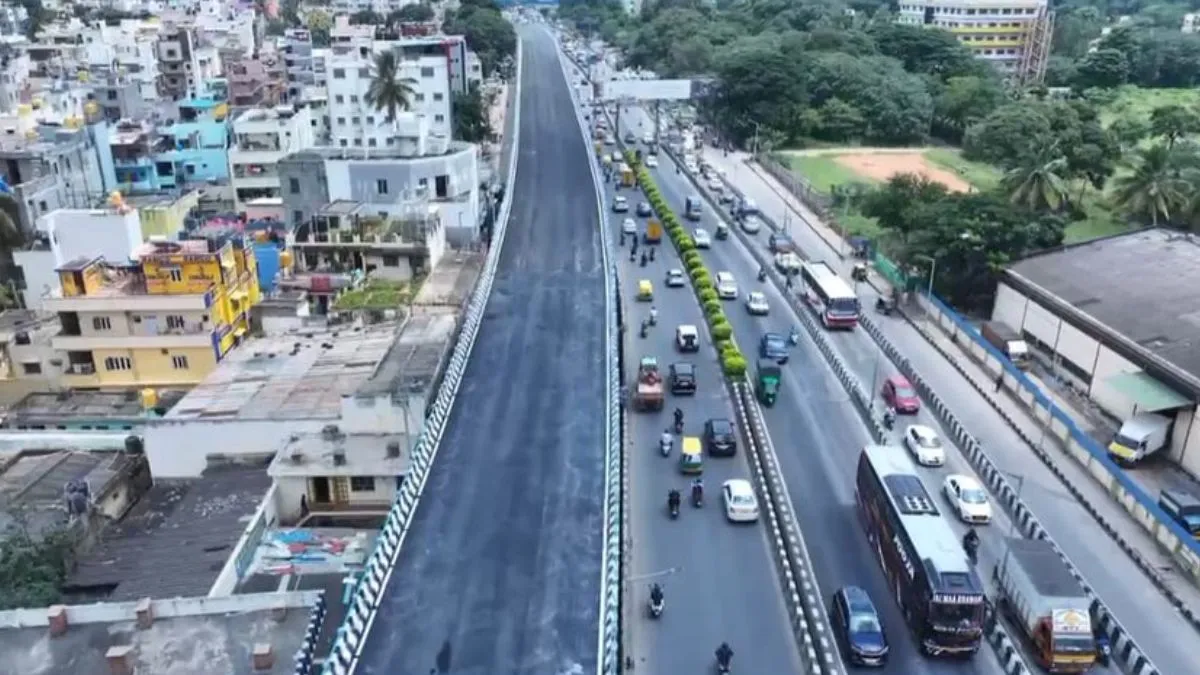
Bengaluru opens two lane Hebbal flyover loop easing traffic congestion
Bengaluru has opened a new two-lane loop at the Hebbal flyover, promising significant relief at one of the city’s most notorious traffic choke points. Built at a cost of nearly Rs 80 crore, the upgraded ramp is expected to cut delays by up to 30 percent. While the project marks a crucial step towards easing congestion, it also exposes fresh challenges downstream, signalling that broader mobility solutions remain urgent for the city.
The Bangalore Development Authority (BDA), which executed the project, has replaced the earlier single-lane ramp with a widened two-lane structure. The loop connects traffic from KR Puram and Nagawara directly towards Mekhri Circle, eliminating the need for manual signal management at the flyover. Trial runs held during the weekend showed a noticeable improvement in traffic flow, with quicker dispersal of vehicles across the junction.Officials highlight that the project is only the first phase of a broader redesign. Work is already in progress on a second loop to channel vehicles from the airport and Kodigehalli side into the city. This extension, scheduled for completion within three months, is expected to further streamline one of Bengaluru’s busiest traffic corridors, used by both daily commuters and airport-bound travellers.However, while the new loop has eased pressure at Hebbal Junction, it has simultaneously shifted bottlenecks further downstream towards Mekhri Circle. During test runs, jams were reported near the underpass, where existing road space proved insufficient to absorb the redirected load.
To address this, the civic body has proposed widening the stretch by acquiring adjoining Defence Department land and creating a free left turn towards RT Nagar, Jayamahal, and Vasanth Nagar.Another pressure point flagged by officials is the area near Baptist Hospital, where buses and private vehicles now converge after dispersal from the new loop. Authorities are assessing whether relocating nearby bus stops could decongest the junction and improve safety for pedestrians.Meanwhile, the long-term mobility challenge at Hebbal remains unresolved. The absence of a direct link for vehicles travelling from KR Puram to BEL Circle continues to strain the junction. While an earlier plan for an underpass was shelved, a two-kilometre tunnel road proposal has been tabled, though work has yet to begin.
Transport experts argue that while flyover expansions provide temporary respite, Bengaluru requires an integrated traffic management plan that balances road expansion with investments in sustainable mobility. With thousands of cars converging at Hebbal every day from the airport road, Nagawara, and KR Puram, demand will continue to outpace supply unless public transit, last-mile connectivity, and land-use reforms are prioritised.The Hebbal flyover expansion may therefore be a step in the right direction, but urban planners caution that Bengaluru cannot build its way out of congestion. A long-term vision that combines infrastructure upgrades with eco-friendly mobility solutions is essential if the city is to achieve sustainable, equitable, and liveable urban transport.