


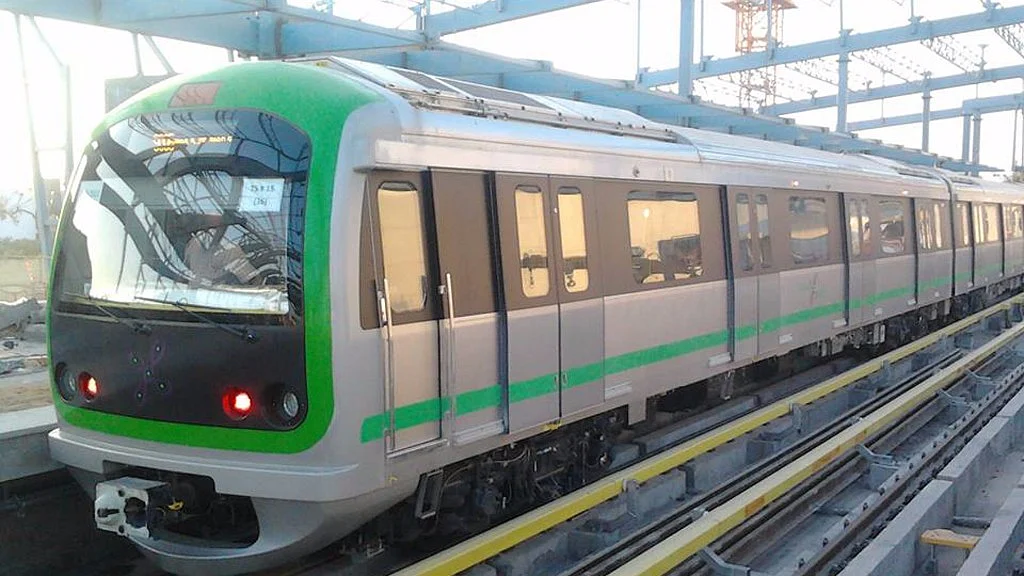
Bengaluru’s metro network has found itself at the centre of a public debate after a commuter expressed discontent over paying an additional ₹30 for carrying a suitcase. The charge, which falls under the city’s oversized luggage policy, has triggered a larger conversation on accessibility, fairness, and the role of public transport in a rapidly growing city that is already struggling with traffic gridlocks and urban stress.
The incident gained traction after the commuter shared the experience online, with several others stepping in to voice both frustration and defence of the policy. While some argued that the surcharge is unfair in the context of already steep fares, others pointed out that oversized luggage consumes space and inconveniences fellow passengers during peak hours. Officials from the Bangalore Metro Rail Corporation Limited (BMRCL) have clarified that luggage which does not fit through the standard security scanner or exceeds prescribed dimensions attracts a fixed fee of ₹30. However, commuters argue that ambiguity persists since there are no clear guidelines on what qualifies as oversized, nor is there any designated storage space for larger bags within the coaches.
Experts in urban transport policy note that this friction is emblematic of a broader challenge—balancing efficiency with inclusivity in public transport. While metros are designed primarily for high-frequency passenger movement, modern cities are increasingly recognising the need to integrate features that accommodate diverse commuter profiles, including travellers carrying luggage, senior citizens, and differently abled passengers. Comparisons were also drawn with other Indian metro systems. Hyderabad Metro, for example, revised its luggage rules in 2022 after complaints of inconsistent enforcement. Analysts suggest that Bengaluru, which is in the midst of aggressively expanding its metro network, could avoid similar controversies by issuing clearer communication, providing visual baggage guidelines, and exploring structural solutions such as luggage racks or dedicated compartments.
Public sentiment remains divided. Some commuters see the surcharge as a necessary regulation to maintain comfort and safety within packed coaches. Others view it as exclusionary, adding yet another layer of cost in a city where metro fares are already among the highest in India. Online discussions reflected this polarity, with one section urging authorities to rethink fare structures and another urging passengers to be considerate of shared spaces. The debate underscores a critical question for Bengaluru’s urban future: should mass transit systems operate purely as commuter shuttles, or should they evolve into more inclusive networks that reflect the varied mobility needs of a diverse population? With the metro expected to shoulder a greater share of daily journeys in the years ahead, the answer may well shape public trust in one of the city’s most ambitious infrastructure projects.
For now, BMRCL has yet to announce any revision to its policy. What is clear, however, is that the issue has highlighted the need for greater transparency, empathy, and long-term planning in the governance of India’s urban transport systems.
Also Read : Indian Railways to launch Gati Shakti freight trains, boosting faster cargo movement
