


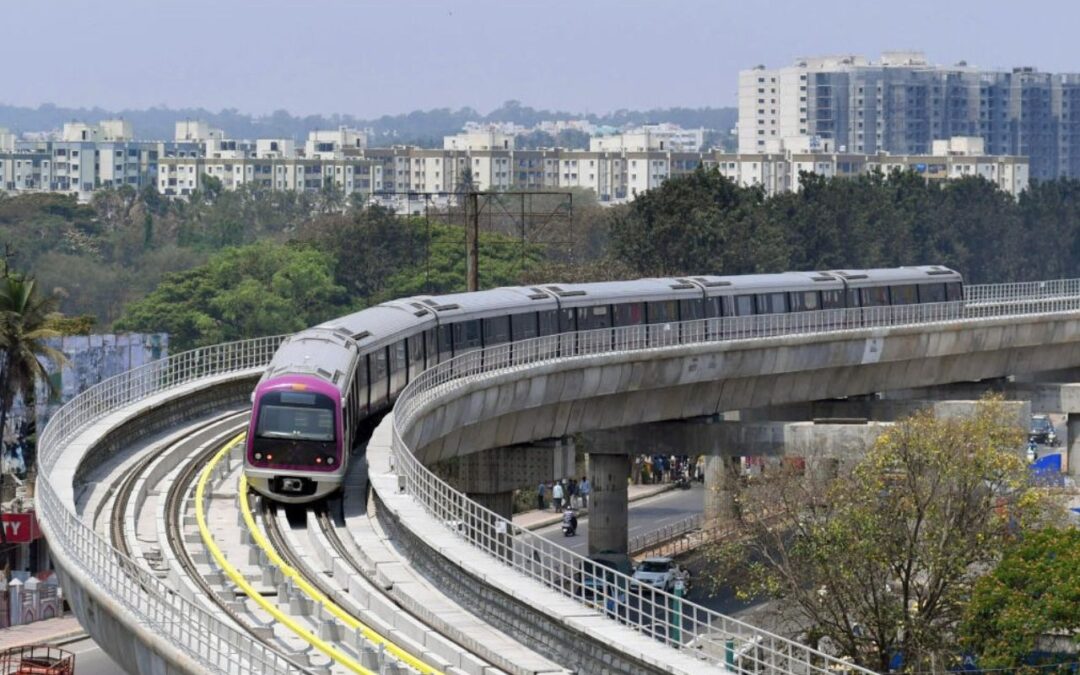
Bengaluru’s expanding metro network is increasingly redefining where residents choose to live, with neighbourhoods linked to rapid transit witnessing sharper growth in homebuyer demand and rental values than the city average. New market assessments indicate that metro proximity has emerged as one of the most decisive factors shaping residential choices in India’s technology capital.
Housing demand in areas within walking distance of operational metro stations rose in the high single digits to high teens over the past year, according to aggregated brokerage and platform data. Established residential districts such as Rajajinagar and Jayanagar recorded double-digit price appreciation, while rental values near key stations climbed faster than in comparable non-metro-connected localities. Urban planners say the trend reflects a structural shift rather than a cyclical upswing. Bengaluru’s chronic traffic congestion and rising fuel costs have made commute time a central consideration for households, particularly dual-income professionals. Metro-linked housing offers predictable travel times and reduced dependence on private vehicles, aligning both economic and environmental priorities. Demand growth has been most pronounced along corridors connecting employment hubs to residential districts. The eastern IT belt, anchored by Whitefield and K.R. Puram, saw some of the strongest traction as improved rail connectivity shortened commutes that previously took over an hour by road. Similarly, southern neighbourhoods linked to technology and industrial clusters benefited from rising tenant interest as office attendance stabilised.
Rental markets have responded even faster than capital values. Analysts note that homes located close to stations and arterial roads now command a significant premium over properties deeper within the same neighbourhoods. For tenants, especially younger professionals, access to reliable public transport is increasingly valued over larger unit sizes or gated amenities. The metro’s influence is also extending beyond currently operational lines. Areas slated for future connectivity have begun seeing price appreciation as buyers factor in long-term accessibility gains. This anticipatory pricing reflects confidence in transit-led development but also raises questions around affordability if supply does not keep pace with demand. Urban economists caution that while metro expansion supports denser, lower-carbon cities, it must be accompanied by coordinated land-use planning. Without adequate pedestrian infrastructure, affordable housing mandates, and last-mile connectivity, transit-oriented development risks becoming exclusionary rather than inclusive. Bengaluru’s experience mirrors global patterns where mass transit investment reshapes housing markets, often faster than policy frameworks can adapt. Cities that successfully harness this momentum typically integrate zoning reforms, mixed-income housing, and public realm improvements alongside rail expansion.
As Bengaluru continues to add new metro corridors, the challenge for policymakers and developers will be to ensure that accessibility-led growth translates into broader livability gains. Whether metro-linked neighbourhoods evolve into equitable, climate-resilient urban districts will depend on how housing supply, affordability, and infrastructure are balanced in the years ahead.
Also Read: Gurgaon Homebuyers Question Price Infrastructure Gap
Bengaluru Metro Corridors Reshape Housing Demand
