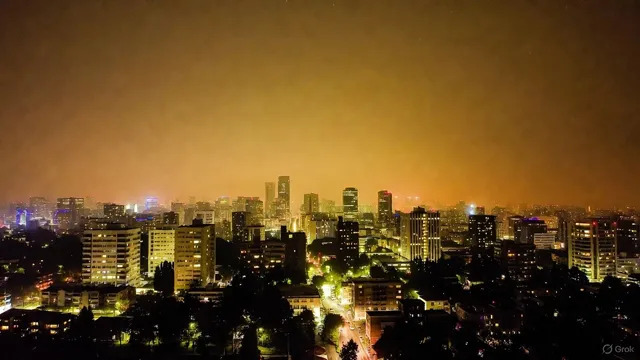
Bengaluru Light Pollution Limits Mars and Planet Sightings
City residents hoping to catch a rare planetary alignment last week were largely left disappointed, with only Jupiter clearly visible above the urban skyline. The celestial event, where Mercury, Venus, Saturn, Uranus, and Neptune clustered in the western sky after sunset, offered a brief opportunity for stargazers to observe multiple planets from a single vantage point. Yet, dense urban development, high levels of light pollution, and atmospheric conditions severely limited visibility.
Urban planners and environmental experts note that this phenomenon underscores the growing challenge of light pollution in expanding Indian cities. Streetlights, illuminated signage, and high-rise buildings not only disrupt nocturnal ecosystems but also restrict residents’ connection to the night sky. “The clustering of planets was largely obscured by artificial lighting and the low horizon line caused by urban structures,” said a senior astronomer at a local planetarium. Jupiter’s bright presence, visible even through city glow, highlighted the contrast between naturally observable celestial bodies and those that require darker skies or optical instruments.
The alignment placed Mercury, Venus, Saturn, and Neptune near the western horizon shortly after sunset, a position that made them almost impossible to view from most residential areas. Mercury’s rapid setting compounded the difficulty, while Venus and Saturn appeared faint and low. Neptune and Uranus, positioned at distances and luminosities beyond naked-eye detection, were visible only with telescopes, illustrating the limits imposed by urban light environments. Economically, such restrictions have broader implications for urban planning and tourism. Cities with dark-sky initiatives and protected viewing zones attract scientific tourism, educational programmes, and community engagement in astronomy. Conversely, unchecked urban illumination can reduce the potential for such civic and educational experiences. Experts suggest integrating urban lighting policies with energy-efficient, directional, and time-controlled systems to balance safety, sustainability, and public access to the night sky.
The planetary alignment also serves as a reminder of the complex interplay between human settlements and natural phenomena. While celestial events occur independent of urban growth, their observability depends on planning decisions, building regulations, and environmental management. Residents in peripheral and rural areas surrounding Bengaluru reportedly enjoyed clearer views, emphasizing the disparity between urban and suburban light conditions. Looking ahead, city authorities and urban designers may consider mapping “night sky corridors” within metropolitan zones. Such initiatives could enhance cultural and scientific engagement, support eco-conscious lighting strategies, and reinforce Bengaluru’s position as a hub for both technology and environmental stewardship.