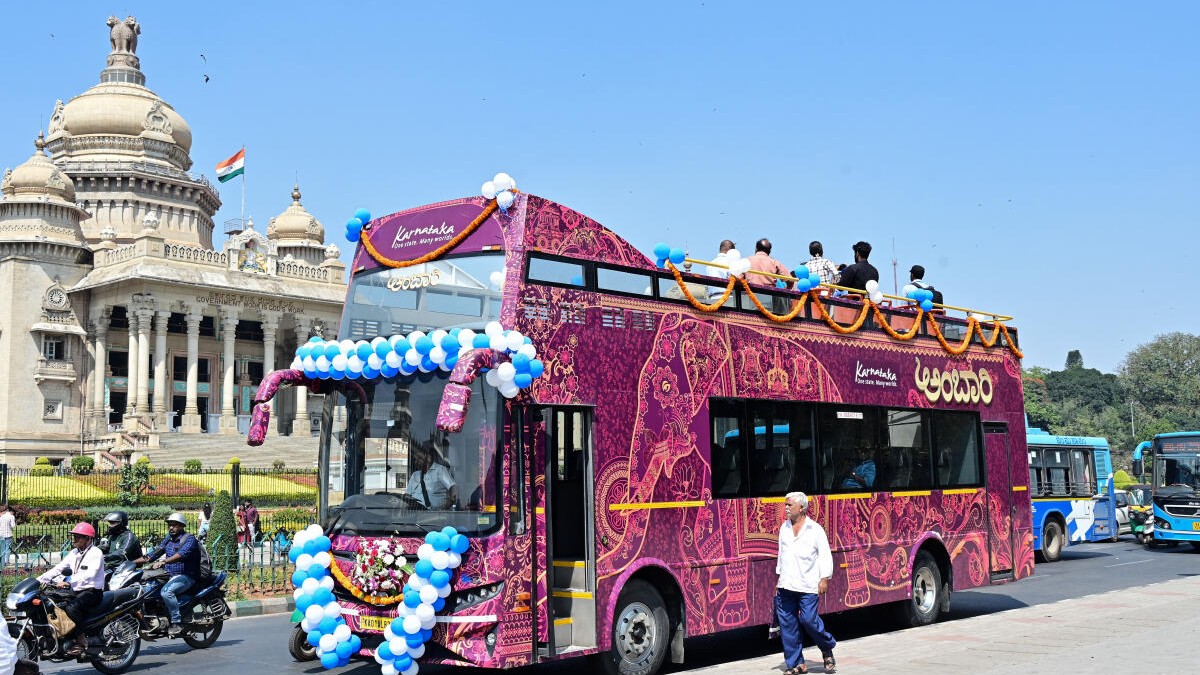
Bengaluru has taken a measured step towards structured urban tourism and low-impact city mobility with the launch of a double-decker hop-on, hop-off bus service operating across the city’s central business district. Designed as a pilot, the initiative signals a renewed attempt to organise sightseeing within existing public transport corridors while reducing reliance on private vehicles in high-density civic zones.
The service introduces open-top double-decker buses running on a circular route that connects major administrative, cultural, and heritage landmarks. Urban planners view the move as significant for a city where tourism activity has largely depended on fragmented travel options, ride-hailing services, and informal guides. By integrating sightseeing into a managed public system, the model aligns with broader goals of congestion mitigation, pedestrian-friendly city cores, and more inclusive access to public spaces. Each bus accommodates forty passengers, split between an air-conditioned lower deck and an open upper deck. Multi-language audio narration provides contextual information about neighbourhoods and landmarks as the route progresses, allowing visitors to engage with the city without the need for additional guides. The design also incorporates visual references to Karnataka’s cultural and ecological identity, positioning the buses as mobile representations of regional heritage rather than purely functional transport assets.
The pilot route loops through prominent civic institutions, museums, public parks, stadium precincts, and legislative buildings before returning to its starting point. Importantly, passengers are allowed to board and alight at designated stops throughout the day, enabling flexible exploration rather than fixed sightseeing schedules. Urban transport experts note that such flexibility is essential for encouraging longer dwell time in public areas, which in turn supports local retail, cultural venues, and informal economies. A full-day ticket has been priced at ₹180, placing the service within reach of students, domestic tourists, and residents seeking curated city experiences. Bookings are available both online and offline, reducing digital access barriers. Services are scheduled across daylight and early evening hours, with routes designed to avoid low clearances, flyovers, and overhead utilities a key reason earlier double-decker operations were withdrawn decades ago.
From an urban governance perspective, the initiative reflects a cautious but pragmatic approach. Rather than introducing new infrastructure, authorities are testing demand through asset re-deployment and route optimisation. If ridership stabilises, officials indicate the network could expand to additional cultural and tourism clusters, potentially extending beyond the central district. As Indian cities reassess how tourism, mobility, and public space intersect, Bengaluru’s pilot underscores a growing recognition that sustainable urban tourism depends less on expansion and more on smarter use of what already exists. The success of the programme will ultimately hinge on reliability, last-mile integration, and whether citizens see it as a public amenity rather than a novelty.