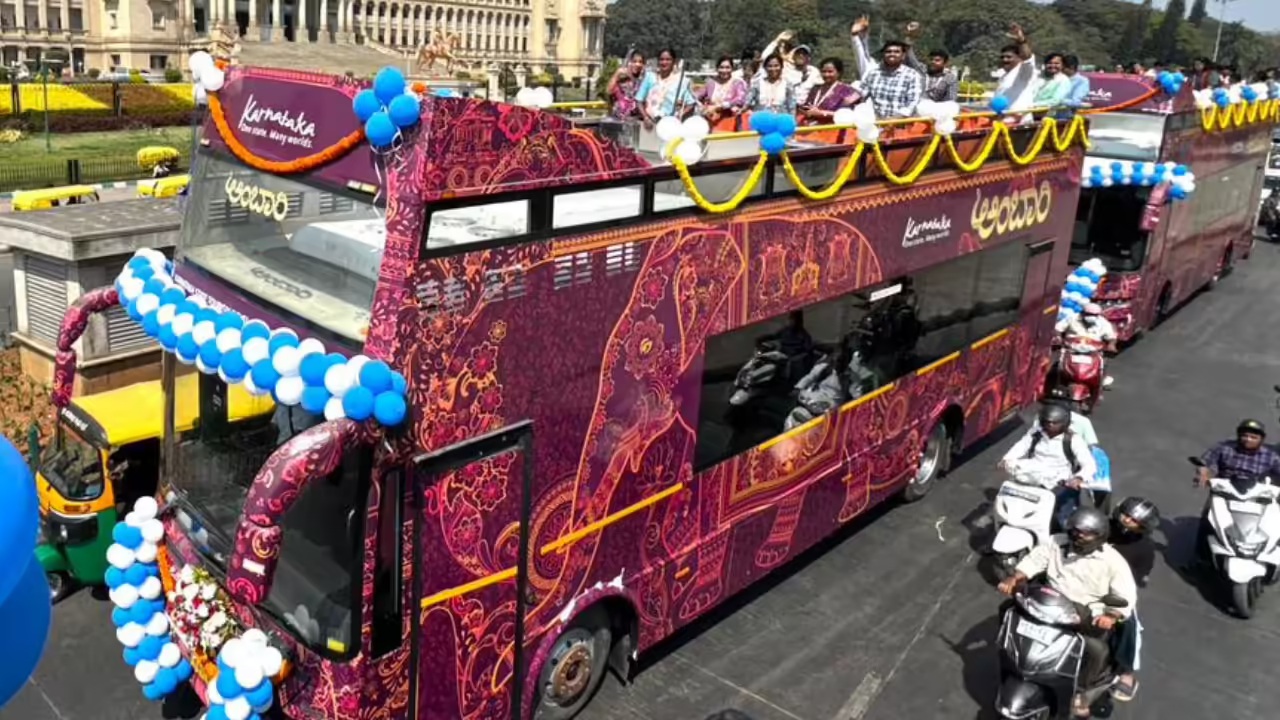
Bengaluru has reintroduced double decker buses as a city sightseeing service, signalling a shift in how urban tourism and mobility are being reimagined in one of India’s fastest-growing metropolitan regions. Rolled out this week by the state tourism agency, the initiative places curated, short-distance travel at the centre of visitor experience while attempting to reduce dependence on private vehicles in congested city zones. Unlike earlier attempts that struggled to balance costs and ridership, the new service is positioned as a structured tourism product rather than a mass transit solution. Three open-top double decker buses have been deployed across fixed circuits that connect major cultural landmarks, heritage zones, green spaces, and commercial districts.
Urban planners say this approach aligns better with global practices where sightseeing buses complement rather than compete with public transport systems. The return of double decker buses comes at a time when Bengaluru is reassessing how tourism fits within its broader urban development strategy. Visitor numbers have steadily recovered post-pandemic, but infrastructure pressure, traffic congestion, and last-mile accessibility remain persistent challenges. A senior tourism official noted that controlled sightseeing routes help concentrate tourist movement, easing pressure on sensitive neighbourhoods while offering visitors a coherent narrative of the city. For residents, the service highlights a growing recognition that tourism infrastructure must be people-first and environmentally mindful. Transport experts point out that well-managed sightseeing buses can reduce fragmented cab trips, lower emissions per visitor, and encourage walking around designated hubs.
While the current fleet size is limited, the model offers a test case for integrating tourism mobility with climate-responsive planning. Economically, the initiative has implications beyond leisure travel. Local businesses near designated stops including small retailers, cafés, and cultural venues are expected to benefit from predictable footfall. Real estate analysts also note that heritage districts and mixed-use precincts increasingly draw value from experiential tourism, provided infrastructure growth remains measured and inclusive. Ticketing has been structured to remain accessible, with both digital booking options and offline counters located in central cultural venues.
Officials emphasise that affordability is critical to attracting domestic travellers and students, who form a significant share of Bengaluru’s visitor base. Urban development specialists caution that the success of the programme will depend on operational consistency, service quality, and integration with other modes such as metro rail and pedestrian networks. Past failures, they note, stemmed from treating double decker buses as novelty transport rather than part of a wider mobility ecosystem. As Bengaluru grapples with balancing economic growth, liveability, and sustainability, the revival of the double decker bus offers a modest but telling experiment. If scaled thoughtfully, it could shape how Indian cities design tourism infrastructure that supports climate goals while keeping cities accessible and humane.