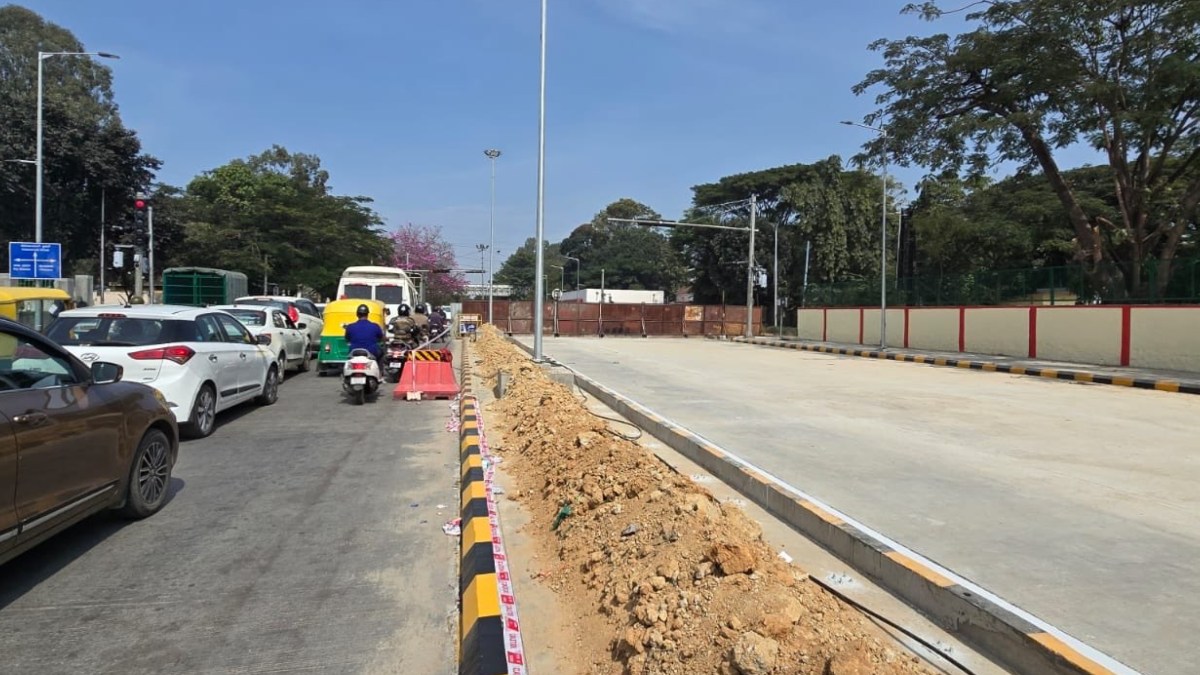
After nearly seven years of restricted access, a key east–west connector in Bengaluru’s central business district has reopened fully, offering long-awaited relief to daily commuters and commercial traffic. Kamaraj Road, linking Cubbon Road with M.G. Road, has been restored to two-way movement following prolonged underground metro construction. While the reopening has eased pressure on surrounding streets, transport planners and commuters alike warn that the gains may be fragile.
The corridor had remained shut since 2019 to facilitate construction of an underground station on the city’s expanding metro network. Its return has immediately redistributed traffic that had been funnelled through Brigade Road, Commercial Street and adjoining lanes, areas that have struggled with chronic congestion for years. For office-goers and service vehicles navigating the heart of the city, the restored link has shortened travel times and reduced circuitous detours. However, the reopening comes amid growing concern over upcoming utility works planned along M.G. Road. Civic infrastructure agencies are preparing to relay ageing water supply and sewerage pipelines on both sides of the arterial stretch, a move that could significantly disrupt traffic once again. Urban mobility experts note that repeated excavation of completed roads highlights long-standing coordination gaps between transport, utility and planning agencies.
Traffic flow has also revealed new challenges. While one bottleneck has eased, signal timing and junction management at nearby intersections have yet to be recalibrated for the altered traffic patterns. Peak-hour queues have reportedly increased at certain crossings on Cubbon Road, underscoring the need for dynamic signal management rather than static reopening of road space. Experts argue that without synchronised signals and pedestrian prioritisation, added road capacity can simply shift congestion rather than resolve it. Beyond traffic movement, the reopened stretch has sparked debate on urban design and environmental restoration. The road now carries a smooth surface and modern drainage, but lacks the tree cover that once defined the avenue. Urban planners say such corridors offer opportunities to integrate shade, permeable surfaces and pedestrian-friendly design, particularly in dense commercial zones where heat stress and walkability are growing concerns.
Officials associated with the metro project have indicated that landscaping and streetscape upgrades are planned as part of post-construction works. However, sustainability advocates stress that greenery restoration should not be treated as an afterthought, especially in a city grappling with rising temperatures and shrinking public spaces.
The reopening of Kamaraj Road underscores both the benefits and limitations of linear infrastructure fixes in complex urban cores. While the restored link improves connectivity in the short term, its long-term success will depend on coordinated planning across transport, utilities and public realm design. For Bengaluru’s central business district, the episode serves as a reminder that seamless mobility is as much about governance and timing as it is about concrete and asphalt.