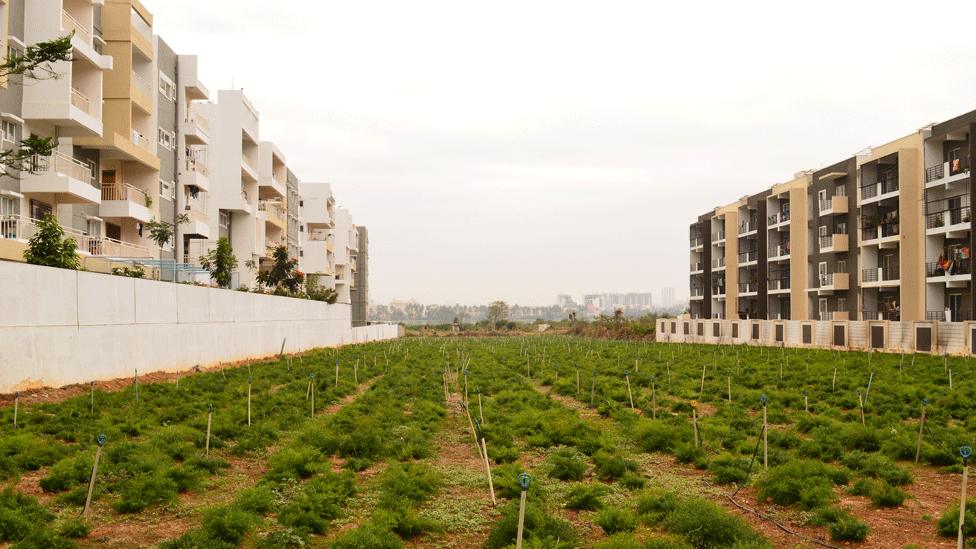
Nearly twenty years after it was first announced, Bengaluru’s Peripheral Ring Road now rebranded as the Bengaluru Business Corridor has become a case study in how prolonged infrastructure planning can quietly destabilise livelihoods even before construction begins. Spanning more than 70 kilometres around the city’s outer edge, the project aims to decongest traffic and unlock commercial growth. But for thousands of landowners across peri-urban Bengaluru, it has instead created a prolonged economic limbo.
More than 2,500 acres across multiple villages were notified for acquisition in the mid-2000s. Since then, landholders have been unable to sell, mortgage, or legally redevelop their property. While urban land prices in surrounding areas have surged due to rapid expansion, notified parcels remain frozen in value and use. Farmers say this has effectively excluded them from Bengaluru’s growth story while placing them at risk of displacement once acquisition proceeds. Officials associated with the project maintain that the corridor serves a larger public purpose, linking highways, easing freight movement, and supporting future employment hubs. In recent months, the planning authority has rolled out multiple compensation options, including cash payouts, developed residential or commercial plots, development rights certificates, and floor area ratio incentives. Authorities argue that these packages reflect current market realities and are drawing increasing consent from landowners.However, agricultural households contest this claim.
Many say the proposed compensation does not account for lost income, rising land prices beyond the city’s periphery, or the cost of relocating farming operations far from established markets. Floriculture growers, for instance, depend on proximity to urban mandis and logistics hubs advantages that are difficult to replicate after relocation. The prolonged notification has also produced less visible but significant impacts. Because notified land cannot be freely updated in official land records, farmers report difficulties accessing crop insurance, subsidies, and government procurement schemes. Trees and crops planted after the original notification may not qualify for compensation, discouraging long-term investment in soil health or sustainable agriculture. Legal ambiguity has further complicated the situation. Landowners argue that acquisition timelines prescribed under planning and land acquisition laws have long expired, rendering the project invalid.
Project authorities counter that its inclusion in statutory master plans keeps it legally alive. This unresolved tension continues to fuel litigation and uncertainty. Urban planners note that infrastructure of this scale cannot succeed through coercion or procedural delay alone. Equitable compensation, time-bound execution, and transparent engagement with affected communities are essential particularly as Indian cities pursue climate-resilient, inclusive growth. Without these, large road projects risk undermining both social trust and environmental sustainability. As Bengaluru debates its mobility future, the Peripheral Ring Road’s greatest test may not be engineering feasibility, but whether the city can align economic ambition with fair urban transition for those living at its edges.