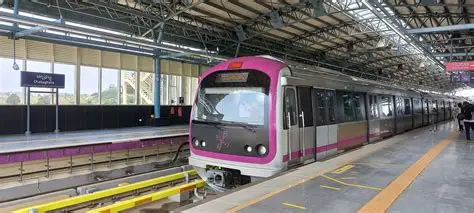
Bengaluru Driverless Trains Ready For Pink Line Test
Bengaluru is preparing to operationalise its long-awaited Pink Line with an initial deployment of five “driverless-capable” trains, with the elevated section from Kalena Agrahara to Tavarekere expected to start service by June 2026. The prototype train, scheduled for unveiling on 11 December, will undergo comprehensive testing over the following five months before it enters public service.
The Pink Line, spanning 21 km with 23 train set, represents a significant step in Bengaluru’s transition towards automated urban transit. The underground segment from Dairy Circle to Nagawara, extending 13.7 km, is slated for completion by December 2026, marking the full operational launch of the corridor. During peak hours, trains are projected to run every 4.5 minutes, reducing to eight-minute intervals during off-peak periods, with daily operations from 5 am to midnight. Officials from the Bengaluru Metro Rail Corporation Ltd (BMRCL) confirmed that all 16 trains for the Pink Line will be delivered in time for the line’s full commissioning. BEML, responsible for rolling stock supply, will provide at least two trainsets per month from April onwards, also managing their maintenance over a 15-year contract an unprecedented inclusion in BMRCL’s procurement process.
The Pink Line will employ a Communication-Based Train Control (CBTC) system, similar to the operational model of the Yellow Line, enabling semi-automated operations (GoA-2) initially. This mode allows a driver to oversee train doors and basic controls while core signalling and movement are automated. The long-term plan includes transitioning to fully unattended GoA-4 operations, contingent on system reliability and passenger readiness. “We will continue to have drivers onboard until the automated system is stable and commuters are accustomed to driverless travel,” a senior BMRCL official said.
The metro line has experienced multiple timeline adjustments. Originally, the elevated section was slated for a September 2025 launch and the underground portion for June 2026. Revised schedules have pushed these to June 2026 and December 2026, respectively.
Industry analysts suggest that the Pink Line’s deployment is not only vital for easing Bengaluru’s urban congestion but also a benchmark in sustainable transit development. By integrating advanced automation and high-frequency services, the line demonstrates potential for reduced energy consumption and lower emissions per passenger kilometre, aligning with the city’s broader net-zero ambitions. As Bengaluru expands its metro network, the Pink Line serves as a model for inclusive and efficient urban mobility, providing commuters with reliable, modern, and environmentally conscious transport options.
Bengaluru Driverless Trains Ready For Pink Line Test