


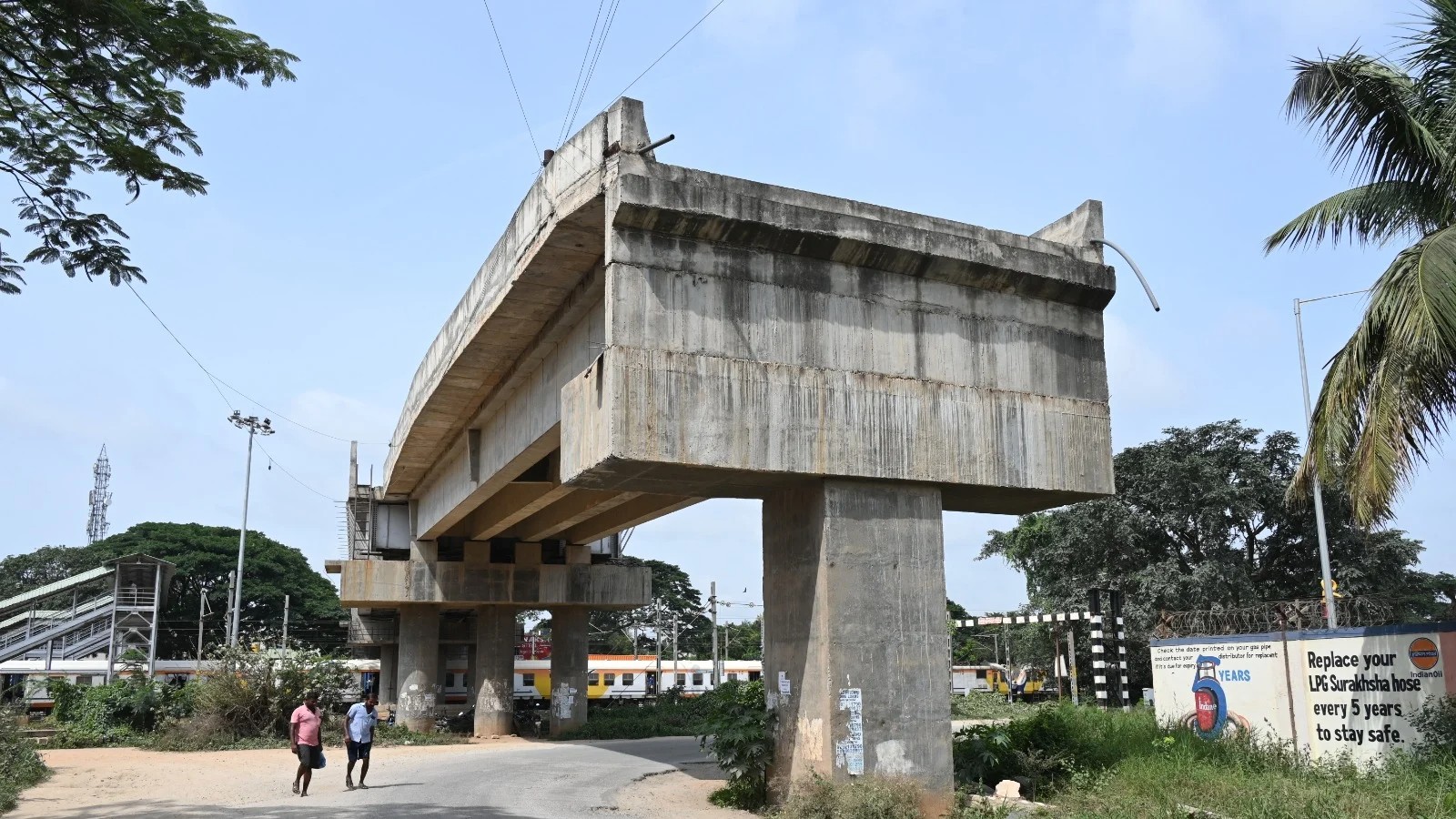
The half-built Road Over Bridge (ROB) at Devanagonthi stands as a stark reminder of the costs of institutional misalignment. Conceived in 2011 as a joint initiative between the railways and the state government to eliminate a high-traffic level crossing near Whitefield, the project remains unfinished more than a decade later, drawing scrutiny from both auditors and citizens.
Originally proposed by South Western Railway (SWR), the ROB was intended to streamline vehicular movement between Kanekal Cross and Hoskote and improve safety at the bustling Devanagonthi-Whitefield rail crossing. The location recorded a staggering 1.6 lakh train-vehicle units per day back in 2009 — a clear indicator of the urgency for a grade separator. Today, the traffic load has more than doubled to 17.71 lakh units, further amplifying the need for immediate intervention. The project, estimated at ₹24.27 crore, was to be funded jointly: ₹10.29 crore from the railways and ₹13.98 crore from the state government. While the railway department completed construction of the main bridge structure by 2018, the Public Works Department (PWD) of the state government failed to acquire land necessary for building the approach roads — rendering the structure functionally useless.
The matter has now been flagged by the Comptroller and Auditor General (CAG) of India in its latest report tabled in Parliament. The audit criticises both parties: the railways for initiating construction without land acquisition assurances, and the state government for delaying its share of responsibilities. According to the report, the railways also failed to recover pending contributions from the state despite sending multiple reminders. Senior officials, while acknowledging the shortfall in inter-agency coordination, maintain that infrastructure projects of this scale require synchronised action across departments — a standard rarely met. The audit has recommended that accountability be fixed for undertaking civil works without ensuring reciprocal commitments, particularly in light of the financial and functional implications of such delays.
Urban planners argue that such missteps have long-term repercussions not only on public mobility but also on sustainability and equity in infrastructure delivery. Without proper planning and joint execution, crucial mobility corridors are reduced to stranded assets — increasing congestion, pollution, and commuter risk. As Bengaluru continues to expand rapidly, especially in its outer zones, the Devanagonthi episode exposes a persistent governance gap in India’s infrastructure execution model. Whether the stalled ROB will be completed anytime soon remains uncertain, but the delay has already cost the city a vital connection and exposed commuters to unnecessary daily risk. The public, meanwhile, awaits a resolution that prioritises efficiency and accountability over administrative inertia.
Also Read : Mumbai Residents of Ghatkopar Police Colony Demand Urgent Redevelopment
