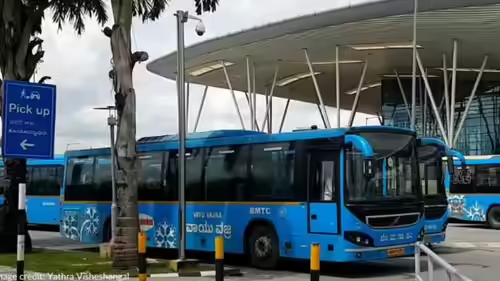
Bengaluru Airport Bus Services Face Operational Cutbacks
Public transport connectivity to Bengaluru’s Kempegowda International Airport is under pressure after a reallocation of space at Terminal 1 reduced bus bays for the city’s Vayu Vajra airport service. Operators and commuters report operational disruptions, longer waiting times, and a rise in reliance on costlier taxis, highlighting the growing tension between private commercial interests and public transport infrastructure in urban mobility planning.
For nearly two decades, the Vayu Vajra fleet—run by the Bangalore Metropolitan Transport Corporation (BMTC)—has been the city’s primary public bus link to the airport, providing affordable, air-conditioned transit over the 35 km corridor. The recent reconfiguration removed an entire row of bus bays, previously allowing seamless boarding and turnaround for buses. Officials said the reclaimed space has been leased to private taxi operators under commercial arrangements, a move that has drawn criticism from both commuters and transport planners.Industry observers note that this shift may disproportionately affect domestic air passengers, who constitute the majority of bus users. Limited bus access forces passengers to either wait longer for fewer vehicles or opt for taxis, whose fares often exceed Rs 1,000 per trip—up to five times the cost of Vayu Vajra. “Public transport optimisation is key for sustainable urban mobility,” said a senior urban planner. “Reducing access to buses not only increases individual travel costs but can also worsen traffic congestion on arterial routes such as Ballari Road, which connects the airport to the city.”
BMTC officials report a daily ridership decline exceeding 1,000 passengers, resulting in estimated revenue losses of Rs 3–4 lakh. The operational constraints also complicate scheduling and fleet management, forcing buses to depart rapidly to avoid terminal congestion. From a policy perspective, such changes highlight the need for integrated transport planning that balances commercial interests with equitable access to public mobility services.Urban development experts emphasise that airport connectivity is a critical element of city infrastructure. Well-planned, reliable public transport links support not only affordability and commuter convenience but also broader sustainability goals, by limiting private vehicle emissions and reducing congestion. Reallocating space without complementary infrastructure adjustments may undermine these objectives and erode public confidence in municipal transport solutions.
Commuters have also expressed frustration over relocated pre-booked taxi points, now nearly a kilometre from arrivals, which adds logistical challenges for families, elderly passengers, and those with luggage. For Bengaluru, these developments underline the urgent need to prioritise multimodal, inclusive, and efficient airport connectivity in line with growing urban and environmental demands.