


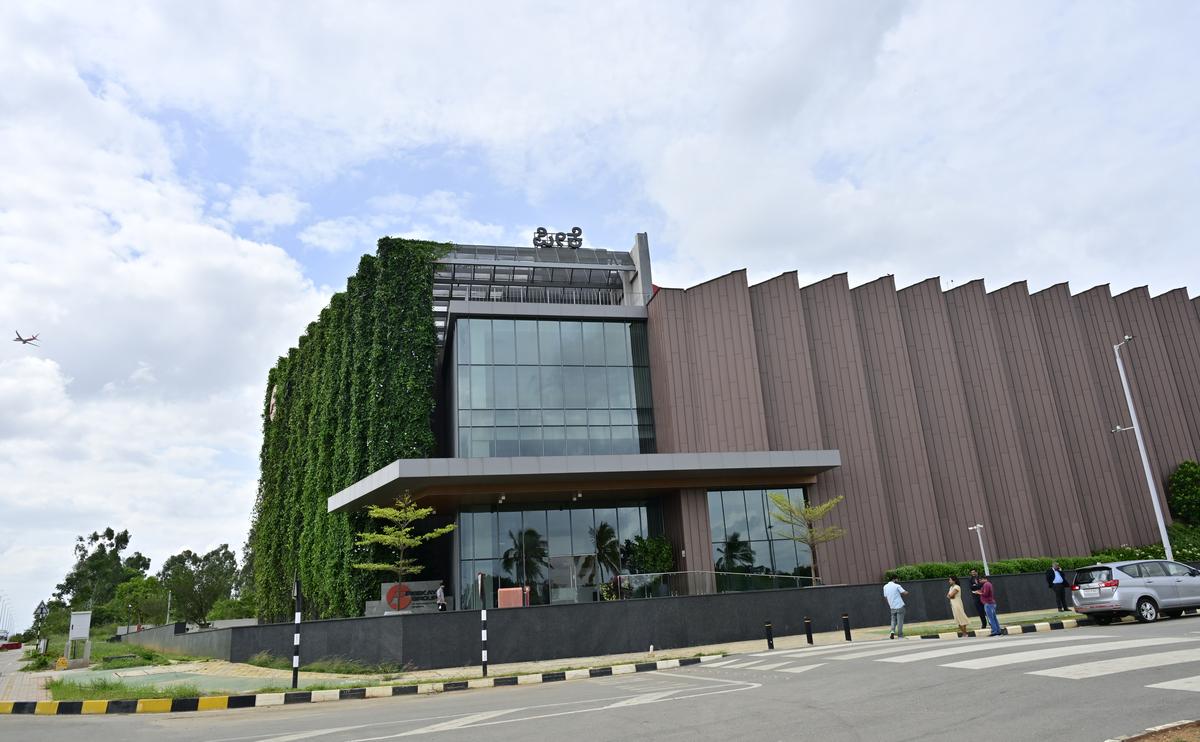
Bengaluru is witnessing the birth of India’s most ambitious aerotropolis, evolving over the next decade around Kempegowda International Airport (KIA) at Devanahalli. The vision transforms the airport into a smart, sustainable, and inclusive urban extension, embodying a “work, live, play, learn, create” ethos, city officials say. Spread across 463 acres within airport precincts roughly 40 kilometres north of Bengaluru, the master plan encompasses an expansive business park (241 acres), a hospitality district (44 acres), and a retail-dining-entertainment (RDE) precinct (23 acres).
The remaining land accommodates logistics, an education-health zone, an aerospace cluster, a corporate retreat, a central park, and advanced mobility nodes. Managed by Bengaluru Airport City Limited (BACL), a KIA subsidiary, the project draws inspiration from airport cities in Seoul, Munich, and Amsterdam, officials confirm. “Visiting international aerotropolises helped calibrate our plan on land-use efficiency, mobility integration, and urban vibrancy,” said a senior BACL executive. Already operational are pilot features such as a 3D-print facility by a German firm and the SATS central kitchen, which produces 170,000 ready-to-eat meals daily since March 2024, signalling commercial readiness.
Strategically, the aerotropolis aligns with global efforts to decentralise employment from city centres by clustering global capability centres, innovation labs, and R&D facilities around air transport nodes. Initial construction includes 2 million square feet of business park space—phase one of a projected 28 million square feet—alongside District I, an innovation hub uniting start‑ups, academia, investors, and corporates. “The clustering effect replicates Silicon Valley‑style ecosystems, correcting the absence of integrated innovation districts in Bengaluru,” noted an industry strategist. A 775-room dual-branded hotel by Vivanta and Ginger is expected to become operational by October 2026, meeting acute hospitality demand, and adding to the existing Taj Bangalore.
Human capital anchoring is evident in planned education and aviation training facilities. By July 2026, an Air India Academy will be launched to train technical staff from local schools for maintenance roles—offering practical pathways to employment. An integrated maintenance repair and overhaul (MRO) park, co‑hosted with Indigo and other MRO services, will support skilled job creation. Cultural vibrancy is woven into the plan via a 10,000-seat concert arena in partnership with Live Nation, scheduled for completion in late 2026. Strategically located adjacent to a future metro station, it aims to draw both domestic and international audiences, further elevating the aerotropolis as a destination.
Urban design prioritises climate-sensitive infrastructure and sustainability. BACL has implemented smart-city solutions—from AI-enabled surveillance, smart lighting, traffic and waste management to public Wi-Fi, digital kiosks, and a dedicated airport-city mobile app. The development has also secured a Platinum rating from the Indian Green Building Council (IGBC) for its green master plan and policies. Collaboration with the Indian Institute for Human Settlements ensures alignment with high-performance building standards. Through IIHS’s ASSURE programme, BACL targets energy-efficient real estate in accordance with national climate commitments. “This airport city transcends the limitations of standalone terminals,” remarked an urban planner. “It functions as a living laboratory, where research, sustainability metrics, and mixed-use mobility converge.” Officials assert that by 2038, 90% of the development will be complete, with the remainder following shortly thereafter.
Experts believe the initiative may catalyse a new economic axis in North Bengaluru—rivalrous to the traditional IT corridors. “Spatial clustering near the airport unlocks fresh opportunities for MICE industries, logistics, aerospace, F&B, and global trade,” said an aviation logistics specialist. Yet challenges remain. Success depends on seamless integration with urban mobility networks, particularly metro connectivity, metro-phase alignment, and road infrastructure upgrades. Peripheral service ecosystems and local community engagement are also vital.
Still, planning for the aerotropolis reflects broader city ambitions toward equitable and low-carbon urbanism. By concentrating employment, retail, and culture within a transit-oriented node, Bengaluru can reduce vehicle dependence, buffer urban congestion, and offer inclusive public spaces. As satellite communities emerge around Devanahalli, the aerotropolis could trigger ripple effects in housing, education, and regional commerce. Official planners anticipate that, eventually, the zone will house thousands of jobs, residents, and visitors—a true micro-city within an urban infrastructure matrix.
For Bengaluru, the KIA aerotropolis represents a transformative leap—an opportunity to lead India’s new generation of smart, sustainable, and socially inclusive urban narratives.
Also Read : Goa Schools Closed Today After IMD Issues Severe Rainfall Warning for State
