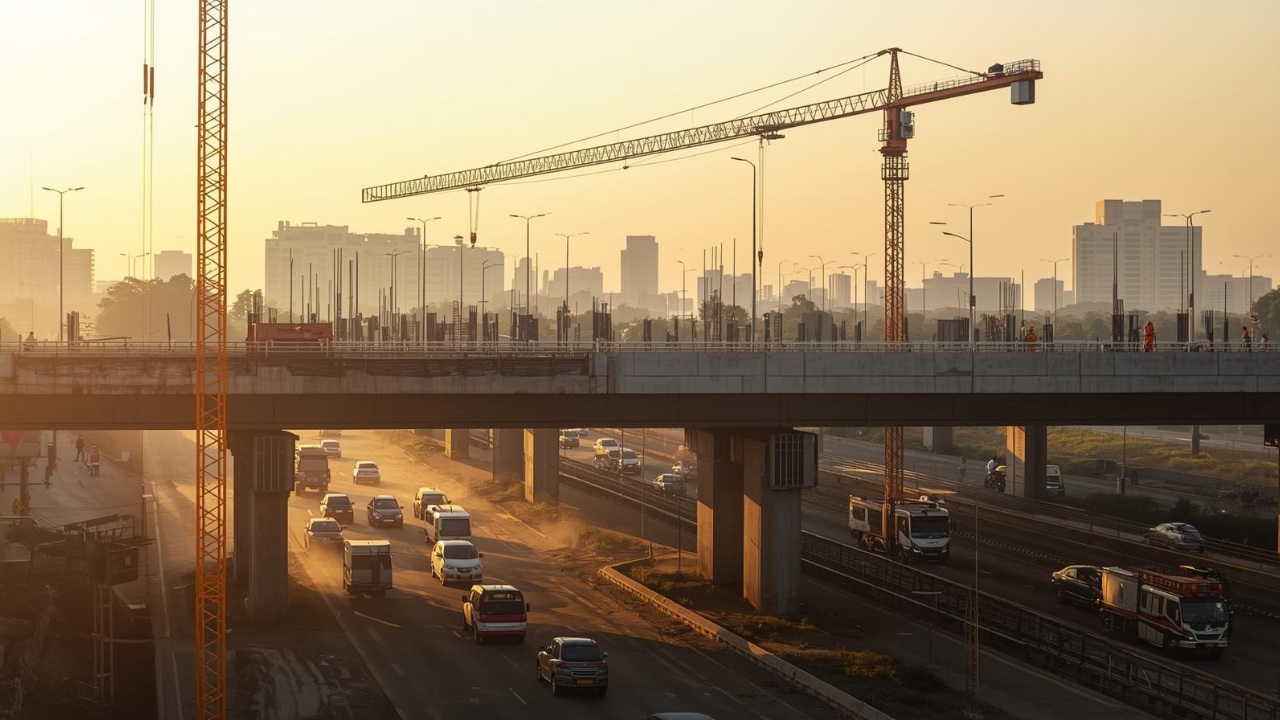
Bengaluru Accelerates Completion Of Ejipura Flyover
Bengaluru authorities have imposed a firm completion timeline for the long-delayed Ejipura flyover, targeting the end of July for full delivery. The move comes as part of renewed efforts to relieve chronic congestion along the Koramangala–Ejipura corridor and strengthen connectivity to key commercial and residential hubs, including the Inner Ring Road and nearby tech clusters.
City planners and infrastructure officials have expressed frustration over the project’s slow pace, highlighting that foundational work, including pillar installation near key medical and educational institutions, only recently resumed after prolonged delays. Authorities are now instructing contractors to undertake simultaneous construction tasks and consider round-the-clock operations to meet the ambitious deadline. The Ejipura flyover, first proposed nearly a decade ago and formally initiated in 2017, has been plagued by intermittent progress, repeated technical setbacks, and complex urban site challenges. Its incomplete state has contributed to widespread traffic bottlenecks, extending congestion into neighbouring areas such as Domlur, Adugodi, and Koramangala. Analysts note that such delays not only increase commuting time but also affect economic activity, fuel consumption, and urban air quality, underlining the importance of timely project execution for a rapidly expanding metropolitan area.
Urban transport experts emphasise that accelerated flyover completion must balance speed with structural quality and safety. Deploying additional machinery and workforce can help, but long-term resilience, including climate-adaptive engineering and sustainable drainage, is critical to prevent future disruptions. The corridor serves high-density neighbourhoods and commercial nodes, so construction planning that minimises local disruption while improving mobility is a priority for equitable urban development. The prolonged construction phase has also sparked public discourse on accountability and civic governance. Social media engagement around the project has highlighted citizen frustration, reflecting broader demands for transparent project management and predictable timelines in Bengaluru’s urban infrastructure sector.
From an urban economics perspective, completing the flyover could unlock smoother traffic flows, reduce vehicle idling, and improve access for last-mile delivery and workforce mobility. For real estate markets along the corridor, improved connectivity may influence property valuations, commercial leasing patterns, and investment confidence. Industry observers suggest that projects like Ejipura, if executed efficiently, could serve as benchmarks for balancing rapid urbanisation with sustainable, people-centric infrastructure planning. As the city moves toward the July target, stakeholders including urban planners, civic authorities, and contractorsb face the challenge of accelerating work without compromising safety or long-term durability. The coming months will indicate whether the city can transform a decade-long infrastructure bottleneck into a model for responsive, resilient urban mobility.