


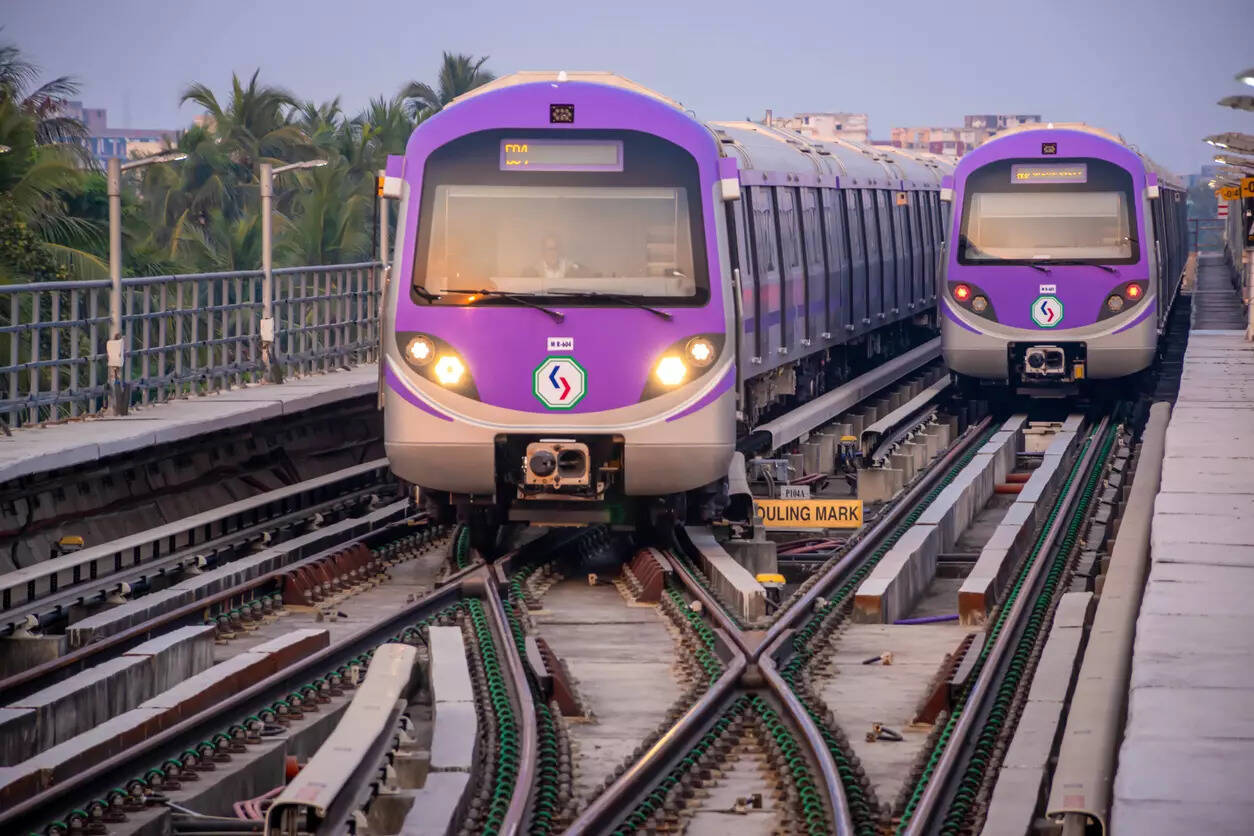
Kolkata’s East West Metro has entered a new era of rapid and sustainable urban mobility, with speed trials confirming that its BEML-manufactured standard gauge rakes can safely touch speeds above 90 kilometres per hour. The high-speed runs, conducted across different stretches of the Green Line, mark a milestone in the city’s long-delayed metro expansion and signal a smoother, faster commute for lakhs of passengers.
Senior officials confirmed that during testing phases in 2020 and 2024, the rakes clocked between 90 and 92 kmph across straight sections of the corridor. The most significant achievement came on the Salt Lake Sector V to Karunamoyee stretch, where the highest recorded speed reached 92 kmph. However, in curved zones, the trains were required to slow down to 55–60 kmph to maintain safety margins. The Green Line has been designed with a speed capacity of 80 kmph. With safety protocols in place, daily operations now run between 65–75 kmph on straight tracks and 40–50 kmph on sharper curves. Railway Design and Standards Organisation experts, along with the Commissioner of Railway Safety, monitored the trials to ensure stability and passenger safety. Officials reported that the rakes remained “extremely stable” throughout testing, reinforcing commuter confidence in the system.
The East West Metro line became fully operational following the inauguration of its last section between Sealdah and Esplanade. This connectivity breakthrough is expected to significantly ease congestion across central Kolkata while offering a low-carbon alternative to road-based transport. However, the project has not been without setbacks. The Bowbazar stretch, where a tunnel boring machine hit an aquifer in 2019, triggered catastrophic cave-ins and caused years of delays. Trial runs through this section were eventually conducted earlier this year after stabilisation works were completed. Officials said that, without the cave-in incidents, the line would have achieved full trials by 2020–21.
At present, 17 passenger rakes are operating on the Green Line. To ensure resilience and emergency preparedness, a battery-powered locomotive has also been inducted into the fleet, designed to clear stranded trains in case of power supply disruptions. Transport experts underline that the successful operation of the East West Metro not only advances Kolkata’s mass transit infrastructure but also contributes to its journey towards becoming a more sustainable, carbon-conscious city. With faster trains and expanded connectivity, the corridor promises reduced dependence on road vehicles, lower emissions, and more equitable urban access.
For a city long shaped by its congested streets and delayed infrastructure rollouts, the 90 kmph trials are more than just numbers—they represent momentum towards modern, eco-friendly, and commuter-centric mobility.
Also Read : MahaMetro Begins DPR Process On 1.3km Kamptee Extension To Strengthen City Transit
