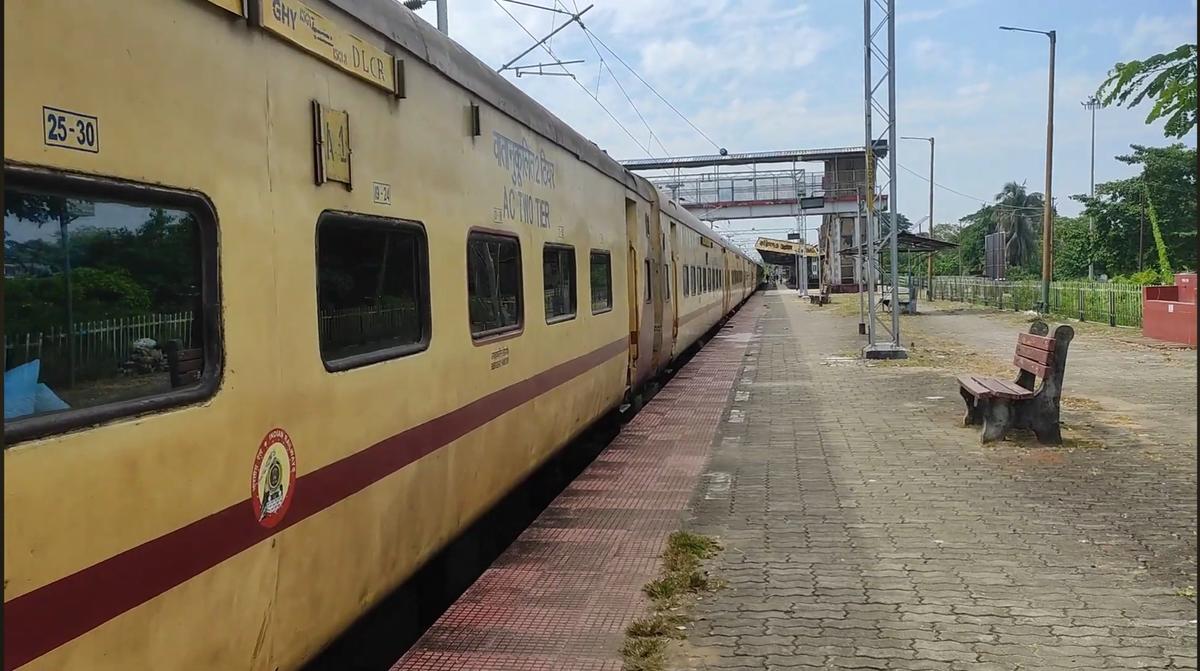
Assam Rail Back Sunday Alternative Highway Planned at Jatinga Lampur
Assam is in emergency mode this week as the state government pushes for full restoration of vital rail and road routes in the Dima Hasao region following extensive landslides triggered by heavy monsoon rainfall. Rail movement along the Lumding–Badarpur hill section and road connectivity on National Highway 27 (NH-27) between Jatinga and Lampur remain severely disrupted.
State Sports and Youth Welfare Minister Nandita Garlosa visited the affected zones on Thursday and assured that rail connectivity may resume as early as Sunday, subject to weather conditions. She also confirmed that an alternative highway alignment has been identified following a technical survey by experts from IIT Guwahati. “The situation remains challenging due to recurring mudslides each night, but restoration work is underway at a war footing,” the minister said, speaking from the Jatinga-Lampur stretch. The area, which falls within a sensitive hill section maintained by the Northeast Frontier Railway (NFR), has seen repeated infrastructure collapses as loose soil and debris continue to threaten progress.
Officials from NFR have deployed round-the-clock teams to stabilise slopes and reconstruct the railbed that was washed out by days of rain. “Our teams are working non-stop despite setbacks caused by new mudslides,” one senior railway official said, adding that multiple support systems and temporary drainage solutions have been put in place to prevent further degradation. The Lumding–Badarpur section is not just a passenger route but a strategic rail corridor linking southern Assam with the Barak Valley and major logistical nodes. Its disruption has not only affected local commuters but also delayed essential freight movement, forcing rerouting through alternative, longer networks. Authorities are prioritising this route’s reopening to ensure minimal long-term impact on both local livelihoods and inter-state supply chains.
Meanwhile, on the highway front, the landslide-hit NH-27 segment connecting Haflong to Silchar is also receiving urgent attention. The stretch near Jatinga and Lampur has suffered major road collapses and slope failures, cutting off vehicular traffic and posing severe mobility challenges for residents and emergency services. Minister Garlosa revealed that a team of IIT Guwahati experts has already completed a technical site assessment and submitted their proposal for a new road alignment. “We have accepted their recommendations and will construct an alternative highway route accordingly,” she stated. The realignment is expected to bypass the most unstable terrain and offer long-term resilience against future weather-induced disruptions.
The state government’s coordinated effort to engage premier institutions like IIT Guwahati reflects a shift towards science-backed infrastructure design in a region historically vulnerable to monsoon damage. By factoring in topographical and geotechnical data, the proposed road could offer both safety and efficiency, reducing the frequency and cost of future repairs. The urgency of the response also signals a stronger commitment to regional equity. Dima Hasao, one of Assam’s more isolated and hilly districts, often faces slower response times in disaster scenarios. By prioritising both road and rail reconnections simultaneously, the state aims to ensure timely access to healthcare, education, and commerce for residents who are otherwise cut off during seasonal disruptions.
Beyond the immediate repair and reconstruction, planners are now pushing for long-term structural interventions. These include pre-emptive slope stabilisation, use of reinforced earth technology, and modern drainage systems that can withstand the intensity of current and projected rainfall patterns in the Eastern Himalayan zone. The government has also signalled openness to incorporating sustainable engineering solutions such as bio-engineered slopes and permeable road materials where viable, in order to balance ecology with infrastructure resilience.
Minister Garlosa’s visit, along with on-ground presence of railway and NHAI officials, underlines the collaborative nature of this restoration effort. Departments that typically operate in silos — such as road transport, railways, disaster management and public works — are now reportedly working with a unified command structure in the affected region. While public patience wears thin due to mobility constraints, the rapid official response has helped ease tensions. Locals in Haflong and surrounding hamlets have been reassured that the government is aware of their isolation and working to restore normalcy at the earliest.
Still, the weather remains a wildcard. With monsoon forecasts predicting continued showers in the region, there is cautious optimism rather than certainty around the Sunday rail resumption target. Experts say this episode should serve as a wake-up call to rethink infrastructure development in ecologically fragile areas. “Linear infrastructure like roads and rail in the Northeast must be designed with climate disruption in mind — and that means moving from reactive to anticipatory planning,” said a professor from IIT Guwahati who participated in the route survey.
For now, Assam is racing the rain. Whether it beats the weather clock or not, its effort to balance speed, safety and science in Dima Hasao’s recovery may well become a model for post-disaster infrastructure response in other vulnerable states.