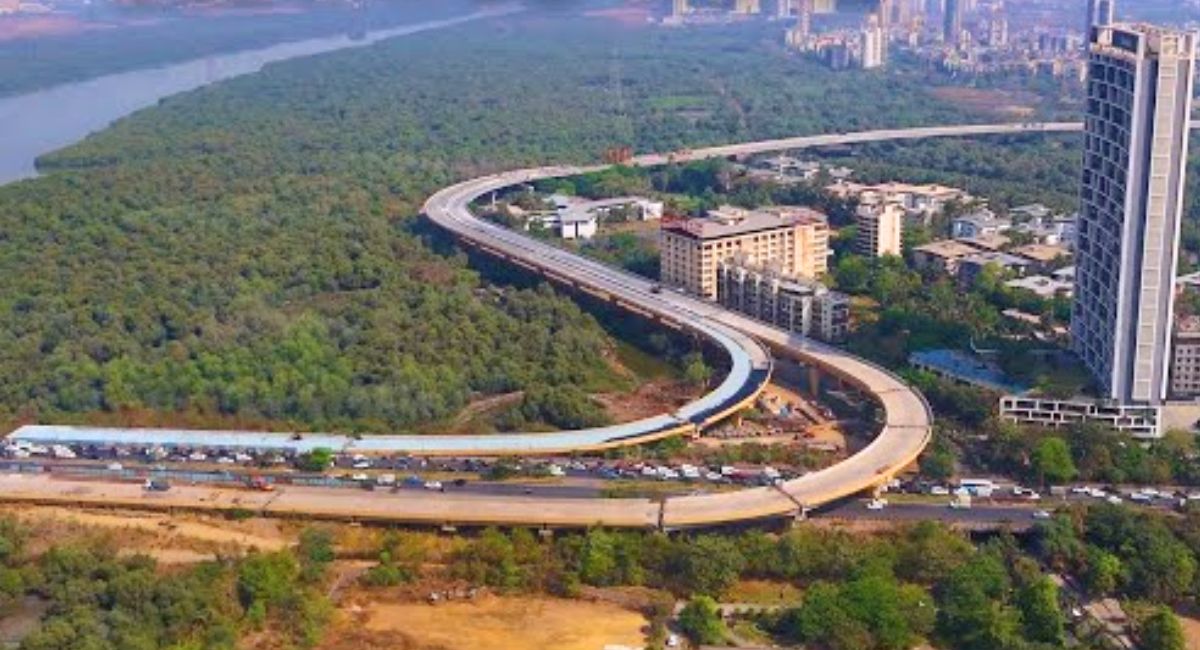
A critical road link connecting Navi Mumbai with Thane and the Kalyan–Dombivli belt is approaching completion, as the Airoli–Katai Elevated Road records significant construction progress. Developed by the Mumbai Metropolitan Region Development Authority, the corridor is emerging as a key intervention to ease chronic congestion across one of the fastest-growing urban stretches of the Mumbai Metropolitan Region.
With a substantial portion of the structure already in place, the elevated road is expected to alter daily travel patterns for thousands of commuters who currently depend on overburdened arterial routes. The corridor offers a direct, signal-free alternative between Airoli and the Kalyan–Dombivli region, reducing reliance on internal roads that often experience peak-hour gridlock. Officials overseeing the project indicate that core civil works along most sections are nearing completion, with the elevated structure now visibly shaping the corridor skyline. Construction efforts have shifted towards finishing activities, including approach ramps, safety installations, drainage networks, and traffic management systems. These elements are critical to ensuring operational safety and long-term durability once the corridor opens to traffic.
Urban mobility experts note that the Airoli Katai Elevated Road addresses a long-standing east–west connectivity gap in the metropolitan region. While rail-based projects continue to expand capacity, road infrastructure remains essential for freight movement, last-mile connectivity, and emergency services. By separating through-traffic from local roads, the elevated corridor is expected to streamline movement while improving travel reliability. The corridor also carries broader economic significance. Improved road connectivity between Navi Mumbai’s industrial zones, Thane’s commercial clusters, and the residential growth centres of Kalyan–Dombivli could reduce logistics costs and improve workforce mobility. Real estate analysts observe that infrastructure certainty often precedes more balanced development, encouraging employment closer to emerging residential hubs.
From an environmental standpoint, planners highlight that smoother traffic flow and reduced idling can lower fuel consumption and emissions, particularly along corridors that currently experience stop-and-go traffic. While elevated roads are not a substitute for mass transit, they can complement public transport by reducing surface congestion and improving bus movement. Project managers say early delays caused by land acquisition and utility relocation have largely been resolved, allowing construction to proceed at a steady pace. Advanced construction methods and phased execution have helped limit disruption to surrounding neighbourhoods, a recurring challenge in dense urban settings.
As the final stages move forward, transport planners are watching closely how the corridor integrates with surrounding road networks. The effectiveness of the Airoli Katai Elevated Road will depend not only on its completion but also on traffic dispersal, signage, and coordination with feeder routes. Once operational, the corridor is expected to offer tangible time savings and ease pressure on parallel highways. For a metropolitan region grappling with rapid population growth, the project underscores the role of targeted infrastructure in supporting mobility, economic activity, and more resilient urban systems.