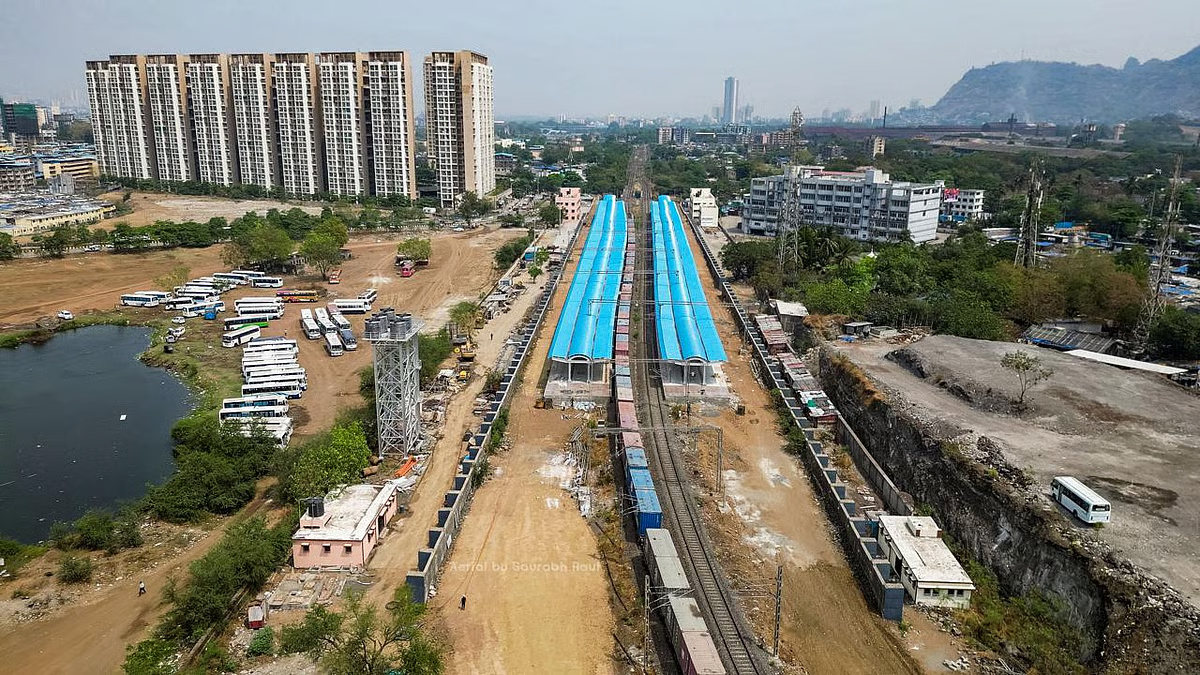
The long-planned Airoli–Kalwa elevated rail corridor in Thane has encountered fresh delays as political and civic concerns over rehabilitation of affected residents resurface. The Thane unit of the NCP–Sharadchandra Pawar (NCP-SP) has warned that surveys required for the project may be halted unless the government provides a written commitment regarding the resettlement of families impacted by the construction.
The corridor, forming a critical part of the Mumbai Urban Transport Project (MUTP), is designed to streamline commuter movement from Kalyan to Navi Mumbai by bypassing the congested Thane station. Spanning roughly three kilometres, the elevated track begins at Kalwa station, crosses multiple existing rail lines near Parsik, and connects to the Trans-Harbour line close to Digha station. However, its path runs through densely populated slum clusters, affecting over 750 households. The rehabilitation issue, dormant since 2017, reignited following a municipal letter indicating that resettlement would begin post-survey but without specifying locations or detailed plans. Party representatives have criticised the communication as vague, underscoring the need for formal agreements with project-affected residents before any work proceeds. “We will not permit surveys or construction without a clear, written relocation plan,” an NCP-SP leader said. The affected residents primarily comprise daily-wage earners and domestic workers, for whom relocation far from their current neighbourhoods could disrupt livelihoods.
Local urban development experts note that resettlement clarity is essential not only for community welfare but also for maintaining project timelines. Ensuring that rehabilitation occurs on government-owned land near current settlements could mitigate social disruption while maintaining commuter benefits once the corridor becomes operational. The corridor’s completion is expected to relieve pressure on existing routes, enhance transit efficiency, and reduce travel times across the Trans-Harbour corridor. With political pressure mounting, city planners emphasise the importance of balancing urban infrastructure expansion with equitable housing policies. Providing affected families with secure, proximate relocation options can ensure inclusivity, prevent forced displacement, and align with sustainable urban development practices. The government is now tasked with presenting a transparent and implementable rehabilitation roadmap to enable surveys and subsequent construction.
The future of the Airoli–Kalwa corridor hinges on resolving these social and political challenges promptly. While the infrastructure promises significant commuter convenience, its success depends on a careful, human-centred approach to resettlement and community engagement.
Airoli-Kalwa Rail Corridor Survey Faces Halt Over Unresolved Rehabilitation Of Residents