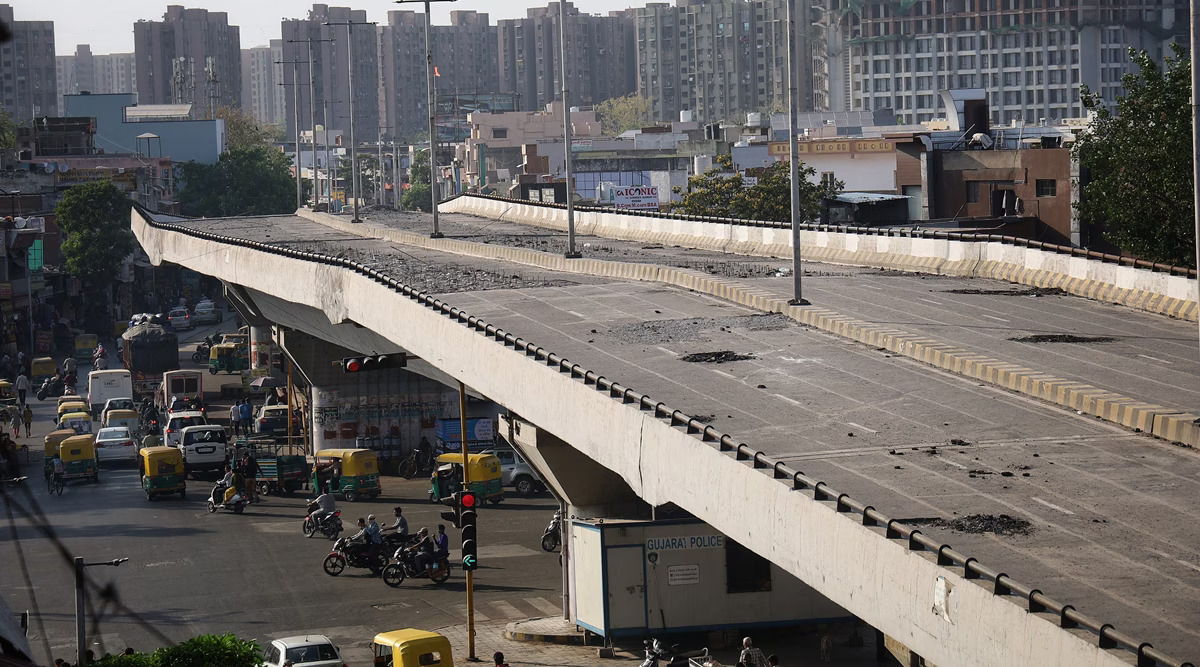
Ahmedabad’s ambitious 2.5-km Naroda Patiya flyover project has ground to a halt, a consequence of unresolved land and environmental clearance issues. This critical piece of infrastructure, designed to ease traffic congestion in eastern Ahmedabad, is now mired in bureaucratic red tape. The forest department has rightfully refused to permit further construction until the Ahmedabad Municipal Corporation (AMC) provides compensation for 1.3 hectares of forest land and secures a re-plantation site for 143 trees slated for felling. This significant delay, which stems from a lack of foresight and inter-agency coordination, not only threatens the project’s timeline but also inconveniences thousands of daily commuters and raises serious questions about the city’s commitment to sustainable urban development.
The Naroda Patiya flyover, a consolidated project replacing three smaller flyovers, was approved in 2021 with an estimated budget of nearly ₹198 crore and a 36-month deadline set for July 2026. Despite a promising start in July 2023, progress has been slow, with only a third of the work completed as of March 2025. The current deadlock over forest land is a critical blow, casting a long shadow over the project’s timely completion. This incident is a classic example of a recurring flaw in the city’s infrastructure development model, where projects are launched with great fanfare but without securing all necessary clearances beforehand. Such oversight not only leads to significant delays and budget overruns but also undermines public trust in civic governance.
This is far from an isolated incident. The history of infrastructure projects in Ahmedabad is littered with similar stories of delays caused by poor planning, flawed designs, and coordination failures between the AMC and the Ahmedabad Urban Development Authority (AUDA). Projects like the Income Tax flyover, Ranip GST flyover, and the Ajit Mill Junction flyover have all faced substantial setbacks due to a mix of post-approval design changes, land acquisition hurdles, and utility clearance issues. The Panjrapol flyover, for instance, has been plagued by a late start and ongoing delays due to changes in direction and design. This recurring pattern suggests a systemic issue that needs to be addressed at a fundamental level.
The Naroda Patiya flyover’s environmental clearance issues are particularly poignant in the context of creating eco-friendly and sustainable cities. The requirement for re-plantation and compensation for forest land is a non-negotiable aspect of responsible development. The civic body’s failure to account for this from the outset not only stalls the project but also demonstrates a disregard for ecological balance. A truly sustainable city must be built on a foundation of respect for the environment, where infrastructure development is harmonised with green initiatives rather than being at odds with them. For the project to move forward, the AMC must now not only resolve the bureaucratic standoff but also re-evaluate its planning processes to ensure that all future projects are thoroughly vetted for land, environmental, and design clearances before a single shovel hits the ground. This will be critical for building a more efficient, equitable, and sustainable urban future for Ahmedabad.