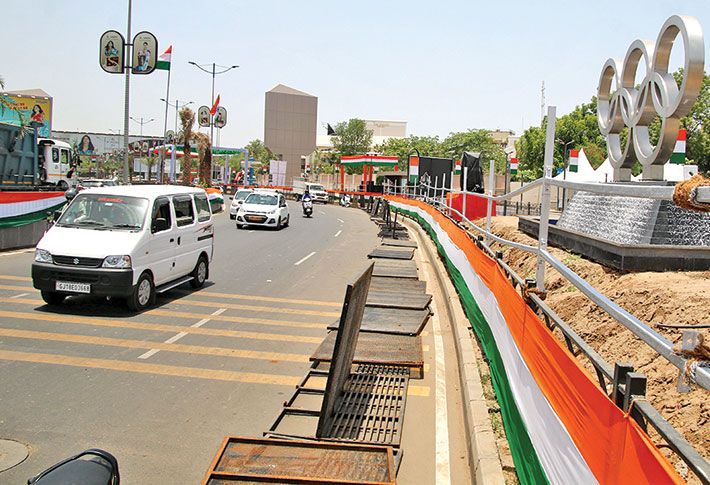
Ahmedabad’s civic authorities have cleared a proposal to widen internal roads in Vastrapur village after several housing societies agreed to voluntarily surrender strips of land, enabling stalled redevelopment projects to move forward. The decision is expected to ease congestion in the neighbourhood while unlocking taller residential buildings under existing building regulations, reshaping both mobility and real estate prospects in the area. The move centres on Vastrapur road widening, which has become critical for redevelopment in older parts of the city. Current development control regulations link permissible building height to the width of adjoining roads. In Vastrapur, many internal roads measure between 7 and 9 metres a legacy of earlier planning norms. That constraint has limited the vertical expansion of ageing three- and four-storey apartment blocks, making redevelopment financially unviable for residents and developers.
By authorising the municipal commissioner to expand key stretches to 12 metres, the city has effectively created the conditions for higher floor space potential. Senior civic officials indicate that participating societies will part with marginal land areas without compensation, reducing the fiscal burden on the corporation. In return, redevelopment proposals can be processed more swiftly once the revised road lines are implemented. Urban planners say this model represents a shift from the conventional acquisition-led approach to road expansion. Typically, road widening is embedded within long-term development plans or town planning schemes, and land acquisition often requires compensation. That process can stretch over years, especially when private plots are involved. In this case, societies have opted for a cooperative route to accelerate change.
The locality falls within an older town planning framework prepared when traffic volumes and vehicle ownership were significantly lower. Over time, increased density and mixed land use have intensified pressure on narrow carriageways, affecting emergency access, pedestrian safety and public transport movement. Experts argue that synchronising Vastrapur road widening with redevelopment could deliver dual benefits: improved mobility and more structurally resilient housing stock. For residents, the stakes extend beyond taller buildings. Redevelopment offers the opportunity to incorporate modern fire safety standards, improved energy efficiency and better access design elements critical to building climate-resilient neighbourhoods. Wider roads can also create scope for footpaths, drainage upgrades and utility corridors, though implementation quality will determine long-term impact.
Real estate analysts note that clarity on road width often acts as a trigger for capital deployment in redevelopment clusters. By resolving a regulatory bottleneck through negotiated land surrender, Ahmedabad has signalled a pragmatic approach to upgrading built-up areas without large public expenditure. As the Vastrapur road widening proceeds, attention will turn to execution timelines and whether similar land pooling mechanisms can be replicated in other congested pockets of the city. If delivered carefully, the initiative could become a template for aligning infrastructure reform with responsible urban renewal.