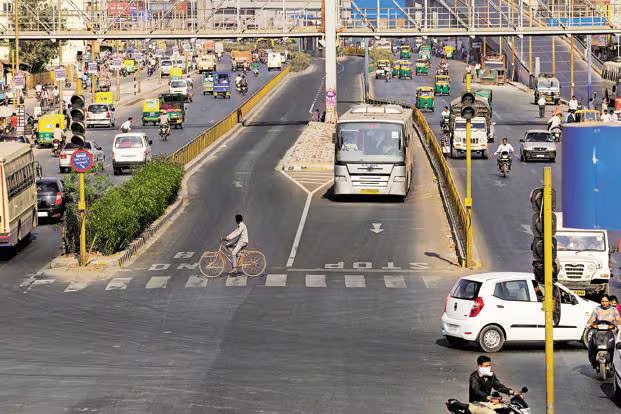
Ahmedabad is rolling out a tightly coordinated traffic and security framework as the city prepares to host multiple high-profile fixtures of the ICC Men’s T20 World Cup 2026 at the Narendra Modi Stadium in Motera. The measures, which include time-bound road closures and large-scale personnel deployment, underline the growing pressure on Indian cities to balance global events with everyday urban mobility. The matches, scheduled across February, are expected to draw tens of thousands of spectators alongside international delegations and VVIP movements. For a city already grappling with peak-hour congestion, the scale of the event presents a live test of Ahmedabad’s transport resilience, last-mile connectivity, and crowd management capacity.
According to officials overseeing urban traffic operations, vehicle movement will be curtailed along a critical corridor connecting Janpath T-junction, the stadium’s primary access gate, and the Motera Village junction. These restrictions will be enforced during extended windows on match days, varying from afternoon-to-late-night closures to full daytime controls, depending on fixture timing. Commuters are being diverted through alternative arterial routes linking Tapovan Circle, Visat, and Bhat-Koteshwar Road, with traffic marshals stationed at key intersections to manage flow. The operational scale is significant. More than 700 personnel have been assigned across four traffic sectors surrounding the stadium precinct, reflecting a layered approach that combines crowd safety, theft prevention, and movement efficiency. Senior officers will oversee on-ground coordination, supported by inspectors, sub-inspectors, and civil defence volunteers.
Urban planners note that such arrangements highlight a recurring challenge for Indian metros: major sporting venues are often embedded within dense residential and mixed-use zones, placing strain on local road networks during large events. While temporary restrictions are necessary for safety, experts argue that long-term solutions lie in improved public transport integration, pedestrian prioritisation, and event-specific mobility planning that reduces dependence on private vehicles. From an economic perspective, global tournaments deliver a short-term boost to hospitality, transport services, and informal commerce. However, unmanaged congestion can dilute these gains by disrupting daily work travel and increasing fuel emissions. As cities compete to host international events, the ability to manage traffic with minimal environmental and social cost is increasingly seen as a benchmark of urban governance.
Residents and businesses in northern Ahmedabad have been advised to plan travel in advance and adjust logistics where possible. Officials maintain that the measures are designed to be temporary, targeted, and responsive to real-time conditions. As Ahmedabad positions itself as a global sporting destination, the coming weeks will offer lessons on how Indian cities can host mega-events while safeguarding liveability, economic continuity, and sustainable urban movement.