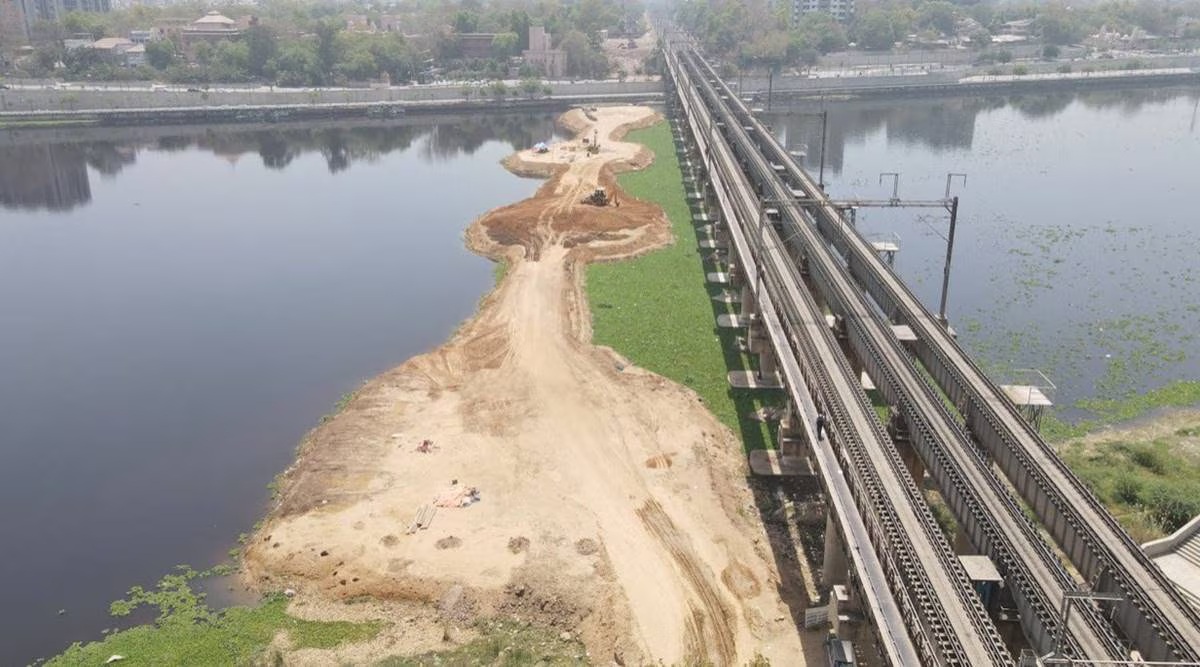
A 100-metre steel bridge built for the Mumbai–Ahmedabad high-speed rail corridor has been completed in Ahmedabad district, marking a crucial engineering milestone for India’s first bullet train line. The structure, positioned above an operational underground metro tunnel, represents a rare example of synchronising new inter-city infrastructure with dense urban transport systems without disrupting existing services or transferring structural load.
The Ahmedabad bullet train steel bridge forms part of a series of steel spans planned across Gujarat to navigate constrained urban and railway zones where conventional concrete viaducts are not feasible. Project engineers redesigned this stretch from a standard span-by-span viaduct to a steel truss configuration after geological and safety assessments indicated the need to avoid pressure on the metro tunnel connecting two of the city’s busiest transit nodes. Urban planners note that such adaptations are increasingly necessary in Indian metros where layered transport networks demand precision construction rather than land-intensive expansion.
Weighing over a thousand metric tonnes, the bridge was fabricated in central India and transported in segments before being assembled on temporary supports roughly 16 metres above ground level. After completion, the temporary framework was removed and the structure was carefully lowered onto permanent bearings. Industry experts say this installation approach reduces vibration risks to underground utilities and minimises disruption to commuter traffic, a growing concern in rapidly densifying cities. Beyond engineering complexity, the project also reflects the domestic industrial ecosystem’s expanding capacity to deliver large-scale infrastructure components. The bridge utilised tens of thousands of high-strength bolts and corrosion-resistant coatings designed for long service life in varied climatic conditions. Such technical detailing, according to infrastructure consultants, is essential for lowering maintenance cycles and lifecycle emissions in public transport assets, aligning with long-term sustainability objectives.
For Ahmedabad, the development signals a shift toward multimodal integration rather than isolated transport planning. High-speed rail corridors, when designed alongside metro systems, regional rail and last-mile connectivity, can influence land values, commercial activity and housing growth patterns around transit nodes. However, urban economists caution that equitable access, affordability and climate-resilient design must remain central as large mobility investments reshape city edges and peri-urban districts. As construction progresses across western India, the emphasis is increasingly on building infrastructure that coexists with existing civic systems rather than replacing them. The Ahmedabad bullet train steel bridge illustrates how future transport projects may need to prioritise structural ingenuity, environmental durability and people-centric planning to ensure that speed and scale do not come at the cost of urban liveability or public safety.