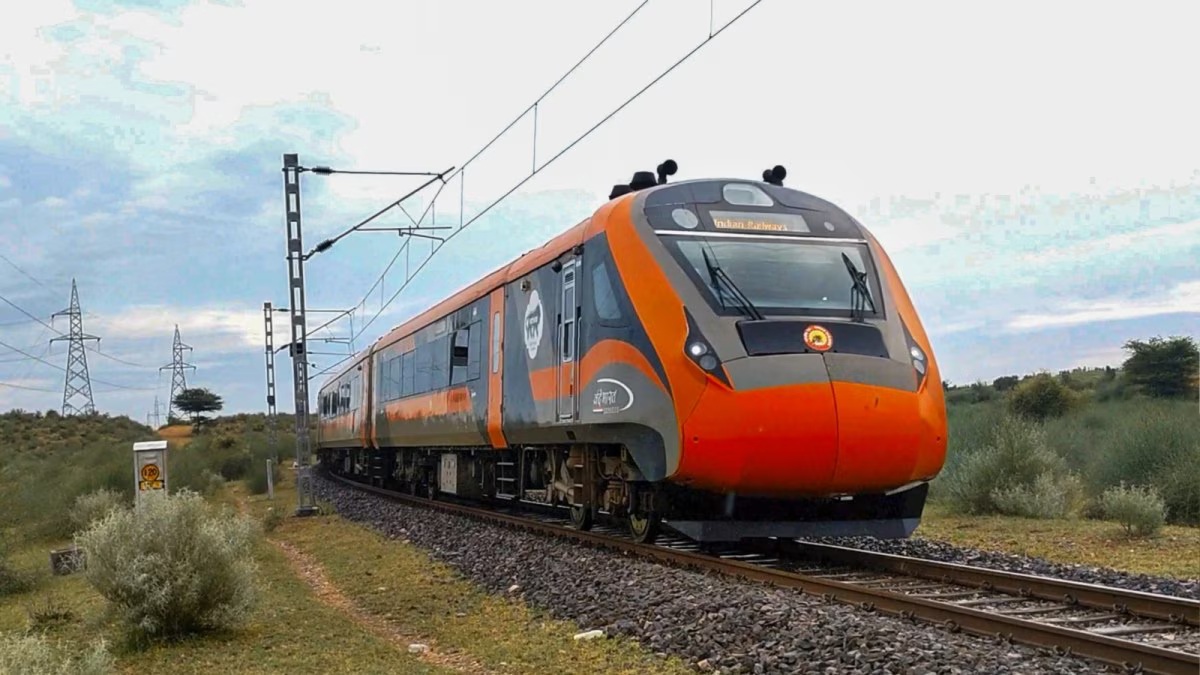
Indian Railways has cleared a new Ahmedabad–Udaipur Vande Bharat corridor while withdrawing two existing services on the western network, signalling a recalibration of premium rail capacity in Gujarat and southern Rajasthan. The move is expected to strengthen intercity business connectivity and tourism flows between the two fast-growing urban centres.Railway officials confirmed that the new Vande Bharat service will enhance travel efficiency along the Ahmedabad–Udaipur axis, a corridor that links Gujarat’s financial and industrial capital with a major tourism and education hub in Rajasthan. The introduction comes alongside the rationalisation of two underperforming premium routes, part of an operational review aimed at improving asset utilisation and passenger load factors.
For Ahmedabad, the High Speed Rail expansion reflects broader mobility trends. The city has witnessed rapid urban growth, expanding industrial estates, and increasing weekend tourism movement toward Rajasthan. Improved rail frequency is expected to reduce dependence on private vehicles along the highway corridor, easing congestion and lowering transport emissions a critical goal as western Indian cities pursue cleaner mobility transitions. Urban planners note that enhanced intercity rail links often have spillover effects on real estate markets. “Premium rail services influence housing preferences, second-home investments, and hospitality demand along the route,” said a senior transport economist tracking infrastructure-led development patterns. Udaipur’s hospitality sector and Ahmedabad’s business travel segment could see incremental gains as travel time reliability improves.
The restructuring also underscores a wider shift within Indian Railways toward demand-based deployment of semi-high-speed trains. Rather than simply expanding the Vande Bharat network numerically, the focus appears to be on route optimisation, occupancy efficiency, and financial sustainability. Industry observers suggest that rationalising underutilised corridors is necessary to ensure long-term viability of high-speed rolling stock investments. From an environmental standpoint, electrified semi-high-speed rail presents a lower-carbon alternative to short-haul aviation and road transport. As India advances toward net-zero targets, strengthening such corridors can contribute to greener regional mobility ecosystems. However, experts caution that last-mile connectivity at both Ahmedabad and Udaipur stations will determine whether the service achieves its full potential.
The Ahmedabad High Speed Rail expansion also aligns with broader economic integration goals across western India. Enhanced mobility between commercial and cultural centres supports labour movement, small business activity, and tourism-driven livelihoods. With infrastructure upgrades continuing across the western railway zone, attention now turns to scheduling efficiency, fare accessibility, and seamless multimodal integration. For passengers, the success of the new service will ultimately hinge on reliability, affordability, and connectivity beyond the station precincts.