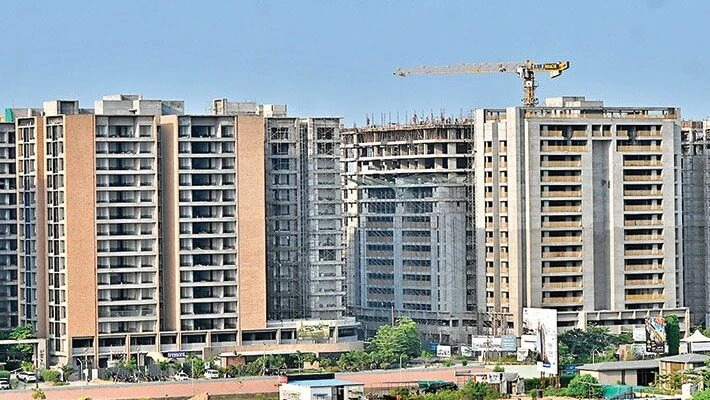
Ahmedabad Public Housing Enters Redevelopment Phase
Ahmedabad is entering a decisive phase of public housing renewal as the Gujarat Housing Board advances four large redevelopment projects across the city, signalling a broader shift in how ageing residential stock is being upgraded through public–private collaboration. The projects span Gota and Naranpura, areas facing rising population density and infrastructure stress, and reflect growing policy emphasis on rebuilding rather than expanding urban footprints. Under a Public-Private Partnership framework, the Gujarat Housing Board has moved proposals for three integrated housing redevelopments while commencing construction on a fourth. Together, the schemes aim to replace structurally ageing buildings with higher-density, service-ready housing aligned with current safety, planning, and infrastructure standards.
The most extensive intervention is planned in Gota, where an integrated redevelopment covering an older municipal colony and adjacent clearance housing is being structured as a mixed-income project. More than 3,800 existing residential units across economically weaker and low-income categories are slated for reconstruction, along with rehabilitation of long-standing neighbourhood commercial spaces. With an estimated investment exceeding ₹500 crore, the project underscores how scale is increasingly being leveraged to make public housing financially viable without expanding city limits. Urban planners note that Ahmedabad housing redevelopment of this nature helps arrest horizontal sprawl while improving service delivery. “Rebuilding in situ allows cities to upgrade water, energy, and transport systems without displacing communities to peripheral locations,” said an urban development expert familiar with the programme.
In Naranpura, three separate housing societies are being redeveloped through standalone packages, each involving full demolition and reconstruction. These projects primarily cater to higher-income group housing built decades ago, where structural fatigue and outdated layouts have become a growing concern. The redesigned developments promise safer buildings, more efficient land use, and upgraded common infrastructure, including parking and energy systems, according to officials involved in planning. All four projects follow an integrated redevelopment model that combines a public housing obligation with a market-linked free sale component. Private developers will rebuild homes for eligible residents at no direct cost, while recovering investments through saleable units created using surplus land and permissible floor space index. Industry analysts say this approach is increasingly central to financing large-scale urban renewal without burdening state budgets.
The projects are being rolled out with timelines ranging from just over two to three-and-a-half years, inclusive of statutory approvals. While execution risks remain particularly around temporary relocation and construction management officials argue that redevelopment is now unavoidable as cities confront climate resilience, safety, and liveability challenges. As Ahmedabad housing redevelopment accelerates, attention will turn to how effectively these projects integrate energy efficiency, water management, and public mobility into rebuilt neighbourhoods. The outcome could shape a replicable model for renewing India’s post-independence housing stock in dense urban cores.