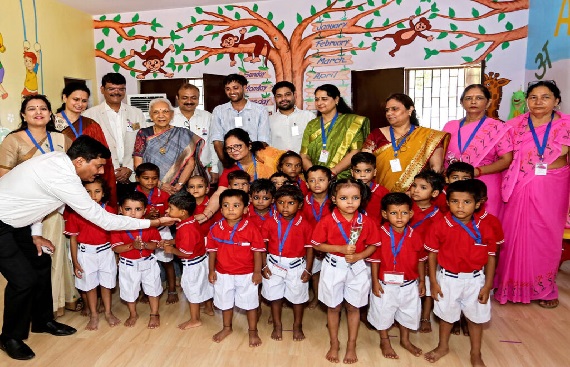
The Ahmedabad civic administration has initiated a large-scale infrastructure upgrade of anganwadi centres across the city, signalling a renewed focus on early childhood development as part of its broader urban governance agenda. The move, which involves the modernisation of more than half of the anganwadis under municipal ownership, reflects how social infrastructure is increasingly being treated as a critical layer of urban development rather than a peripheral welfare function.
According to officials familiar with the programme, the Ahmedabad Municipal Corporation (AMC) is in the process of upgrading 386 of its 618 anganwadi centres. These facilities form part of a wider ecosystem of over 2,100 anganwadis operating across the city’s urban sectors, including centres housed within municipal buildings, rented premises, school campuses, and community spaces. The upgrades are being undertaken through a mix of state-supported grants, zonal infrastructure budgets, and Corporate Social Responsibility (CSR) funding partnerships. Urban planners note that anganwadis play a foundational role in dense cities like Ahmedabad, where women’s workforce participation, child nutrition, and early learning outcomes are deeply interlinked with access to reliable neighbourhood-level services. Improving physical infrastructure lighting, ventilation, sanitation, safety, and learning spaces has a direct impact on attendance, health outcomes, and caregiver engagement, particularly in lower-income wards.
The AMC’s approach goes beyond routine repairs. Design interventions include child-centric spatial planning and visual learning tools integrated into the building fabric. Walls are being repurposed as educational surfaces using age-appropriate graphics, alphabets, numbers, and environmental imagery. This “learning-through-space” model aligns with global best practices in early childhood education, where the built environment is treated as an active teaching aid rather than a passive container. From an urban economics perspective, experts say the anganwadi upgrade programme reflects a shift towards more balanced civic spending where investments in roads, drainage, and transport are complemented by attention to social and human capital infrastructure. In climate-vulnerable cities, resilient public buildings that serve children and caregivers also double up as community anchors during heatwaves, flooding, or public health disruptions.
Municipal engineers involved in the project say the use of zonal budgets allows localised planning, ensuring that upgrades respond to ward-level needs rather than applying a one-size-fits-all template. CSR participation, meanwhile, is helping accelerate implementation without placing additional pressure on municipal finances, though officials stress that long-term operations and maintenance remain the corporation’s responsibility. As Ahmedabad continues to expand outward and densify inward, the success of this anganwadi modernisation drive may serve as a blueprint for how Indian cities can embed inclusivity and resilience into everyday urban services. The next phase, planners suggest, will need to focus on monitoring outcomes attendance, learning indicators, and health metrics to ensure that physical upgrades translate into measurable improvements for children and families.