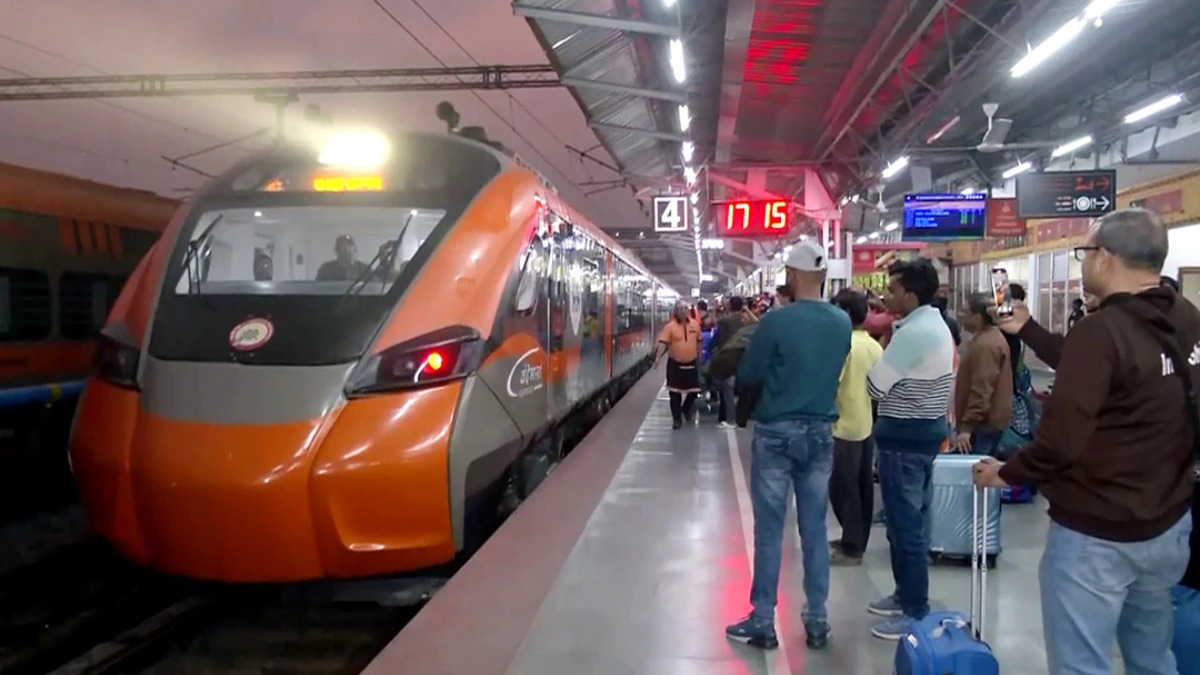
A key intercity rail link connecting Gujarat’s commercial capital with India’s financial hub has quietly expanded its carrying capacity, signalling how transport planners are responding to sustained urban mobility pressure across western India. The Ahmedabad–Mumbai Vande Bharat Express is now operating with a longer rake, increasing seating availability on one of the country’s busiest short-haul business corridors.The upgraded train configuration came into effect in late January, adding four additional air-conditioned chair car coaches to the existing service. The capacity expansion reflects consistently high occupancy levels on the route, which serves daily commuters, business travellers, and intercity professionals moving between two of India’s fastest-growing metropolitan regions.
Urban transport experts say the change highlights a shift in how Indian Railways is managing demand on premium corridors not by introducing parallel services, but by optimising existing assets. Extending rake length allows higher passenger throughput without increasing track congestion, energy consumption per trip, or station dwell times, aligning with efficiency-driven mobility planning. The Ahmedabad–Mumbai corridor spans nearly 500 kilometres and is among the most economically productive rail routes in the country. It links manufacturing clusters, financial services hubs, logistics centres, and port-linked industrial zones across Gujarat and Maharashtra. Faster, higher-capacity rail connectivity plays a direct role in supporting labour mobility, reducing road traffic pressure, and lowering per-capita transport emissions compared to short-distance aviation and private vehicles. According to railway operations officials, the additional coaches increase seating capacity by nearly 300 passengers per trip.
This has immediate implications for fare stability and seat availability during peak travel periods, particularly weekdays when demand is driven by business travel and institutional movement between the two cities. From an urban development perspective, the expansion also reinforces the role of high-frequency, medium-distance rail in shaping polycentric growth. Reliable intercity travel enables professionals to live further from traditional employment cores, easing housing pressure in dense city centres while supporting transit-oriented development around secondary stations. The service operates six days a week and halts at key urban nodes along the western rail spine, offering rapid connectivity without extensive intermediate stops. Transport planners note that such patterns are critical for balancing speed with accessibility, especially in regions where multiple cities function as a single economic ecosystem.
While the additional coaches are currently scheduled for a defined operational period, sustained ridership trends may influence longer-term deployment strategies across other high-demand Vande Bharat routes. Rail economists suggest similar capacity-led interventions could emerge on corridors where infrastructure expansion is constrained but passenger growth remains strong. As Indian cities grapple with rising travel demand, climate commitments, and land-use constraints, incremental yet targeted upgrades like this reflect a pragmatic approach strengthening mass transit capacity while keeping energy efficiency and passenger experience at the core of urban mobility planning.