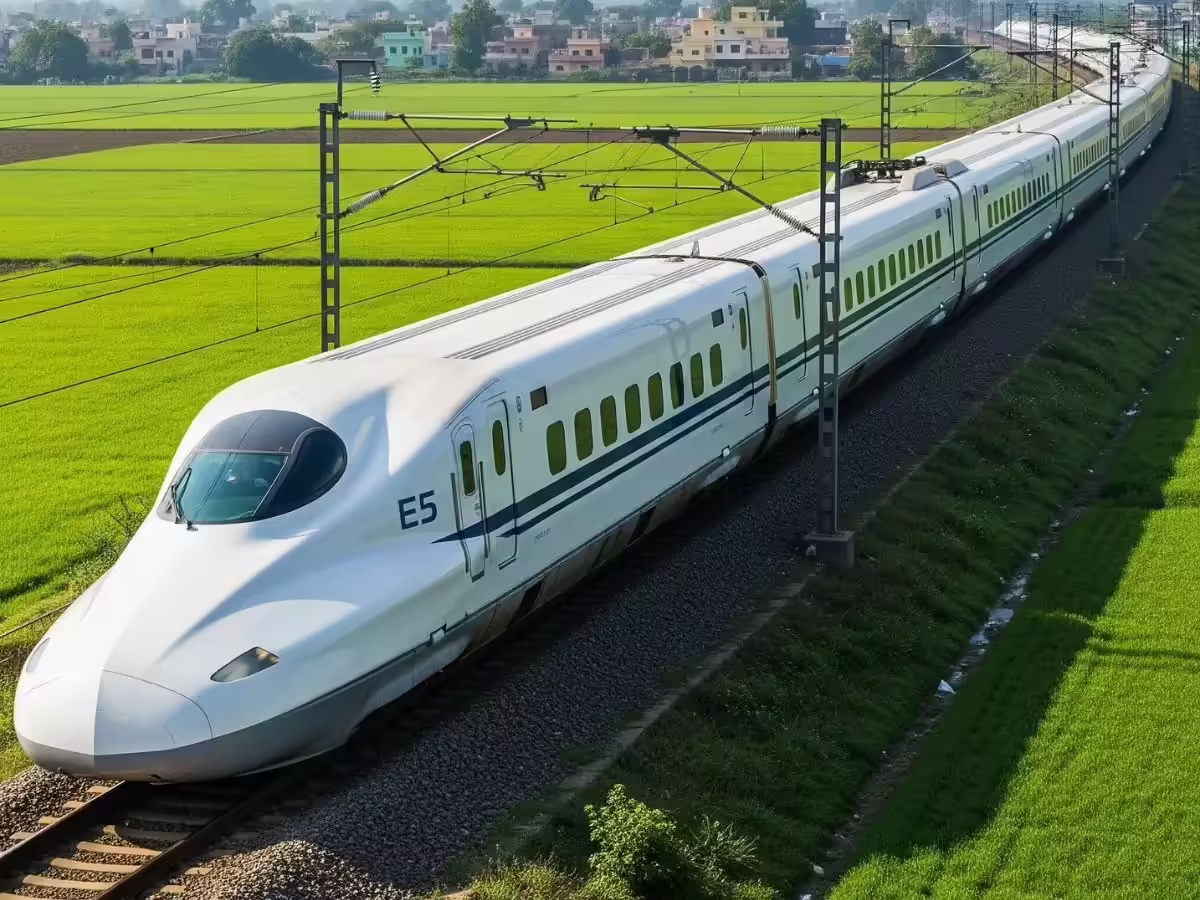
India’s first high-speed rail corridor has crossed a critical construction threshold, signalling a shift from planning ambition to on-ground urban transformation along the western growth belt. Official project monitoring data shows that more than half of the Mumbai–Ahmedabad bullet train corridor is now physically complete, marking a decisive moment for intercity mobility, land use, and economic integration across Maharashtra and Gujarat.
The 508-kilometre corridor, being built as a dedicated high-speed rail system, has recorded over 56 per cent physical progress, with public expenditure exceeding ₹85,300 crore so far. The project is being tracked under the central government’s infrastructure performance monitoring framework, which evaluates timelines, spending efficiency, and execution risks for nationally significant assets. Urban planners note that this phase of progress is especially significant because it coincides with large-scale civil works nearing completion across viaducts, stations, depots, and river crossings. These assets are expected to reshape travel behaviour between India’s two major commercial regions, reducing dependency on air travel and long-distance road transport while offering predictable, lower-emission mobility at scale.
From a city-building perspective, the Mumbai Ahmedabad bullet train is already influencing development patterns around station zones. Real estate analysts observe rising interest in mixed-use developments near planned terminals, particularly in Tier-2 and Tier-3 cities along the route, where improved accessibility could unlock jobs, housing supply, and regional investment without intensifying pressure on megacities. The corridor is being designed for operational speeds of up to 320 kmph, with phased commissioning planned before full completion. Initial operations are expected to begin on a limited stretch, allowing systems testing and ridership calibration before the entire line becomes functional later in the decade. Once fully operational, travel time between the two cities is projected to drop to under two hours, fundamentally altering business travel, tourism flows, and daily commuter possibilities.
Infrastructure economists point out that while the capital cost remains high, the long-term value lies in productivity gains, reduced carbon intensity per passenger kilometre, and the creation of a template for future high-speed corridors in India. The project’s alignment with compact, transit-oriented development principles could help cities grow outward without repeating car-dependent urban sprawl. As construction advances toward its final stages, attention is shifting to last-mile connectivity, station-area planning, and integration with metro and suburban rail networks. The success of the Mumbai Ahmedabad bullet train will ultimately be judged not just by speed, but by how well it supports inclusive, resilient, and sustainable urban growth across western India.