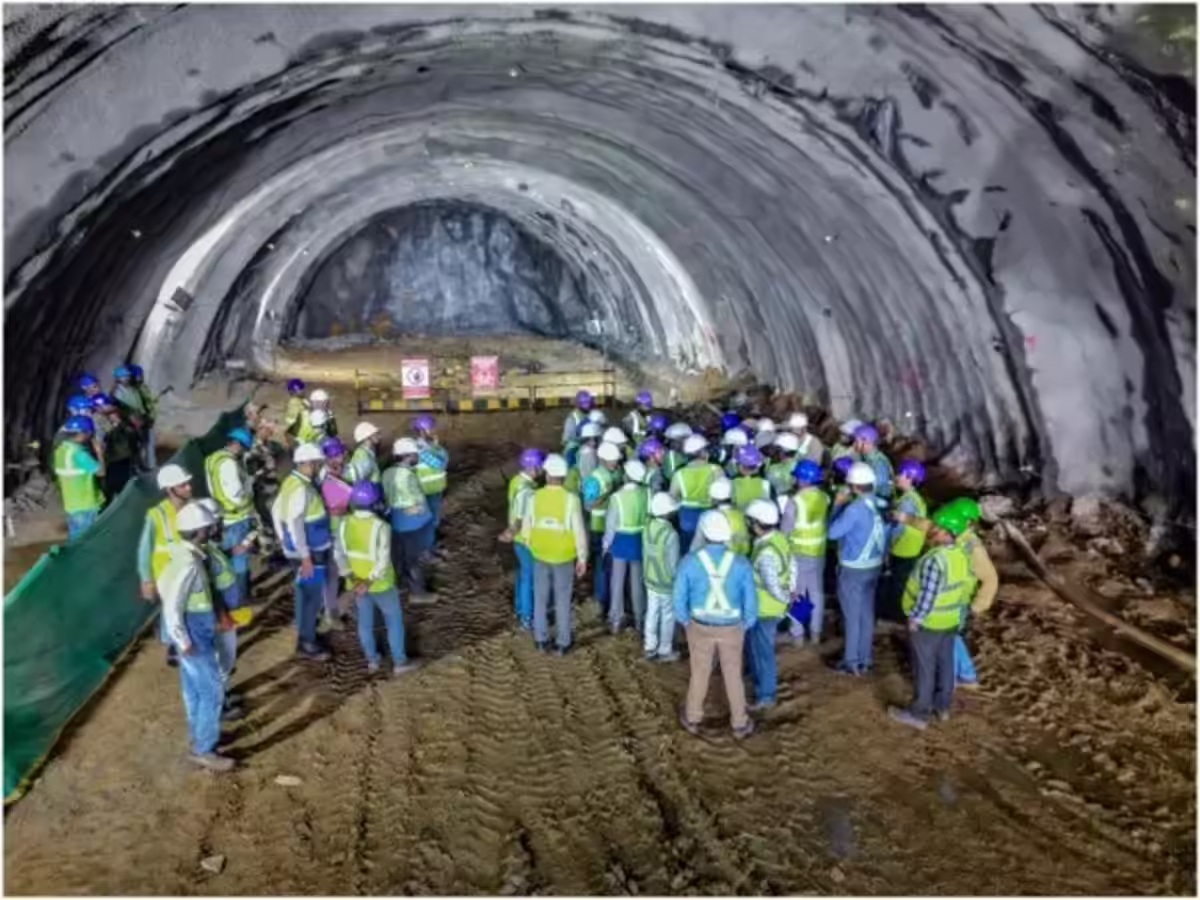
A critical underground link on India’s first high-speed rail corridor has been completed in Palghar district, signalling steady progress on the Maharashtra leg of the Mumbai–Ahmedabad bullet train. The successful excavation of a mountain tunnel through difficult terrain marks a turning point for a project that has faced complex land, geological and urban challenges, particularly as it approaches the Mumbai metropolitan region.
The newly completed tunnel, measuring just over 450 metres, is designed to accommodate dual tracks for bi-directional high-speed services. Engineers involved in the project say the breakthrough reduces construction risk in one of the most technically demanding stretches of the corridor, where steep gradients, mixed rock conditions and environmental sensitivity have slowed conventional construction methods. For Palghar, the milestone carries broader implications beyond rail connectivity. Urban planners note that large infrastructure works in the district are beginning to reposition it as a logistics and industrial extension of the Mumbai region, while also raising questions around land use, ecological protection and long-term settlement planning. The high-speed rail alignment runs alongside freight rail upgrades and port-led development, amplifying the need for coordinated regional planning.
Construction teams relied on the New Austrian Tunnelling Method, a technique that allows tunnel profiles to be adapted in real time based on ground conditions. This approach is increasingly favoured in hilly and forested areas where large tunnel boring machines are less effective and environmentally intrusive. Project engineers indicate that continuous monitoring systems, ventilation controls and fire safety mechanisms have been integrated from the early construction stage, reflecting tighter safety and resilience standards. Across Maharashtra, work is progressing on elevated viaducts, river crossings and station structures, while a long underground stretch connecting the financial district in Mumbai to the city’s northern outskirts remains one of the corridor’s most complex components. Transport economists point out that these sections will ultimately determine how seamlessly the Mumbai–Ahmedabad bullet train integrates with existing suburban rail and metro networks, which are already under pressure from daily commuter volumes.
At a corridor level, more than half of the 508-kilometre route has now seen major civil structures completed, with track laying and systems work accelerating in western India. Officials overseeing the project maintain that initial high-speed services are expected to begin in phases, allowing operational lessons to be incorporated before full-scale deployment. From an urban development perspective, the corridor is increasingly viewed as a test case for climate-conscious infrastructure delivery. Reduced travel times between major cities could shift short-haul aviation and road traffic to rail, lowering emissions if supported by clean power and compact station-area development. However, experts caution that the long-term benefits will depend on how station precincts are planned, how local communities are integrated into growth, and whether affordability and environmental safeguards remain central as construction advances.