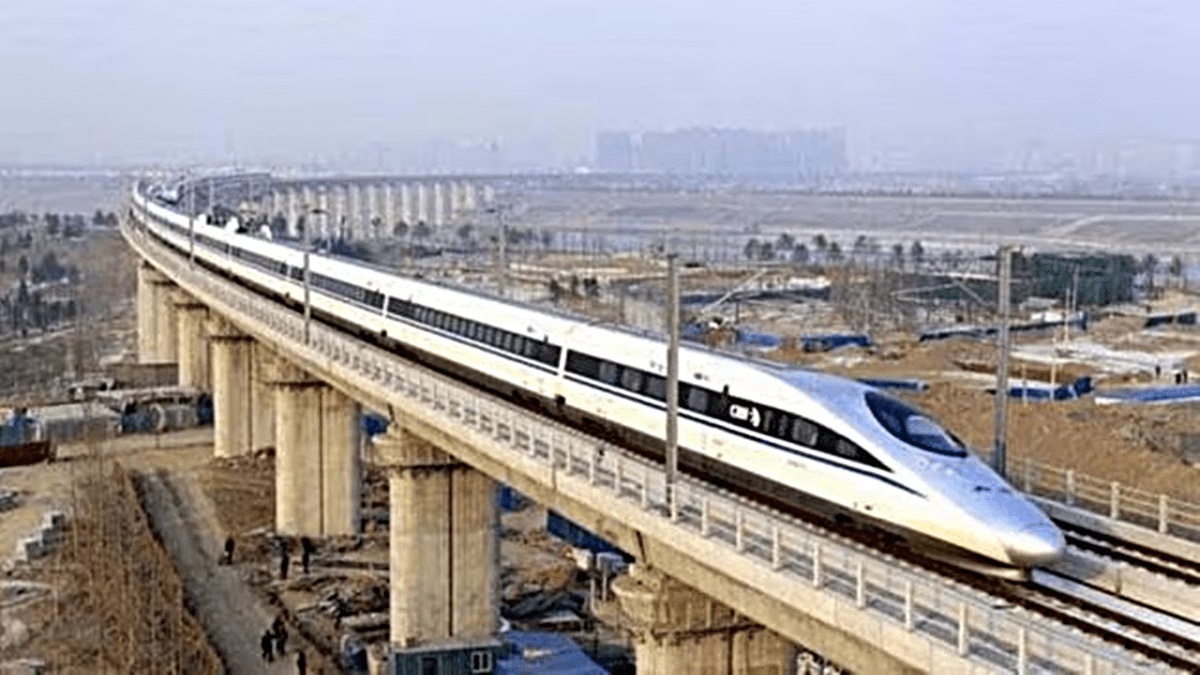
India’s first high-speed railway between Mumbai and Ahmedabad is steadily transitioning from blueprint to built reality, with major civil works, tunnelling and station foundations advancing across Gujarat and Maharashtra. The 508-km Mumbai Ahmedabad Bullet Train corridor is emerging not only as a transport upgrade, but as a structural shift in how Indian cities approach intercity mobility, industrial capability and low-carbon infrastructure.
The elevated alignment, funded with significant technical and financial collaboration from Japan, is designed for speeds exceeding 300 kmph. Urban planners note that such travel times could redraw economic geography between Mumbai and Ahmedabad, enabling faster business connectivity while easing pressure on congested aviation and highway networks. For a region that anchors India’s financial and manufacturing output, the corridor signals a new mobility spine. Civil progress has accelerated in recent months. Land acquisition across the alignment is complete, utilities have been relocated, and foundations are in place at multiple stations. Seventeen river bridges have been built, and work on an undersea tunnel section between Ghansoli and Shilphata is underway, with several kilometres already excavated. Engineers are deploying a full-span launching system to place 40-metre prestressed girders weighing nearly 1,000 tonnes a method that reduces construction time and limits disruption on the ground.
The Mumbai Ahmedabad Bullet Train project is also being positioned as a technology transfer platform. Domestic manufacturers have begun producing long-span steel truss girders, specialised slab track components and noise barriers. A dedicated training centre in Surat is preparing engineers and technicians in Japanese high-speed rail standards, with nearly a thousand professionals reportedly trained so far. Industry experts suggest this knowledge base will be critical as India evaluates future high-speed corridors linking other metropolitan clusters. Safety systems are central to the design. Stations will incorporate controlled entry points, baggage screening, metal detectors and extensive surveillance networks. Academic institutions are supporting advanced dynamic and traction modelling to ensure stability at high speeds, while indigenous safety devices are being tested to mitigate rollover risks in extreme scenarios.
Financially, the project represents one of India’s largest rail investments, with expenditure nearing ₹87,000 crore by the end of 2025. Its scale parallels the Dedicated Freight Corridors, which are reshaping goods movement across the country. Together, these investments reflect a broader strategy to separate passenger and freight operations a move that transport economists say can improve efficiency, reduce logistics costs and cut carbon emissions per passenger kilometre. As construction intensifies, the long-term question is how effectively high-speed rail integrates with urban transit, affordable housing and last-mile systems around stations. If aligned with sustainable planning, the Mumbai Ahmedabad Bullet Train could become more than a prestige project it could redefine intercity growth while reinforcing climate-conscious mobility for western India.