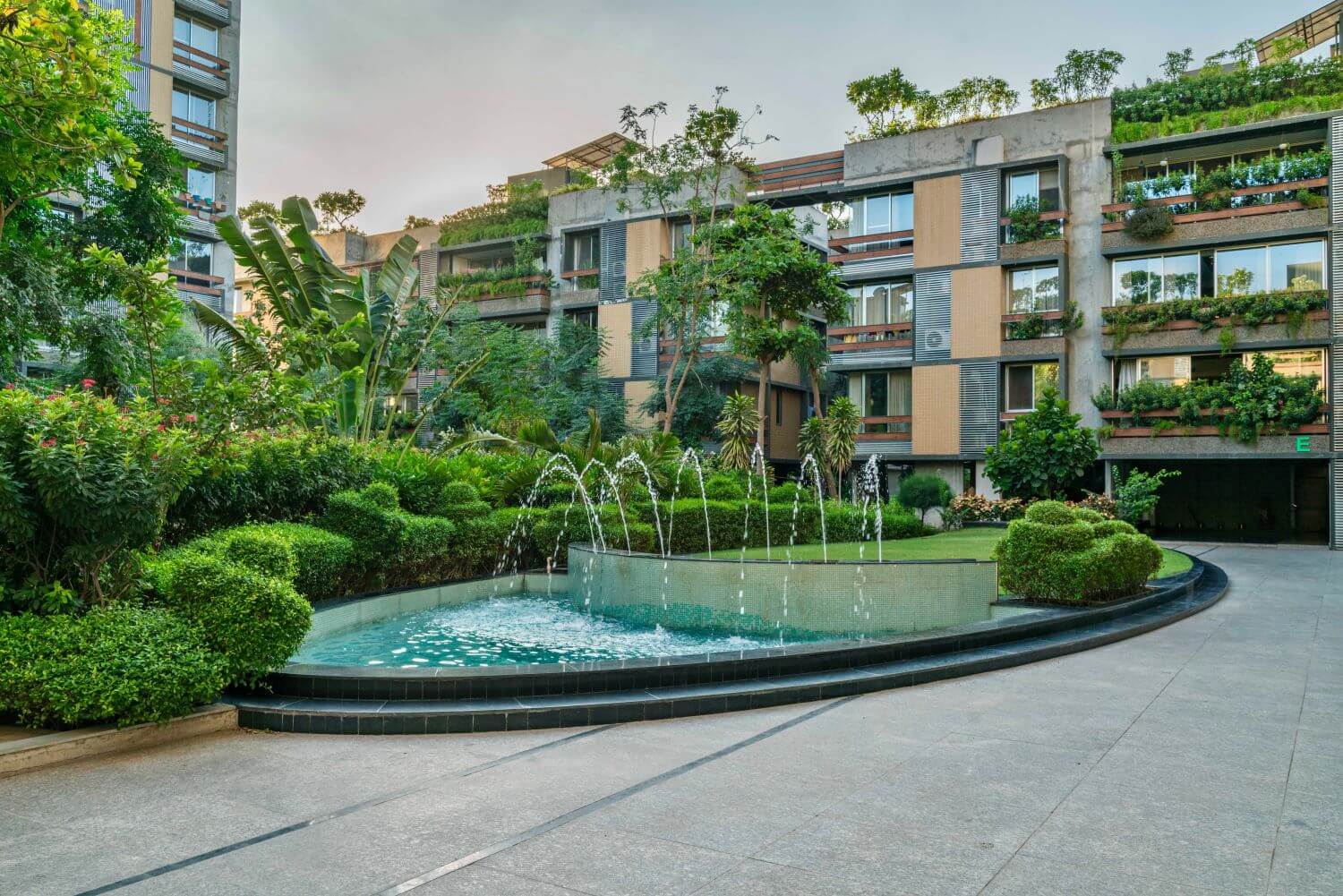
A new mid-rise residential development in Ahmedabad is drawing attention for how it addresses one of India’s most pressing urban challenges: building higher-density housing without sacrificing climate comfort, social cohesion or liveability. Located in the Satellite neighbourhood, the project reflects a growing shift in Indian cities towards climate responsive housing that works with, rather than against, local conditions.
Set on a site of just under three acres within an established residential district, the development adopts a distributed planning approach instead of a single large block. Five mid-rise towers are arranged to allow light, air and landscape to flow across the site, responding to Ahmedabad’s hot, dry climate and dense urban fabric. Urban planners note that such layouts are increasingly relevant as cities look to accommodate growth while preserving neighbourhood character.
A defining feature of the scheme is its people-first site strategy. Vehicular circulation is restricted to the outer edges, reducing noise and improving safety within the development. By avoiding basement construction, the project introduces a naturally lit and ventilated podium parking level, freeing the ground plane for green spaces and shared amenities. This approach reflects broader conversations in Indian real estate about reducing energy-intensive construction while maximising usable open space.
The climate responsive housing strategy extends to architectural massing. The towers are positioned to improve cross-ventilation, limit mutual overlooking and ensure consistent daylight. Generous spacing between buildings helps avoid the heat traps and visual congestion often associated with high-density developments. Industry experts say such planning decisions can significantly reduce reliance on mechanical cooling, lowering long-term energy demand. At the centre of the site is a car-free landscaped podium that functions as a social and environmental core. Designed as a shared community zone, it integrates shaded walkways, play areas, seating for older residents and water elements that help moderate microclimate conditions. In a city where outdoor comfort is often seasonal, these semi-open communal spaces play a critical role in encouraging social interaction across age groups.
Residential layouts prioritise privacy and environmental performance. Homes are planned without shared walls and are naturally ventilated from multiple sides, improving acoustic comfort and indoor air quality. Residences begin above ground level, separating living spaces from street activity and improving airflow. Clear zoning between private, shared and service areas supports efficient daily operations without disrupting residents. Sustainability measures are embedded across systems rather than treated as add-ons. Rainwater harvesting, on-site water recycling, solar energy generation and water-efficient fixtures collectively reduce pressure on municipal infrastructure. Naturally ventilated parking areas further cut energy consumption.
Such integrated strategies align with Ahmedabad’s broader climate resilience goals, particularly as water stress and heat extremes intensify.
As Indian cities reconsider how housing density, climate adaptation and quality of life intersect, projects like this highlight a viable middle path. Climate responsive housing, when paired with thoughtful urban design, can deliver compact growth that remains humane, efficient and resilient an approach increasingly relevant for fast-growing urban regions across the country.
Ahmedabad mid rise housing rethinks climate living