New Delhi: The Union Cabinet has cleared infrastructure investments worth ₹11,806 crore spanning rail network expansion, the Ahmedabad Metro extension, and a new integrated terminal at Srinagar airport, signalling a continued push to strengthen urban mobility and regional connectivity across multiple states.
The largest share of funding approximately ₹9,072 crore will be directed towards three railway capacity enhancement projects. These include doubling the Gondia–Jabalpur line and adding third and fourth tracks along the Punarakh–Kiul and Gamharia–Chandil corridors. Together, the works will add roughly 307 kilometres of multi-tracking across Maharashtra, Madhya Pradesh, Bihar and Jharkhand, with completion targeted by 2030–31. Railway planners say multi-tracking reduces bottlenecks on saturated routes, enabling faster freight movement and additional passenger services. Officials estimate that up to 38 new express and passenger trains could be introduced once the upgrades are operational. For industrial belts and agricultural districts along these alignments, improved rail throughput is expected to lower logistics costs and strengthen supply chains.
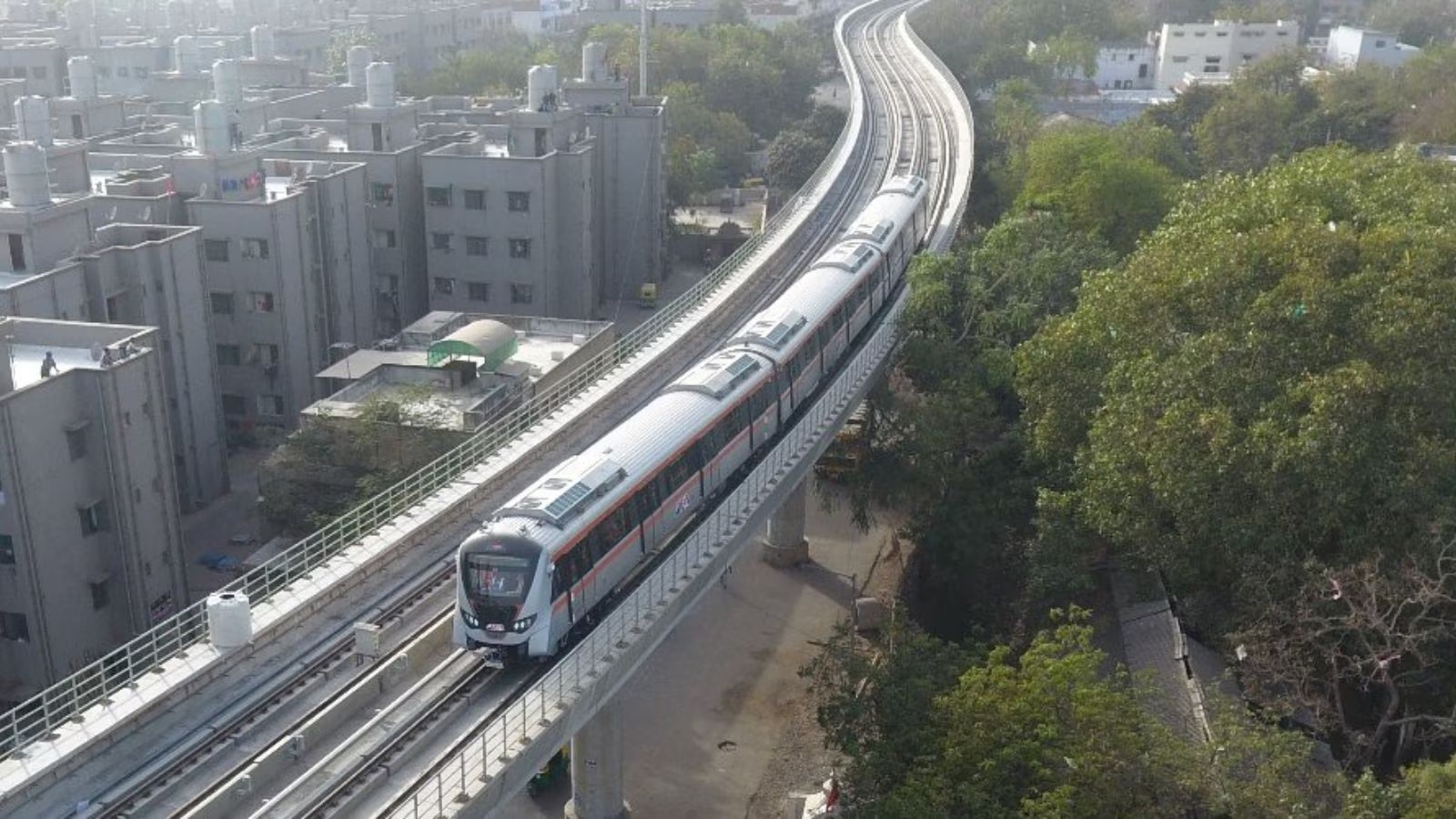
In Gujarat, the Cabinet approved the Ahmedabad Metro extension at an estimated cost of ₹1,067 crore. The corridor, scheduled for completion within four years, is projected to serve nearly 23,700 daily passengers by 2029. Urban transport experts view the expansion as critical to deepening last-mile connectivity and supporting transit-oriented development in the city’s growing residential and commercial clusters. Ahmedabad’s metro network has been positioned as a long-term strategy to reduce private vehicle dependence and curb transport emissions. Planners note that incremental expansions, when synchronised with bus networks and pedestrian infrastructure, can meaningfully shift commuter behaviour over time.
In Jammu and Kashmir, the government approved a ₹1,677 crore investment for developing a new civil enclave at Srinagar airport. The project aims to expand terminal capacity in response to rising passenger demand to the Valley. Aviation analysts suggest that upgraded airport infrastructure could stimulate tourism, hospitality and local employment, while improving resilience during peak travel seasons. Separately, the Cabinet Committee on Economic Affairs authorised an increase in the equity investment ceiling for PowerGrid subsidiaries from ₹5,000 crore to ₹7,500 crore. The move is intended to strengthen the public sector utility’s ability to bid for large transmission projects and accelerate evacuation infrastructure for renewable energy. This aligns with India’s 2030 goal of achieving 500 GW of non-fossil fuel capacity.
Taken together, the approvals reflect a multi-sector approach to connectivity from urban rail to long-distance freight and aviation. The effectiveness of these investments, however, will hinge on timely execution, integration with local mobility plans and adherence to environmental safeguards. For cities such as Ahmedabad and Srinagar, the coming years will test whether infrastructure expansion can balance economic opportunity with climate-conscious growth and equitable access.
Ahmedabad Metro extension and rail boost