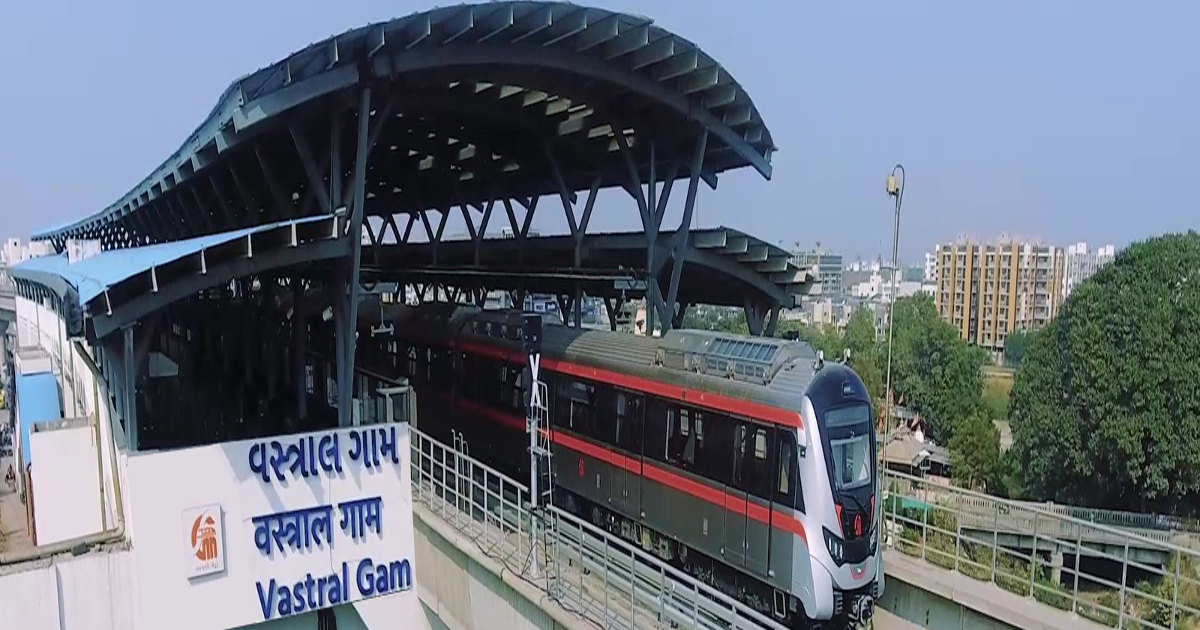
Ahmedabad’s urban transit network reached a decisive moment this week as the final section of the city’s second metro phase opened to passengers, completing a long-planned rail link between the city and Gandhinagar. The commissioning of the remaining northern stretch closes a key gap in the network, extending mass rapid transit into government, institutional and residential districts that have seen rapid growth but limited public transport options.
The newly operational segment completes the northern extension of the north–south corridor, linking Motera with Mahatma Mandir over nearly 23 kilometres. With all stations now active, Ahmedabad Metro Phase 2 becomes fully functional, integrating with the earlier east–west and north–south lines developed under Phase 1. Together, the two phases create a continuous metro system of nearly 62 kilometres, reshaping daily mobility across the Ahmedabad–Gandhinagar urban region. Urban planners view the completion as more than a transport milestone. The corridor serves high-density residential pockets, emerging commercial zones and state administrative complexes, areas that previously relied heavily on private vehicles and bus services. By offering predictable travel times and higher passenger capacity, the metro is expected to reduce peak-hour congestion on arterial roads while lowering transport-related emissions, a persistent challenge for one of India’s fastest-growing urban agglomerations.
A senior transport official noted that the focus of Phase 2 was regional integration rather than isolated city travel. The alignment strengthens links between Ahmedabad’s northern suburbs and Gandhinagar, supporting workforce mobility without encouraging further road-led sprawl. Real estate analysts say improved rail access is likely to stabilise office and residential demand along the corridor, especially around station precincts, provided zoning controls and last-mile connectivity are managed responsibly. Ahmedabad Metro Phase 2 also builds on the operational lessons of Phase 1, which spans over 39 kilometres across two corridors. The earlier phase demonstrated strong ridership potential but also highlighted the importance of feeder services, walkable station access and fare integration. Transport economists argue that sustained ridership growth will depend less on network length and more on how seamlessly the metro connects with buses, cycling infrastructure and pedestrian networks.
From a climate resilience perspective, the completed corridor supports a shift away from carbon-intensive travel in a region facing rising heat stress and air quality concerns. Rail-based mass transit, when paired with compact urban development, remains one of the most effective tools for balancing economic expansion with environmental limits. As services stabilise across the full network, attention is likely to turn towards service frequency, affordability and station-area planning. For residents and workers commuting between Ahmedabad and Gandhinagar, the immediate change is practical: shorter journeys, fewer transfers and a viable alternative to congested roads. For the city, the challenge ahead lies in ensuring the metro anchors inclusive, low-carbon growth rather than becoming just another piece of infrastructure.
Ahmedabad Metro Expansion Connects Capital Region