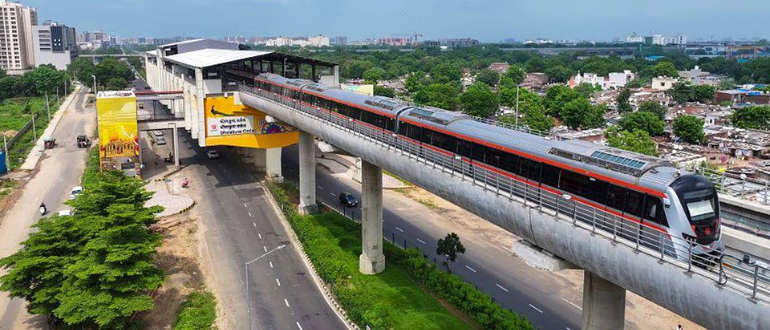
Urban transport infrastructure in Gujarat is set for another strategic upgrade after the Union Cabinet cleared a metro rail extension connecting Ahmedabad with its rapidly expanding financial district. The approved corridor will extend metro services from Gujarat’s global finance hub to Shahpur, reinforcing public transport access to one of the state’s most concentrated employment and investment zones. The decision signals sustained policy focus on rail-based mobility as a tool for managing urban growth, emissions, and commuter demand.
The proposed extension spans just over three kilometres and will be developed as an elevated corridor with three new stations. While modest in length, urban planners say the stretch fills a critical connectivity gap between Ahmedabad’s established urban fabric and the high-density commercial ecosystem emerging around Gujarat International Finance Tec-City. The project carries a sanctioned cost of ₹1,067 crore and is expected to be delivered over a four-year construction timeline. Officials involved in urban transport planning indicate that the extension is designed to reduce pressure on arterial roads linking Ahmedabad with the finance and technology district. Daily travel between the two zones has grown steadily as corporate offices, data centres, educational institutions, and residential developments cluster around GIFT City. By shifting a larger share of commuters to electric mass transit, the corridor is expected to support lower transport emissions and more predictable travel times.
Ridership assessments prepared during project appraisal suggest a gradual but sustained increase in passenger numbers as the surrounding areas densify. Estimates indicate that the corridor could handle more than 23,000 daily passengers within a few years of commissioning, with volumes potentially doubling over the longer term. Urban mobility experts note that metro corridors linked to employment hubs tend to outperform projections once land use intensifies and feeder systems mature. Beyond mobility outcomes, the project is also expected to deliver economic spillovers. Construction activity is projected to generate around a thousand direct jobs over the build period, while ongoing operations and maintenance will support additional skilled and semi-skilled employment. Such infrastructure-led job creation continues to play a stabilising role in urban economies, particularly during periods of private sector investment cycles.
Implementation responsibility rests with Gujarat Metro Rail Corporation Limited, a joint venture between the central and state governments that has overseen the phased rollout of metro services across Ahmedabad. The agency has already operationalised two major phases of the city’s metro network, gradually reshaping commuting patterns and reducing reliance on private vehicles. With daily ridership on Ahmedabad’s metro network already crossing 1.6 lakh passengers, transport analysts see the new extension as part of a broader transition toward compact, transit-oriented urban growth. As GIFT City continues to attract global capital and talent, the success of this corridor will likely influence how future business districts across India integrate mobility planning with climate-conscious urban development.
Ahmedabad Metro Expansion Boosts GIFT Connectivity